
Hvar
About this place
Hvar island brings together different landscapes that cannot be reduced to the harbour of its namesake town. Hvar's urban centre offers a concentrated cultural programme, while Stari Grad Plain opens a broader setting of paths, dry-stone boundaries and cultivated land. Its UNESCO status belongs to a defined cultural landscape, not automatically to the entire island. Stari Grad, Jelsa, Vrboska and other settlements should therefore be considered separate bases and destinations with their own relationship to coast and interior. The island suits travellers wanting culture, sea and smaller excursions, but a good itinerary depends on where they stay. A day in Hvar town is not a tour of the whole island, just as a ferry ticket to the island does not guarantee arrival beside the accommodation. With several days, separate an urban cultural circuit, time in Stari Grad Plain and a day around your base. Respect the plain's agricultural function: walls and crops are not scenery to cross at will. The breadth of choice distinguishes Hvar from a simple beach destination, but rewards selectivity rather than daily rushing across the island.
Around Vrisnik and Svirče, vineyards and olive groves reveal Hvar's agricultural interior, while Velo Grablje and Brusje preserve the island's lavender-growing heritage. The regular plots and more open terrain of Stari Grad Plain differ from the steep southern growing sites around Sveta Nedjelja. On the coast, Jelsa and Vrboska have their own harbours, squares and churches, so an island stay need not revolve around Hvar Town. Velo Grablje is especially revealing: stone houses, dry-stone walls and the legacy of lavender distillation remain visible beyond the flowering season. Together, these villages and harbours show an island very different from the town waterfront alone.
Top places

Hvar
Town · Hvar

Stays nearby
 Apartment
Apartmeni Klenovica.eu
Klenovica
Klenovica, 265 km from Hvar
up to 4 guests · 1 bedroom
The host confirms the exact price for your dates and availability.
Things to see
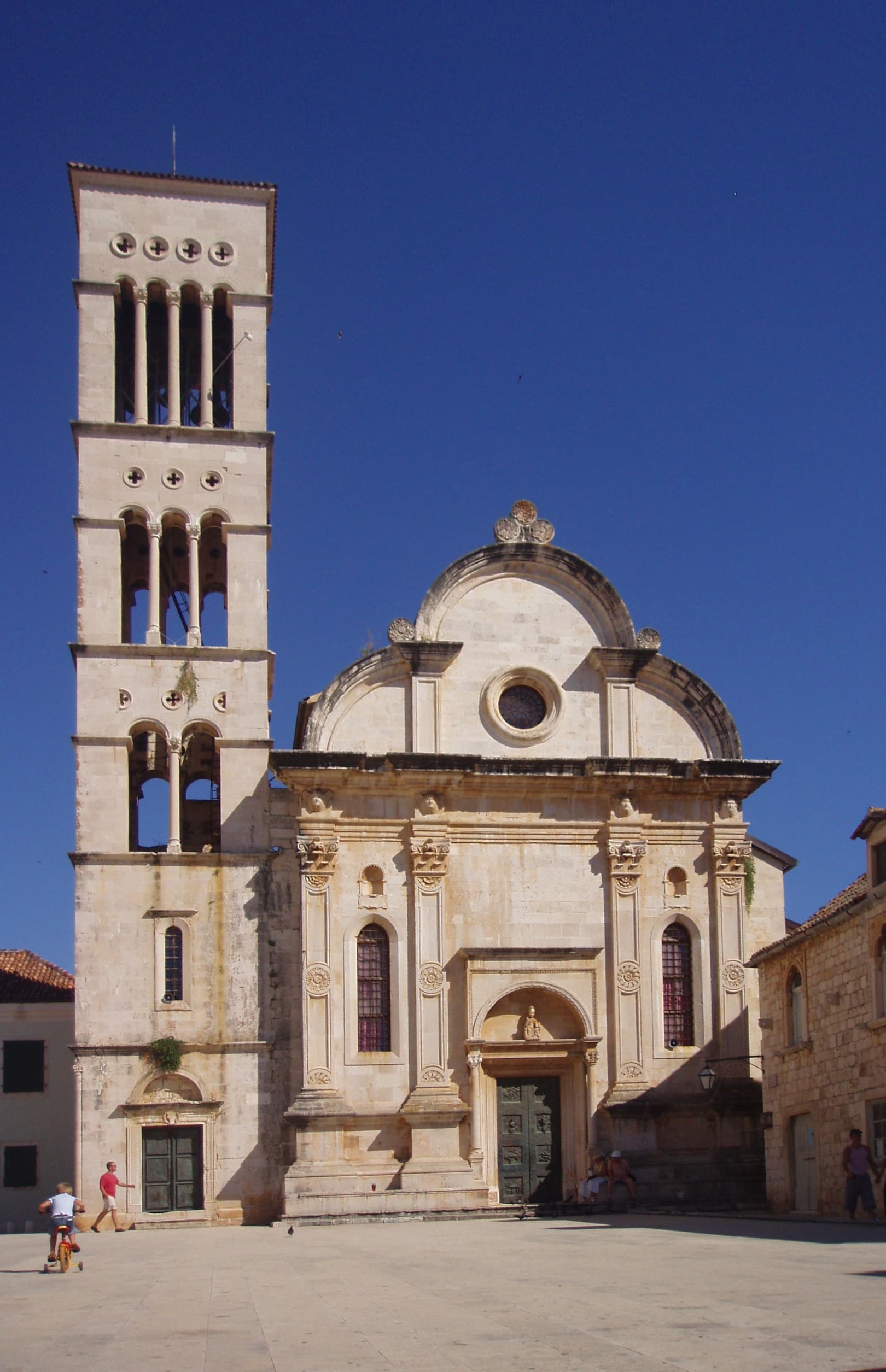
Petar Hektorović's Tvrdalj in Stari Grad is arranged around a mullet-filled fishpond, a surrounding porch, a dovecot and a garden. Stone inscriptions give this fortified residence a personal literary dimension, revealing the Renaissance poet's thoughts and his intention to welcome guests. Vrboska offers another kind of fortified building: St Mary of Mercy, reshaped as a refuge for residents after the sixteenth-century Ottoman attack. In Hvar Town, the Arsenal combines the building's former maritime function with a historic theatre founded in 1612. At Tvrdalj, inscriptions appear in Latin, Croatian and Italian, turning the stone walls of Hektorović's residence into a literary part of the visit.
Beaches
Pokonji dol is a pebble bay about one and a half kilometres from central Hvar Town, accessible along the coast. Swimming here does not require a crossing to the Pakleni Islands, even though both often feature in plans for the same stay. On the Jelsa side of Hvar, Soline can be approached along Vrboska's waterfront, passing the marina area and bridge. Nearby Milna has a pebbly section and sandy shallows at the head of its bay; this is not the Milna near Hvar Town. The Glavice peninsula continues the shoreline with flat rocks and small pebble coves. These beaches differ in their surfaces and in the harbour towns from which they are reached.

Things to do
Spend the first island day in the arrival area and get to know your accommodation base. If Hvar town is the main purpose, connect its centre with one cultural interior rather than assuming a distant island circuit will fit as well. Over three days, focus the second on Stari Grad and its plain, and the third on another settlement or a quieter seaside day. The plain is a cultural landscape understood through the arrangement of paths and cultivated plots; entering private land is unnecessary. Cyclists should select an actual route according to surface and traffic, because a level-looking photograph does not describe every approach. Check local transport and the return before an excursion, especially when combining road and boat sections. For families, a shorter landscape visit is preferable to a whole day of hot, lengthy transfers. Choose cultural events by settlement and date rather than assuming one island festival supplies the same programme everywhere. This produces a clearer experience of the island's different places without turning the itinerary into a collection of disconnected stops.
Activities
The dry-stone park near Velo Grablje directs walkers towards terraces, stone shelters and old lime kilns rather than another town promenade. Hvar cycling route 709, Dubova, makes a 20.5-kilometre circuit through Milna, Dubovica, Moča and Malo Grablje. Its mix of asphalt and gravel makes it a different undertaking from a short ride along Jelsa's waterfront. Stari Grad Plain offers another setting, where field tracks and dry-stone boundaries reveal an ancient agricultural layout among vineyards and olive groves. Active exploration on Hvar can therefore focus on Velo Grablje's stone-built landscape, Dubova's mixed-surface cycling route or the open countryside of Stari Grad Plain.
Day trips
The Pakleni Islands lie off Hvar Town and require a separate sea excursion rather than a continuation of an island road trip. This protected landscape includes underwater Posidonia meadows, reefs and marine caves. From Hvar's southern coast, Šćedro offers a different outing opposite Zavala, with indented bays along its northern shore. Šćedro has no land connection to Hvar, making both arrival and return a matter of boat transport. Zečevo, by contrast, lies off the Vrboska and Jelsa area on the other side of the main island. Choose among the Pakleni Islands, Šćedro and Zečevo according to your Hvar base; they are not neighbouring stops on one short excursion.
Food and drink
Hvar gregada brings fish, potatoes, onions and olive oil together in one pot, producing a very different meal from a platter of grilled fish. Stari Grad's paprenjok offers the island's sweet side through honey, flour, olive oil, prošek and spices such as cinnamon and cloves. Its name should not lead you to expect only black pepper: in the local tradition, it refers to spices more broadly. Around Zavala and other southern settlements, plavac mali vineyards connect the table with slopes descending towards the sea. A food-focused journey around Hvar can link gregada in a coastal tavern, paprenjok in Stari Grad and wines from the island's southern growing sites.
Towns
Stari Grad
Town · Stari Grad
All other placesShow all 12Hide list
Practical information
Practical information
Drivers travelling from the Jelsa area to Zavala encounter the approximately 1.4-kilometre Pitve-Zavala tunnel, where traffic lights control alternating directions. This narrow, unlit passage is very different from the main road towards Stari Grad and Sućuraj; vehicle restriction signs matter when choosing an approach to the southern coast. The name Milna also requires care: the settlement near Hvar Town is not the Milna bay near Vrboska on the northern shore. When arranging transport, specify Stari Grad, Sućuraj or Hvar Town rather than only the island's name. Accommodation in Vrboska or Jelsa likewise provides a different everyday beach base from a stay near Pokonji dol.
Parking
For a car visit to Hvar Town, the useful names are Dolac 1, Dolac 2 and Dolac 3, operated by Hvar Parking. These are open-air lots; the operator places Dolac 1 closest to the centre, at approximately 200 metres. Veneranda provides a further town parking option. For swimming near Vrboska, parking is listed at Soline, so there is no reason to plan a Hvar Town parking stop for a beach on the island's other coast. Dolac and Soline belong to different settlements and different outings.
Getting there and around
Bringing a vehicle to Hvar centres on two Jadrolinija routes: 635 from Split to Stari Grad and 632 from Drvenik to Sućuraj. Stari Grad provides access to the western and central island, while Sućuraj lies at its eastern end. Under the conditions published for 2026, a Split-Stari Grad ticket reserves the chosen sailing; a Drvenik-Sućuraj ticket can also be used on other departures on the printed date. Passenger services calling at Hvar Town are different from these vehicle ferries. Plan onward travel to Jelsa, Vrboska or Zavala from the actual arrival port: Hvar Town and Stari Grad's ferry terminal are not interchangeable starting points.
Frequently asked questions
Is the entire island a UNESCO World Heritage Site?
No. Stari Grad Plain is a separately inscribed cultural landscape.
Are Hvar and Stari Grad the same town?
No. They are different towns on the island.
May I walk across cultivated plots?
No. Use accessible paths and respect agricultural land.
Can I visit without a car?
Yes, if the base and itinerary fit actual transport connections.
How many bases do I need for three days?
Related guides

Jelsa
Jelsa is a compact town on Hvar’s north coast, arranged around a sheltered harbour, a renewed waterfront and a park shaded by mature trees. It developed as the port of the inland village of…
Read the guide

Help improve this page
Spot something missing or wrong? Suggest a correction, add your photo or report a problem. Editors review every suggestion before it is published.
Photo credits
- Hvar — col_ford · CC BY 2.0 · Wikimedia Commons
- Hvar, Vrboska — Carsten Steger · CC BY-SA 4.0 · Wikimedia Commons
- Sveta Nedjelja — Falk2 · CC BY-SA 4.0 · Wikimedia Commons
- Milna


