About this place
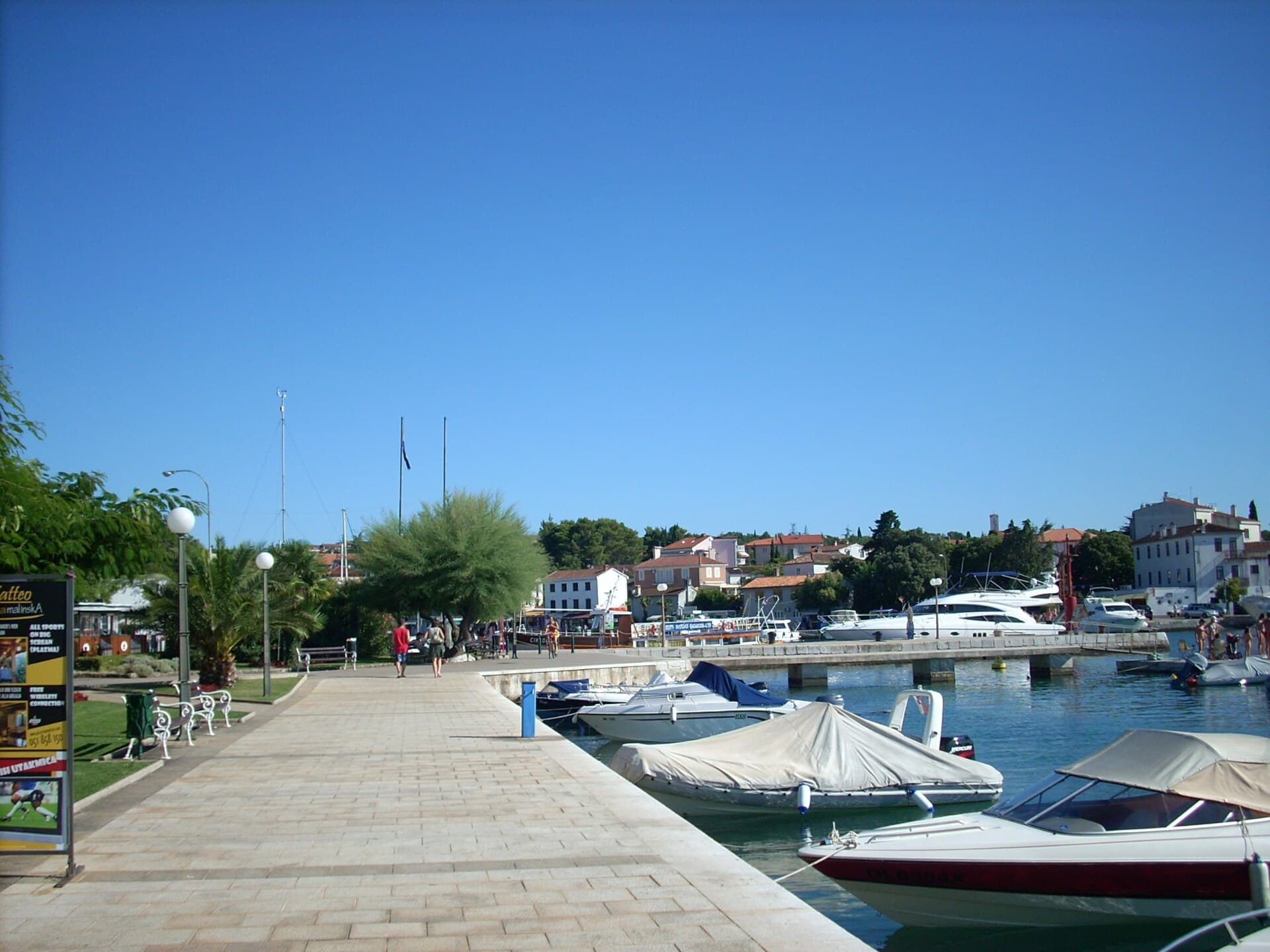
The bridge across Sveti Marko islet brings you to an island where Vrbnik's vineyards, Dubašnica's oak woods and the stony Baška valley can feature in the same road journey. Krk Town preserves its cathedral, walls and Frankopan castle beside Kamplin, but the island's history extends well beyond that waterfront. St Lucy's church at Jurandvor marks the original setting of the Baška Tablet, while Fulfinum-Mirine near Omišalj reveals a Roman town and early Christian basilica. On Košljun, in the middle of Puntarska draga, monastery collections bring together traditional dress, fishing equipment and historic books. Malinska's DUBoak explores another strand of island life through oak, shipbuilding and maritime trade with Venice. For swimming, Baška's long pebble beach contrasts with Sveti Marak's sand near Risika; below Rudine, Biserujka contains stalactites and calcite columns. Local meals feature šurlice pasta, presnac sheep's-cheese pie and Vrbnik žlahtina wine. Walkers can follow individual Camino Krk stages between the cathedral and the route's finish at Kornić. Valbiska provides onward ferry links to Merag on Cres and Lopar on Rab.
Northern Krk, around Omišalj and Dobrinj, is lower than the rocky southern uplands above the Baška valley. Dubašnica is characterised by oak woods and plots enclosed by dry-stone walls; its former trading harbour, Malinska, shipped timber, wool and food towards Venice. Vrbnik's field on the eastern side is associated with žlahtina vineyards. Puntarska draga cuts deeply into the southwestern shore around Košljun, whereas Baška occupies the end of a long valley facing Prvić. Plavnik and Cres lie west of Krk, while Sveti Marko to the north supports the middle section of the bridge connection to the mainland.
Top places

Krk
Town · Krk

Stays nearby
 Apartment
Apartmeni Klenovica.eu
Klenovica
19 km from Krk
up to 4 guests · 1 bedroom
The host confirms the exact price for your dates and availability.
Things to see
Fulfinum-Mirine near Omišalj preserves a Roman settlement founded in the first century and a later early Christian basilica beside Sepen bay. In 2026, the municipality also presented digital interpretation using interactive information points and a knowledge game for children. Košljun's collections range from ancient finds to sopele instruments, cheese-making equipment and model boats. In Krk Town, the cathedral and St Quirinus's church stand within the historic centre, while the castle at Kamplin recalls the Krk counts. Biserujka near Rudine adds an underground site with a Great Hall, Northern Channel and calcite columns.

Beaches
Baška's Vela plaža extends for approximately 1,800 metres along the settlement, with a pebble surface and places to eat beside the waterfront. Vela luka and Mala luka occupy a more isolated stretch of the Baška coast beyond the main town beach. Near Risika, Sveti Marak is distinguished by sand and a small peninsula carrying the remains of its namesake church. Natural shade is limited directly beside the sand, with a grassy area behind the beach. Potovošće and Kozica offer other bathing coves around Vrbnik, giving visitors staying there alternatives to the sandy shore at Sveti Marak.
Things to do
A northern Krk outing can start in Omišalj and descend through Dubec park and Pesja bay to Fulfinum's remains at Sepen. The walk moves from today's hilltop settlement to the site of the ancient waterfront town. For an excursion centred on early Croatian writing, choose Jurandvor: the Baška Tablet replica at St Lucy's remains within the architectural setting to which the original inscription belonged. From Punat, take a boat to Košljun for an ethnographic collection about island fishers, farmers and their tools. In Malinska, DUBoak explains the waterfront's links with Dubašnica's forests, shipbuilding and timber trade.
Activities
Camino Krk is arranged into seven daily stages over approximately 150 kilometres, from Krk Cathedral to St James's church in Kornić. The first stage passes through Vrh, Šotovento, Skrbčići and Pinezići towards Brzac, and a published GPS track accompanies the route. For a shorter northern-island walk, an educational trail connects Biserujka with Slivanjska bay through five interpretation panels. Omišalj's walk through Dubec, Pesja and Fulfinum continues towards Fortičina above the harbour. Dubašnica's woodland paths connect dry-stone walls and olive groves with Porat, Fumak and the Cickini archaeological site.
Day trips
Košljun is a small wooded islet in Puntarska draga, reached by boats from Punat's waterfront. The Franciscan monastery, churches and museum collections make it a cultural excursion; arrange the outward and return transfers with the boat operators. From Valbiska on western Krk, the ferry crosses to Merag on Cres, taking approximately 25 minutes according to Jadrolinija's 2026 information. Cres's settlements are then reached by road from Merag. The other Valbiska ferry route arrives at Lopar on Rab after roughly 80 minutes. That connection gives access to northern Rab's sandy coves, with the return journey tied to a separate ferry departure.
Events
Lovrečeva, the Krk Fair, took place from 8 to 10 August 2026 on Kamplin, the waterfront and streets of Krk's historic centre. Its programme included a Frankopan procession, archers, craft demonstrations and stalls selling island products. Vrbnik marked the twentieth Wine Days edition in August 2026 with tastings, workshops and the Vrbnik Wine Walk through local wineries. In Malinska, Homo na jidra celebrates traditional vessels and maritime heritage; the 2025 edition opened at DUBoak with Luciano Keber's model-boat exhibition. The historical performances on Kamplin and Malinska's boats draw on the island's Frankopan and shipbuilding heritage.
Food and drink
Šurlice is Krk's pasta shaped around a needle, which leaves a hollow running through each piece when withdrawn. Island recipes serve it with lamb goulash or other meat-based žvacet, finished with local cheese. Presnac is a sheep's-cheese sweet pie, giving island sheep farming a place in dessert as well as the main course. Vrbnička žlahtina is the white wine associated with vineyards around Vrbnik. In Krk Town, the Hoteli Krk group presents its Marina restaurant as a venue for island cooking, while Vrbnik's taverns offer an opportunity to taste žlahtina in the settlement where its winemaking tradition is centred.
Towns
All other placesShow all 47Hide list
Practical information
Practical information
Rijeka Airport is on Krk, at Hamec 1 near Omišalj; its name does not indicate a terminal in Rijeka city. The airport's 2026 information distinguishes its official terminal shuttle from other bus operators that stop at a junction two kilometres away. For arrivals in Krk Town, Arriva lists the bus station at Šetalište sv. Bernardina 3. Travellers continuing from Krk to Cres or Rab need Valbiska as their ferry port. Košljun uses a different departure point, Punat's waterfront, where the boat transfer and return from the islet are arranged.
Parking
Vecla operates public parking in Krk Town, listing Portapisana on Krčkih iseljenika Street, Lukobran, Fratri on Stjepana Radića Street and other locations. Punta di Galetto parking is associated with Ružmarinska Street, while Plav is on Senjska Street. Coach parking is provided at the Sports Centre on Slavka Nikolića Street. Vecla's first-hour-free scheme, listed in September 2026, requires prior approval and applies to eligible Krk Town residents with locally registered vehicles; it is not a general visitor concession. These Krk Town zones do not cover parking in Baška, Vrbnik or Malinska.
Getting there and around
The Krk bridge connects the Kraljevica area with Omišalj across Sveti Marko, so driving from the mainland does not require a ferry ticket. Arriva operates the Rijeka-Krk bus connection in 2026, with onward island travel depending on the selected service. From Valbiska, route 332 sails to Merag on Cres and route 338 to Lopar on Rab. Under Jadrolinija's 2026 conditions, Merag tickets can be used on other departures that day, whereas a Lopar ticket reserves the selected sailing. Rijeka Airport publishes a separate shuttle service linking its terminal with Omišalj, Kraljevica and Rijeka.
Frequently asked questions
Where does Camino Krk finish?
The approximately 150-kilometre route ends at St James the Apostle's church in Kornić, having started beside the cathedral in Krk Town.
Is the original Baška Tablet at Jurandvor?
St Lucy's church contains a replica; the original has been held by the Croatian Academy of Sciences and Arts in Zagreb since 1934.
How cool is Biserujka Cave?
Air temperatures in Biserujka's deeper section are approximately 15 degrees Celsius, with high humidity.
Where is Sveti Marak sandy beach?
Sveti Marak is near Risika on Krk's eastern coast, beside a small peninsula with the remains of its namesake church.
Related guides
Krk
Kamplin makes a useful starting point because several aspects of the town meet in a small area. The castle's defensive architecture stands alongside the religious complex, while changes in…
Read the guide

Help improve this page
Spot something missing or wrong? Suggest a correction, add your photo or report a problem. Editors review every suggestion before it is published.
Photo credits
- Krk, Krk, Franjevački samostan na Košljunu — Berthold Werner · CC BY-SA 3.0 · Wikimedia Commons
- Baška — Olaf1541 · CC BY 2.5 · Wikimedia Commons
- Jurandvor, Dobrinj