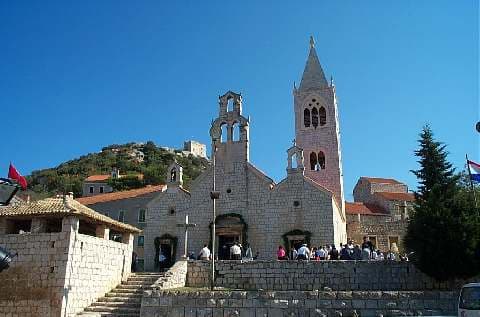
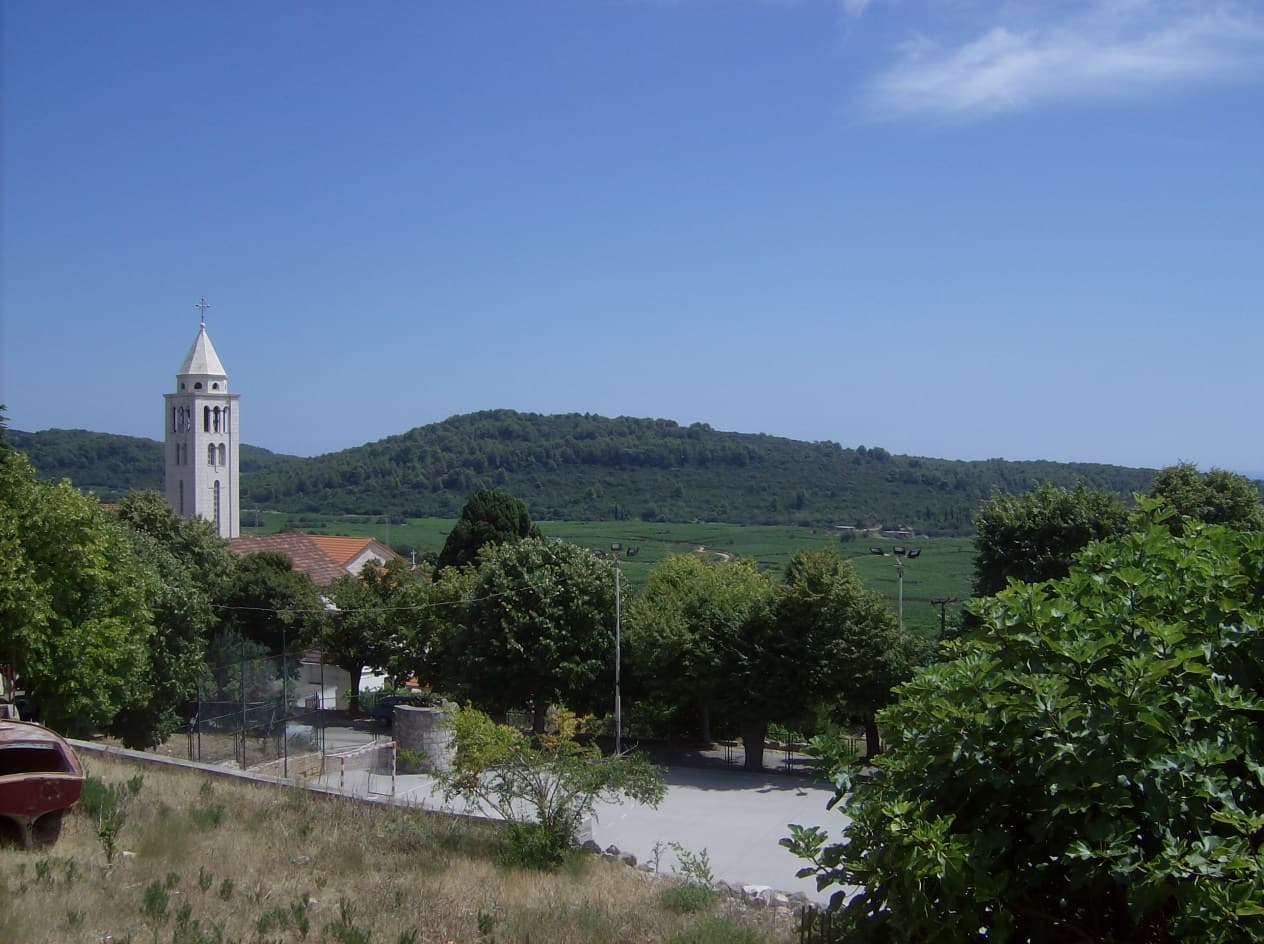
Blato, Korčula
About this place
Blato lies inland in western Korčula between Vela Luka and the coastal coves of Prigradica, Prižba and Gršćica. Its main urban axis is especially recognisable for an almost one-kilometre avenue of lime trees planted in 1911, an unusual feature for a Dalmatian island town. Historic landmarks include the parish Church of All Saints, Arneri Castle with a local museum, and a series of stone houses. Blato maintains the kumpanija, a traditional sword dance performed in ceremonial costume, while the local cake lumblija is strongly associated with Blato tradition and the period around All Saints’ Day. Vineyards, olives, figs and other Mediterranean crops grow in the surrounding field. The sea is not directly in the town centre: Prigradica lies about four kilometres to the north, while Prižba and Gršćica are around five kilometres south. Blato therefore offers a different Korčula experience from the island’s coastal towns, with greater emphasis on inland life and local customs.
Blato is not a seaside centre but a historic inland settlement in western Korčula’s fertile interior, while its municipality reaches Prigradica on the north coast and Prižba, Gršćica, Karbuni and Triporte to the south. This geography gives it two distinct faces: stone houses, farming and community life gather around Zlinje, while beaches and holiday accommodation are scattered among coastal coves. Blato’s identity is expressed most strongly through the Kumpanjija sword tradition, the local dialect and lumblija, a long-lasting All Saints’ cake. Olive groves, vineyards and small producers provide a living connection between the inland town and its roughly 40-kilometre coastline.
Stays nearby
 Apartment
Apartmeni Klenovica.eu
Klenovica
Klenovica, 286 km from Blato, Korčula
up to 4 guests · 1 bedroom
The host confirms the exact price for your dates and availability.
Things to see
The parish Church of All Saints is Blato’s principal sacred monument, while nearby Arneri Castle houses a local collection. The town’s main walk is defined by the avenue of lime trees planted in 1911 and extending for roughly one kilometre. Kumpanija is the most important living tradition: a ceremonial sword dance performed in folk costume that distinguishes Blato from other settlements on Korčula. For archaeology, the wider Blato area also includes Kopila, a hillfort settlement and necropolis dating from the 4th to the 1st century BC.

Beaches


Things to do
Set aside time in Blato for Zlinje, the green space at the heart of the village, before visiting the Barilo Ethno House. Housed in the Marinović Barilo ancestral home, its collection brings together farm tools, formal clothing, traditional costume, kitchenware, handicrafts and fishing equipment. Stone household objects are displayed in the courtyard, while the garden grows local aromatic, medicinal and ornamental plants. The hosts also offer tastings of homemade liqueurs, rakija, candied orange peel, roasted almonds and dried figs made to traditional recipes. Barilo is listed among Blato Municipality’s protected cultural heritage.
Food and drink
In Blato itself, Konoba Zlinje serves island cooking in a former wine cellar and is one of the registered places producing protected lumblija. Moja Nadalina is the stop for local sweets, pairing lumblija with its own trademarked Blatska torta and Kumpanjol creations. On the coast, family-run Restaurant Prižba has operated since 1977; its listed dishes include grilled fish, seafood risotto and octopus baked under a peka, and it stands about seven kilometres from Blato. Local wines, olive oil and Korčula honey can also be traced through the producers featured at Blato’s “Okusi i mirisi zavičaja” food event.
Practical information
Practical information
Blato Tourist Board is at Trg dr. Franje Tuđmana 4; use +385 20 851 850 or [email protected] for visitor information. For after-hours support, the office publishes [email protected]. Healthcare in Blato itself is provided through the Dr Ante Franulović Health Centre, listed at +385 20 851 205. Save the tourist office contact before leaving for Prižba, Gršćica or Prigradica: these coastal coves lie outside Blato’s centre, whereas the information office is on the village’s main square. Both the visitor contacts and health-centre number are published by the local Tourist Board and municipality.
Getting there and around
Blato bus station is at 1. Ulica 71. Arriva lists the Blato–Vela Luka journey as roughly 7 km and about ten minutes; buses depart from Blato station and arrive beside Vela Luka’s ferry berth. For travel from Split, use Vela Luka: Jadrolinija’s 2026 timetable for ferry route 604 links Split, Vela Luka, Hvar and Ubli on Lastovo. The published 2026 sea connections also include route 9604 via Lastovo/Ubli, Vela Luka, Hvar and Split, plus route 9608 between Korčula, Prigradica, Hvar and Split.
Frequently asked questions
Why is Blato’s tree-lined avenue distinctive?
The avenue of lime trees extends for roughly one kilometre and was planted in 1911 along the town’s main promenade.
What is the Blato kumpanija?
Kumpanija is a traditional ceremonial sword dance performed in folk costume.
Is Blato directly on the coast?
No. The town is inland; Prigradica is about four kilometres north, while Prižba and Gršćica are around five kilometres south.
What is Blato’s traditional cake?
Lumblija is the best-known local cake and is especially associated with the All Saints period.


Related guides

Dubrovnik
Dubrovnik’s historic centre is organised around Stradun, yet its character changes within a few steps of that main street. At the western end beside Pile stand the Large Onofrio Fountain,…
Read the guide

Help improve this page
Spot something missing or wrong? Suggest a correction, add your photo or report a problem. Editors review every suggestion before it is published.
Photo credits
- Blato, Korčula — Quahadi Añtó 19:10, 5 June 2012 (UTC) · CC BY-SA 3.0 · Wikimedia Commons
- Vela Luka — Wojtkow · CC BY-SA 4.0 · Wikimedia Commons
- Smokvica — Photograph by Greg O'Beirne · CC BY 2.5 · Wikimedia Commons
- Čara, Korčula — Marijan · Public domain · Wikimedia Commons
- Vela Spila