Lumbarda
About this place
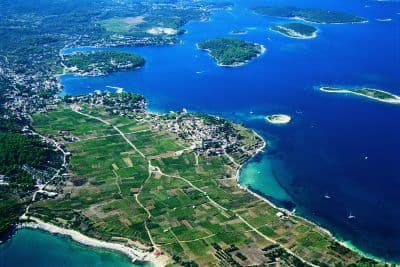
Lumbarda lies a few kilometres east of Korčula Town, between sandy fields, vineyards and a low-lying coast. The place stands out for its unusual combination of archaeology and wine: the Lumbarda Psephism, a Greek inscription from the 3rd century BC, records the founding of a colony and the allocation of land, while the same fields now grow Grk, the indigenous white variety for which Lumbarda is known. Sandy bathing spots matter particularly to families, with Pržina and Bilin Žal among the best known. The local landscape is easy to explore by bicycle or on foot, as paths run between vineyards, the sea and the settlement. The cultural calendar includes Lumbarajske užance, presenting local customs, dances, songs, food and wine. Korčula Town is close enough for a visit to its historic centre without changing accommodation, yet Lumbarda has an identity of its own rather than feeling like a suburb. It is best experienced through three connected motifs: the psephism, a glass of Grk from a local vineyard and swimming on a sandy shore. Sandy ground matters not only to swimmers but also to vineyards, as it is a defining feature of the local landscape.
Stays
No stays listed here yet
Things to see
Three local motifs best explain Lumbarda. The Lumbarda Psephism dates from the 3rd century BC and contains a Greek inscription connected with the founding of a colony and the distribution of land. The wine-growing continuation of that story can be seen in the sandy fields where Grk, an indigenous white variety that has become the village’s hallmark, grows. The third motif is sandy beaches, rare along much of the Korčula coast; Pržina and Bilin Žal are among the best known nearby. Walking and cycling routes connect vineyards, the settlement and the shore, so all three elements can be discovered without travelling far. Lumbarajske užance further presents local customs, food, songs and wine through its summer programme.

Beaches
Bathing water quality nearby
- Uvala Tatinja · 672 mexcellent · season 2025
- Bilin žal · 1.3 kmexcellent · season 2025
- Uvala Pržina · 1.7 kmexcellent · season 2025
- Badija · 2.6 kmexcellent · season 2025
Source: European Environment Agency (EEA); data from Croatian authorities. · bathing water profile
Practical information
Getting there and around
Lumbarda is connected by road with Korčula town and the Dominče ferry terminal. Arriva lists the Lumbarda–Korčula route at about 12 kilometres with a journey of roughly 15 minutes, with departures displayed according to the selected travel date. For visitors arriving by car from Pelješac, the key sea connection is Jadrolinija ferry line 634 between Orebić and Dominče. The crossing takes around 20 minutes and a seasonal 2026 timetable provides multiple daily departures. From Dominče, Lumbarda is reached by a short road transfer, allowing arrivals from Orebić to avoid driving through the centre of Korčula town.
Frequently asked questions
What period does the Lumbarda Psephisma date from?
The psephism probably dates from the 3rd century BC.
What is Grk in Lumbarda?
Grk is an indigenous white grape variety grown in Lumbarda’s sandy vineyards.
Which sandy beaches are well known in Lumbarda?
Pržina and Bilin žal are among the village’s best-known sandy beaches.
What do Lumbarajske užance present?
The programme presents local customs, dances, songs, crafts, food and wine.
How far is Lumbarda from Korčula Town?
Nearby

Orebić
Village · Dalmatia – Dubrovnik

Related guides

Dubrovnik
Dubrovnik’s historic centre is organised around Stradun, yet its character changes within a few steps of that main street. At the western end beside Pile stand the Large Onofrio Fountain,…
Read the guide
Help improve this page
Spot something missing or wrong? Suggest a correction, add your photo or report a problem. Editors review every suggestion before it is published.
Photo credits
- Lumbarda — Maroje · Public domain · Wikimedia Commons
- Orebić — Quahadi Añtó 11:23, 15 January 2011 (UTC) · CC BY 3.0 · Wikimedia Commons
- Podgorje, Orebić — Quahadi Añtó 11:46, 20 July 2015 (UTC) · CC BY 3.0 · Wikimedia Commons
- Stankovići, Orebić — Quahadi Añtó 14:37, 2 December 2009 (UTC) · CC BY-SA 3.0 · Wikimedia Commons
- Žrnovo


