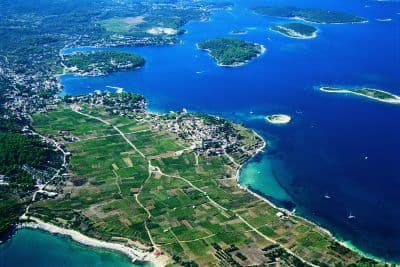
Orebić
About this place
Orebić lies on the southern side of the Pelješac peninsula opposite Korčula and has a strong maritime identity visible in captains’ houses, gardens and local museum heritage. Above the town, at about 150 metres above sea level, the fifteenth-century Franciscan monastery and Church of Our Lady of the Angels provide one of the best-known views across the Korčula Channel. Beside the monastery is the captains’ cemetery with the Mimbelli family mausoleum. Trstenica is the best-known local beach, forming a long bathing area east of the centre. Orebić is also a transport link to Korčula: in 2026 the car ferry to Dominče takes about twenty minutes, while a passenger boat serves Korčula town on a timetable that changes by season. This proximity makes an island day trip easy, but Orebić itself deserves time for its seafaring heritage, waterfront and the vineyard landscape of Pelješac.
Orebić is the main settlement of south-western Pelješac and has been tied to seafaring for centuries. Captains’ houses and gardens along the coastal area recall the period when Orebić maritime families played an important role in Adriatic and Mediterranean shipping. The town faces Korčula directly across a narrow channel, so the relationship with the island is visible in everyday transport as well as in the view. Behind the settlement, the terrain rises quickly towards Mount St Elijah, while Pelješac vineyards extend inland. Orebić therefore brings together three distinct landscapes: a coastal town, a steep mountain backdrop and the wine-growing interior of the peninsula.
Stays nearby
 Apartment
Apartmeni Klenovica.eu
Klenovica
Klenovica, 301 km from Orebić
up to 4 guests · 1 bedroom
The host confirms the exact price for your dates and availability.
Things to see
The Franciscan monastery and Church of Our Lady of the Angels were built in the fifteenth century on the slope above Orebić, about 150 metres above the sea. The church preserves votive objects associated with sailors, while the adjacent captains’ cemetery contains the Mimbelli family mausoleum by sculptor Ivan Rendić. The monastery’s position provides a broad view towards Korčula and the channel once crossed by ships commanded by Orebić captains. In the town itself, maritime heritage continues through captains’ houses and museum material, so the climb to the monastery works best as the conclusion to a story that begins on the waterfront.
Beaches
Bathing water quality nearby
- Orebić · 562 mexcellent · season 2025
- Trstenica · 1.1 kmexcellent · season 2025
- Ht. Bellevue · 1.1 kmexcellent · season 2025
- Badija · 2.9 kmexcellent · season 2025
Source: European Environment Agency (EEA); data from Croatian authorities. · bathing water profile
Things to do
Begin an Orebić day among the sea captains’ houses and the Maritime Museum, then climb to the Franciscan monastery of Our Lady of the Angels, roughly 150 metres above the channel. Spend the afternoon on Trstenica’s mix of fine pebbles and sandy patches, or cycle west through Kućište towards Viganj. Ponta Liberan becomes especially lively when the mistral draws windsurfers onto the water. Back in Orebić, finish with a tasting of Pelješac Plavac Mali, Postup or Dingač and an evening walk along the waterfront.
Food and drink
For dinner in Orebić’s historic core, choose the family-run Mimbelli at Trg Mimbelli 6, where Dalmatian and Mediterranean cooking meet. Its menu includes fish pâté, octopus carpaccio, black risotto and Korčula-style macaroni with prawns. The terrace serves Pelješac specialities, and both cash and cards are accepted. The local tourist board also lists Stari Kapetan on Šetalište kneza Domagoja and Adriatic in Mokalo, useful choices after a waterfront walk or a swim at Mokalo.
Practical information
Practical information
Orebić Tourist Board is at Zrinsko Frankopanska 2; its contact details are +385 20 713 718 and [email protected]. The pharmacy is on Ulica bana Jelačića bb, phone +385 20 713 019. Cars cross to Korčula on Jadrolinija’s Orebić–Dominče route 634, and a ticket is valid on any sailing on its printed date. The ferry terminal and town centre work well without moving the car, while the climb to the Franciscan monastery begins above Orebić.
Getting there and around
Orebić is Pelješac’s main sea connection with Korčula. According to the published 2026 timetable, the Jadrolinija car ferry between Orebić and Dominče takes about 20 minutes, with departures becoming much more frequent during the summer season. A passenger boat also links Orebić directly with Korčula town; the published 2026 schedule changes across several seasonal periods, so the actual sailing should be selected for the travel date. Dominče is the practical arrival point for travellers taking a car, while the passenger connection to Korčula town is useful for a day trip without a vehicle.
Frequently asked questions
How long is the Orebić–Dominče ferry crossing?
The published 2026 timetable gives a crossing time of about 20 minutes.
Is there a boat directly from Orebić to Korčula town?
Yes. A passenger boat links Orebić with Korčula town on a seasonal timetable.
Where is the Franciscan monastery in Orebić?
The monastery and Church of Our Lady of the Angels stand on the slope about 150 metres above the sea.
What is beside the monastery?
The captains’ cemetery beside the complex contains the Mimbelli family mausoleum.
Nearby

Podgorje, Orebić
Village · Dalmatia – Dubrovnik

Related guides

Dubrovnik
Dubrovnik’s historic centre is organised around Stradun, yet its character changes within a few steps of that main street. At the western end beside Pile stand the Large Onofrio Fountain,…
Read the guide

Help improve this page
Spot something missing or wrong? Suggest a correction, add your photo or report a problem. Editors review every suggestion before it is published.
Photo credits
- Orebić — Quahadi Añtó 11:23, 15 January 2011 (UTC) · CC BY 3.0 · Wikimedia Commons
- Podgorje, Orebić — Quahadi Añtó 11:46, 20 July 2015 (UTC) · CC BY 3.0 · Wikimedia Commons
- Stankovići, Orebić — Quahadi Añtó 14:37, 2 December 2009 (UTC) · CC BY-SA 3.0 · Wikimedia Commons
- Lumbarda — Maroje · Public domain · Wikimedia Commons
- Kućište, Orebić