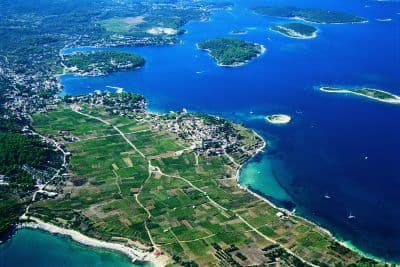
Kućište, Orebić
About this place
Kućište occupies a natural bay on Pelješac’s southern shore, about six kilometres west of Orebić and directly across the channel from Korčula Town. The village faces the narrow Pelješac Channel, with the slopes of Mount St Ilija rising behind it. Its fishing and seafaring past survives in stone moorings, tiny rock-cut harbours and the substantial homes of maritime families. A walk through the settlement links the Baroque Lazarević residence with the small churches of St Anne, the Holy Trinity, St Lawrence and St Luke. Kućište and neighbouring Viganj share some of Dalmatia’s best-known conditions for windsurfing and kitesurfing: the summer maestral accelerates through the channel and supports local schools as well as experienced riders. Long pebble shores extend around Zamošće Bay and towards Perna, with Korčula’s walled old town visible from many waterfront jetties. Paths climb from the village towards the older hamlets of Zukovac and Bilopolje, while passenger boats for Korčula leave from nearby Orebić.
Kućište’s character comes from seafaring, stone-built landing places and the wind funnelled through the Pelješac Channel. The settlement lies between Orebić and Viganj, continuing east towards Perna and Zamošće Bay. Old captains’ houses and the Lazarević family residence distinguish its historic fabric from the newer visitor accommodation along the shore. Across the water, the view settles on Korčula’s fortified old town, while Mount St Ilija rises immediately behind the village. The local maestral is central to daily life rather than a minor weather detail: together with Viganj, it has made Kućište a recognised Dalmatian base for windsurfing and kitesurfing.
Stays
No stays listed here yet
Things to see
Kućište’s principal secular landmark is the Lazarević maritime-family residence, a complex combining a late-Renaissance house with a Baroque addition from the late 18th century. Its religious heritage is distributed among four small Baroque churches dedicated to St Anne, the Holy Trinity, St Lawrence and St Luke. The village’s rock-cut landing places, locally called vlake, and its stone moorings reveal the practical architecture once used by local boats. Two natural markers complete the visit: Cape Liberan, separating Kućište from Viganj, and Zamošće Bay to the east, where a long pebble shore frames the view towards Korčula.

Beaches
Kućište’s waterfront alternates between long pebble stretches and smaller bathing entries beside stone jetties. Zamošće Bay, east of the village core, has an extended pebble shore, while Cape Liberan towards Viganj is edged with pale shingle. Beaches facing the Pelješac Channel become exposed when the maestral strengthens, creating excellent windsurfing conditions; swimmers seeking calmer water should favour the morning. The Orebić Tourist Board also identifies Kućište’s sandy and pebble sections as suitable for families, while its destination guide emphasises the long beaches lining the village’s natural bay.
Bathing water quality nearby
- Kučište · 755 mexcellent · season 2025
- Viganj - Ponta · 1.6 kmexcellent · season 2025
- Sv. Nikola · 1.9 kmexcellent · season 2025
- Medvinjak · 2.0 kmexcellent · season 2025
- Ispod zidina · 2.3 kmexcellent · season 2025
- Žrnovska Banja · 2.5 kmexcellent · season 2025
Things to do
Begin the morning beside Kućište’s stone moorings, then seek out the Lazarević residence and the village’s four small Baroque churches. Once the maestral builds later in the day, book a windsurfing lesson or watch experienced riders along the shore towards Cape Liberan. Spend the calmer part of the afternoon on the pebbles of Zamošće Bay, before following the path uphill towards the old hamlets of Zukovac or Bilopolje. For a full-day change of scene, travel the six kilometres to Orebić and board state passenger line 614 across to Korčula Town.
Food and drink
In Kućište, dinner naturally follows the Pelješac Channel and the peninsula’s wine-making heritage: together with Viganj, the village is known for windsurfing and lies on Pelješac. Look for fish and shellfish dishes, including mussels na buzaru, prepared in the Dubrovnik area with olive oil, parsley, garlic and wine. Pair seafood with a Pelješac wine; vineyards and wine production are among the peninsula’s long-established signatures. Kućište forms part of the Pelješac destination listed by the county tourist board alongside Orebić, Viganj and Lovište.
Practical information
Practical information
The nearest tourist office is in Orebić, the administrative and transport centre approximately six kilometres away. Kućište stretches along the waterfront and the road towards Viganj, so accommodation should be checked against the exact location of Zamošće Bay or a chosen windsurfing school. The maestral typically strengthens through the day; swimmers and novice riders should plan around current conditions in the Pelješac Channel. For trips to Korčula, operator G&V Line Iadera publishes the current 2026 timetable, with passenger-line boarding taking place in Orebić rather than Kućište itself.
Getting there and around
Kućište is linked by road to Orebić, roughly six kilometres east, and to neighbouring Viganj immediately to the west. To reach Korčula Town, travellers first go to Orebić harbour, where G&V Line Iadera operates state passenger route 614 with the vessel Zvijezda Kvarnera in 2026. The vehicle ferry towards Dominče also uses the Orebić area, so cars cannot be loaded in Kućište itself. Because the village extends linearly along the coast, walking and cycling work well for local journeys towards Perna or Viganj, while a car is more practical for exploring the rest of Pelješac.
Frequently asked questions
Where is windsurfing centred in Kućište?
Riders use the Pelješac Channel shore towards Cape Liberan and Viganj, where the daytime maestral develops particularly well.
Where do boats for Korčula depart?
Passenger route 614 to Korčula departs from Orebić, about six kilometres from Kućište.
Where is Zamošće Bay?
Zamošće lies on Kućište’s eastern side towards Perna and is distinguished by its long pebble shoreline.
Can I hike inland from Kućište?
Paths above the village lead towards the old hamlets of Zukovac and Bilopolje.


Related guides

Dubrovnik
Dubrovnik’s historic centre is organised around Stradun, yet its character changes within a few steps of that main street. At the western end beside Pile stand the Large Onofrio Fountain,…
Read the guide

Help improve this page
Spot something missing or wrong? Suggest a correction, add your photo or report a problem. Editors review every suggestion before it is published.
Photo credits
- Kućište, Orebić, Viganj — ModriDirkac · CC BY-SA 4.0 · Wikimedia Commons
- Žrnovo — Quahadi Añtó 07:12, 19 July 2011 (UTC) · CC BY 3.0 · Wikimedia Commons
- Podgorje, Orebić — Quahadi Añtó 11:46, 20 July 2015 (UTC) · CC BY 3.0 · Wikimedia Commons
- Orebić