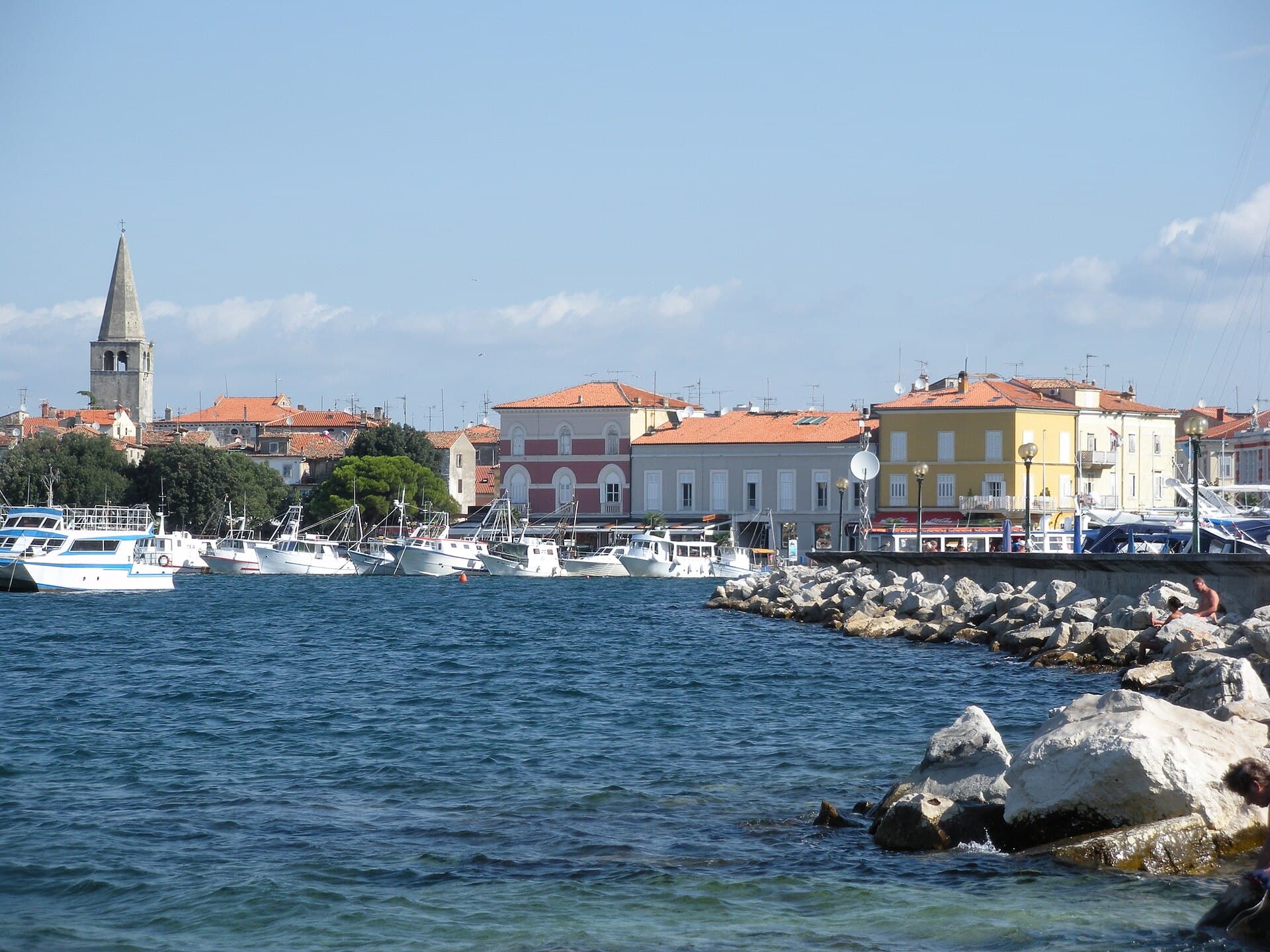
About this place
Bale is a small Istrian town about 14 kilometres southeast of Rovinj, yet its historic centre has the layered character of a much larger place. The settlement developed on the site of a prehistoric hillfort and Roman castrum, while today’s centre is dominated by Soardo-Bembo Castle. Its Gothic residential wing links two older towers and gives Bale its distinctive silhouette. The parish church was built in 1880 on the site of an early Christian basilica, while the smaller churches of the Holy Spirit and St Anthony preserve late-Gothic frescoes. The town’s special character is not limited to the Middle Ages: dinosaur finds from the coast near Colone introduce a palaeontological theme rarely encountered in Istrian hill towns. The sea does not begin beside the old centre; Colone and San Polo are reached through a landscape of olive groves and rural estates. This separation helps preserve Bale’s quieter rhythm, allowing a day to move from stone lanes and the castle to the coast without making the historic town feel secondary to the beach.
Bale occupies a hill 140 metres above sea level, with its stretch of Adriatic coast roughly five kilometres away. Stone houses and narrow lanes cluster around the medieval Soardo-Bembo castle within a protected historic centre. The bilingual name Bale–Valle reflects the town’s Italian heritage, while references to the Roman Castrum Vallis reveal much older roots. The bell tower of St Julian’s parish church rises above the rooftops, and fossil discoveries at Colone give this inland-looking settlement an unexpected connection with its palaeontologically important shoreline. Bale is therefore not a conventional seafront resort: it is a small historic town whose beaches are reached by travelling through olive groves and Mediterranean vegetation.
Stays nearby
 Apartment
Apartmeni Klenovica.eu
Klenovica
83 km from Bale
up to 4 guests · 1 bedroom
The host confirms the exact price for your dates and availability.
Things to see
Soardo-Bembo Castle is Bale’s principal architectural landmark. It was formed by joining two towers with a Gothic residential wing during the 14th and 15th centuries, so its façades combine the defensive and residential history of the old centre. The parish church, built in 1880 on the site of an early Christian basilica, preserves traces of older stonework and liturgical heritage. The small churches of the Holy Spirit and St Anthony are important for their late-Gothic frescoes. A completely different layer comes from dinosaur fossils associated with the coast near Colone, some of which are presented in a local collection. A short walk through Bale can therefore connect Roman foundations, a medieval castle, church art and palaeontology.

Beaches
Bale’s bathing spots are concentrated around San Polo and Colone, several kilometres from the historic centre. Porto Bus cove, in the Colone area, is reached through Mon Perin resort and combines a coastal path, level natural rock ledges and shade beneath a small stand of holm oaks. Its clear shallows invite snorkelling, while the wider Datule–Barbariga area is protected for its palaeontological value. In 2025, drivers visiting Colone had to leave their cars at the entrance, at Punta Dandoli beside the Mulini area, because vehicles were not permitted inside the coastal zone. San Polo suits visitors wishing to combine a swim with the campsite’s facilities and nearby Paleo Park.
Things to do
Begin on Tomaso Bembo Square, pass the Soardo-Bembo castle and enter the web of stone lanes in Bale’s old quarter. Continue to the Church of the Holy Spirit, whose interior preserves late-Gothic frescoes, before descending towards the historic loggia. Reserve the afternoon for the coast at Colone, following the short shoreline walk from Porto Bus beach to flat rock terraces and a small holm-oak grove. From this section of coast, the view takes in Colona islet, the Rovinj archipelago and the Sveti Ivan na Pučini lighthouse. Families can combine the outing with Paleo Park; during the 2025 tourist season, a free land train connected Bale with the coastal camping area.
Practical information
Practical information
Visitor information for Bale is available at the office on Trg Sant Elena 11, while the official town map also marks the pharmacy, clinic, post office, bus stop, food shops and parking areas. The historic centre is best explored on foot because its narrow stone lanes are unsuitable for through traffic. San Polo and Colone beaches are not beside the town itself, so a beach day requires transport to the coast, roughly five kilometres away. During the 2025 tourist season, a free land train ran between Bale and Mon Perin campsite. The tourist office is the most useful first stop for current details on beach transport, parking access and services in this small inland-coastal municipality.
Parking
Bale’s official town map marks several public parking areas, including Val de Godena, the space behind the sports hall and locations near La Musa and Tomaso Bembo squares. A separate coastal arrangement applied in 2025: visitors and second-home owners parked beside Paleo Park or at the Colone entrance, with no car access into Colone itself. Punta Dandoli, beside the Mulini area, served that section of coast. At San Polo, designated spaces were reserved for the permitted user categories, and driving farther through the campsite was restricted. Current tariffs for managed public parking are published through the municipal utility company Forlanette, so the posted notice remains authoritative on arrival.
Frequently asked questions
How was Soardo-Bembo Castle formed?
The castle was formed by joining two towers with a Gothic residential wing during the 14th and 15th centuries.
Why is Bale associated with dinosaurs?
Dinosaur fossils were found on the coast near Colone, and part of this material is represented in local museum displays.
When was Bale’s present parish church built?
The present parish church was built in 1880 on the site of an early Christian basilica.
Where can late-Gothic frescoes be seen in Bale?
Late-Gothic frescoes are preserved in the small churches of the Holy Spirit and St Anthony.
Related guides

Novigrad
Novigrad-Cittanova developed on Istria’s north-western coast near the mouth of the Mirna, in a maritime setting that shaped centuries of fishing and trade. The historic centre still…
Read the guide
Help improve this page
Spot something missing or wrong? Suggest a correction, add your photo or report a problem. Editors review every suggestion before it is published.
Photo credits
- Bale — Atbc at Italian Wikipedia · CC BY-SA 4.0 · Wikimedia Commons
- Holy Spirit Church — Thomas Pusch · CC BY-SA 3.0 · Wikimedia Commons
- Apartmeni Klenovica.eu — Apartmani Klenovica.eu · courtesy of the property owner
- Novigrad — Sl-Ziga · Public domain · Wikimedia Commons
- Pula — Orlovic · CC BY-SA 3.0 · Wikimedia Commons