Veli Lošinj
About this place
Veli Lošinj curls around a narrow inlet on Lošinj’s south-eastern coast, where brightly painted seafarers’ houses face a harbour guarded by a round stone tower. Built in the 15th century against pirate raids, the Tower now presents the town’s history and its long maritime tradition. A waterfront walk continues from the old harbour to Rovenska, a former fishing quarter whose substantial breakwater was begun in 1856 with the involvement of Archduke Ferdinand Maximilian. The village is also home to the Blue World Institute’s Lošinj Marine Education Centre, opened in 2003 as the first institution of its kind on the eastern Adriatic. This combination of seafaring heritage, dolphin research and coastal walking gives Veli Lošinj an identity quite distinct from a conventional island resort. Swimming places extend towards Rovenska, Javorna and Valdarke, while paths above the roofs enter the wooded Podjavori area. The historic harbour, Tower, marine centre and Rovenska form a compact area that is easiest to explore on foot; the bus stop on Omladinska Street stands roughly 200 metres from the centre.
Veli Lošinj’s character was shaped by captains, shipbuilders and fishermen, still evident in the imposing harbour houses and the humbler fishing quarter of Rovenska. Inside the Tower, a model of Esempio recalls the last sailing ship built at the Rovenska yard, in 1877. The Blue World Institute adds a contemporary layer to that maritime identity: its centre in Kaštel connects village life with long-running research and protection of Lošinj’s bottlenose dolphins. Above the roofs, Podjavori forest park preserves another chapter—the development of Veli Lošinj as a climatic health resort in the late 19th century.
Stays
No stays listed here yet
Things to see
The principal landmark is the freestanding round Tower, constructed in the 15th century with thick walls, narrow openings and a low profile designed to resist cannon fire from ships. Restored between 1997 and 2000, it reopened as a museum in 2001; the ground floor contains a full-size Apoxyomenos replica positioned as the bronze was found underwater. In Rovenska, look for the substantial breakwater begun in 1856 and the Annunciation chapel on the headland, once a navigational marker for sailors. The maritime circuit concludes at Blue World’s education centre, housed in a building dating from 1826.
Beaches
Bathing water quality nearby
- Punta Leva · 358 mexcellent · season 2025
- Dječja bolnica Lošinj · 361 mexcellent · season 2025
- Barakuda · 566 mexcellent · season 2025
- Hotela Punta · 634 mexcellent · season 2025
- Hotela Punta - sjeverna plaža · 789 mexcellent · season 2025
- Uvala Valdarke · 1.7 kmexcellent · season 2025
Source: European Environment Agency (EEA); data from Croatian authorities. · bathing water profile
Food and drink
The official tourism listing places Konoba Marina directly on Obala maršala Tita beside Veli Lošinj harbour. Pinia at the Veli Lošinj Health Resort and Olea at Hotel Punta received the Taste of Vitality label in 2026, recognising dishes that combine island produce with contemporary nutritional guidelines. Across the certified programme, characteristic ingredients include fish, shellfish and crustaceans from Lošinj waters, island lamb, game and local aromatic herbs. Marina is the convenient choice after exploring the historic harbour, while Pinia and Olea fit naturally into a walk towards Podjavori and Punta.
Practical information
Practical information
Visitor information for Veli Lošinj is provided by the Town of Mali Lošinj Tourist Board at Priko 42 in Mali Lošinj. Within the village, the Lošinj Marine Education Centre is at Kaštel 24, about a ten-minute walk from the bus stop; entry to its visitor area is free, while group workshops require advance booking. The Tower follows a strongly seasonal timetable and, from 13 October, opens by prior arrangement requested at least two days ahead. Veli Lošinj’s bus stop is on Omladinska Street, approximately 200 metres from the central harbour.
Frequently asked questions
Where can visitors learn about dolphins in Veli Lošinj?
The Blue World Institute’s Lošinj Marine Education Centre is at Kaštel 24, roughly a ten-minute walk from the bus stop.
What is displayed inside the Veli Lošinj Tower?
The exhibition covers the Tower and village history, a replica of the Apoxyomenos and a model of Esempio, the last sailing ship built in Rovenska in 1877.
Where is the bus stop in Veli Lošinj?
The stop is on Omladinska Street, about 200 metres from the village centre.
Why is the Rovenska breakwater notable?
Its foundation stone was laid in 1856 by Archduke Ferdinand Maximilian, then commander of the Austrian navy.
Nearby
Mali Lošinj
Town · Lošinj

Related guides
Rab
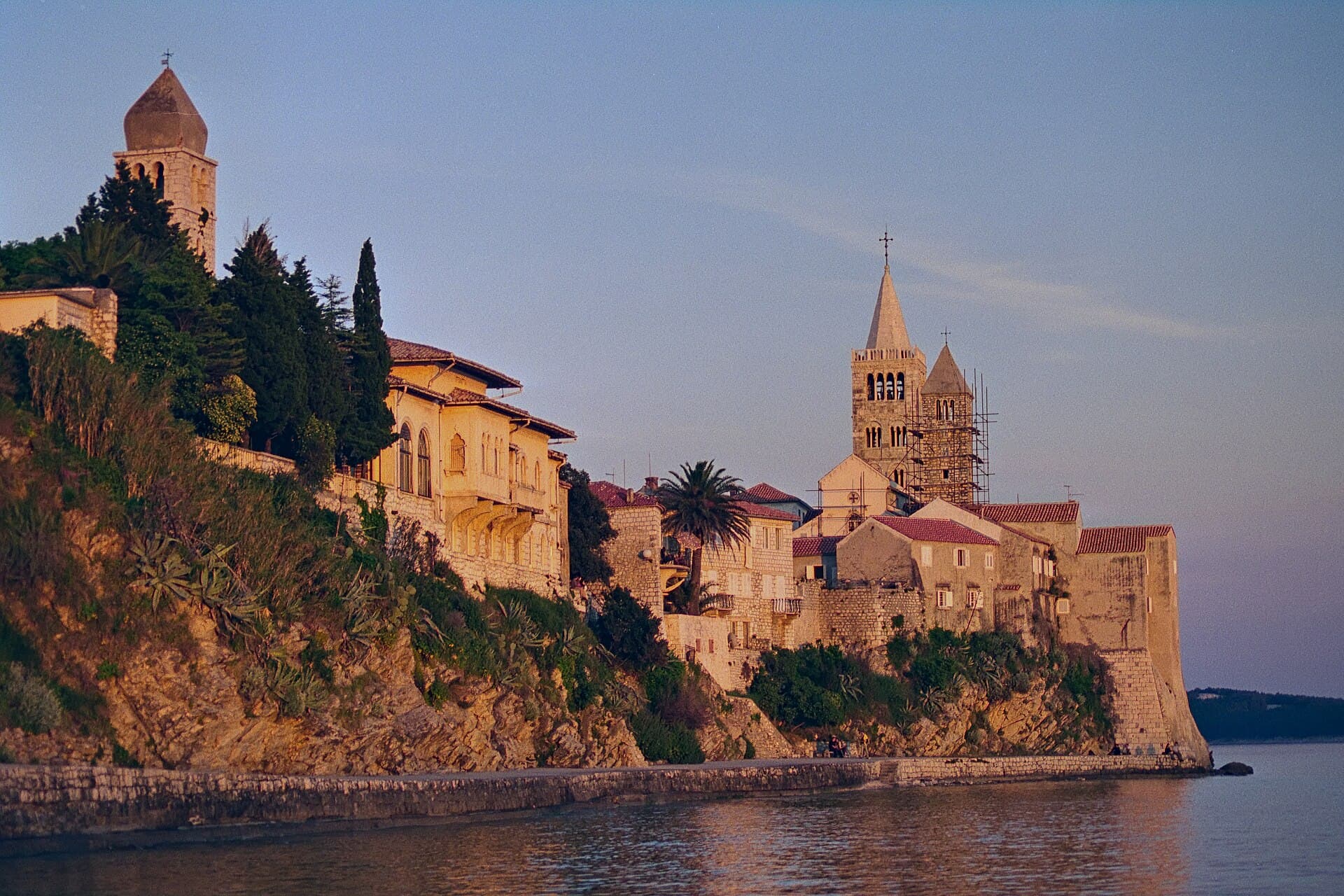
Rab's old town has a clear silhouette, but it rewards more than a postcard view. Its four towers mark distinct religious sites: the Assumption of Mary, St John the Evangelist, St Andrew and…
Read the guide
Help improve this page
Spot something missing or wrong? Suggest a correction, add your photo or report a problem. Editors review every suggestion before it is published.
Photo credits
- Veli Lošinj — Sti2 · CC BY-SA 3.0 · Wikimedia Commons
- Mali Lošinj — K. Korlevic · Public domain · Wikimedia Commons
- Ilovik — The original uploader was Einer flog zu Weit at German Wikipedia. · CC BY-SA 3.0 · Wikimedia Commons
- Sveti Petar — Darko Tepert Donatus · CC BY-SA 2.5 · Wikimedia Commons
- Punta Križa — Žiga · Public domain · Wikimedia Commons