Rab
About this place
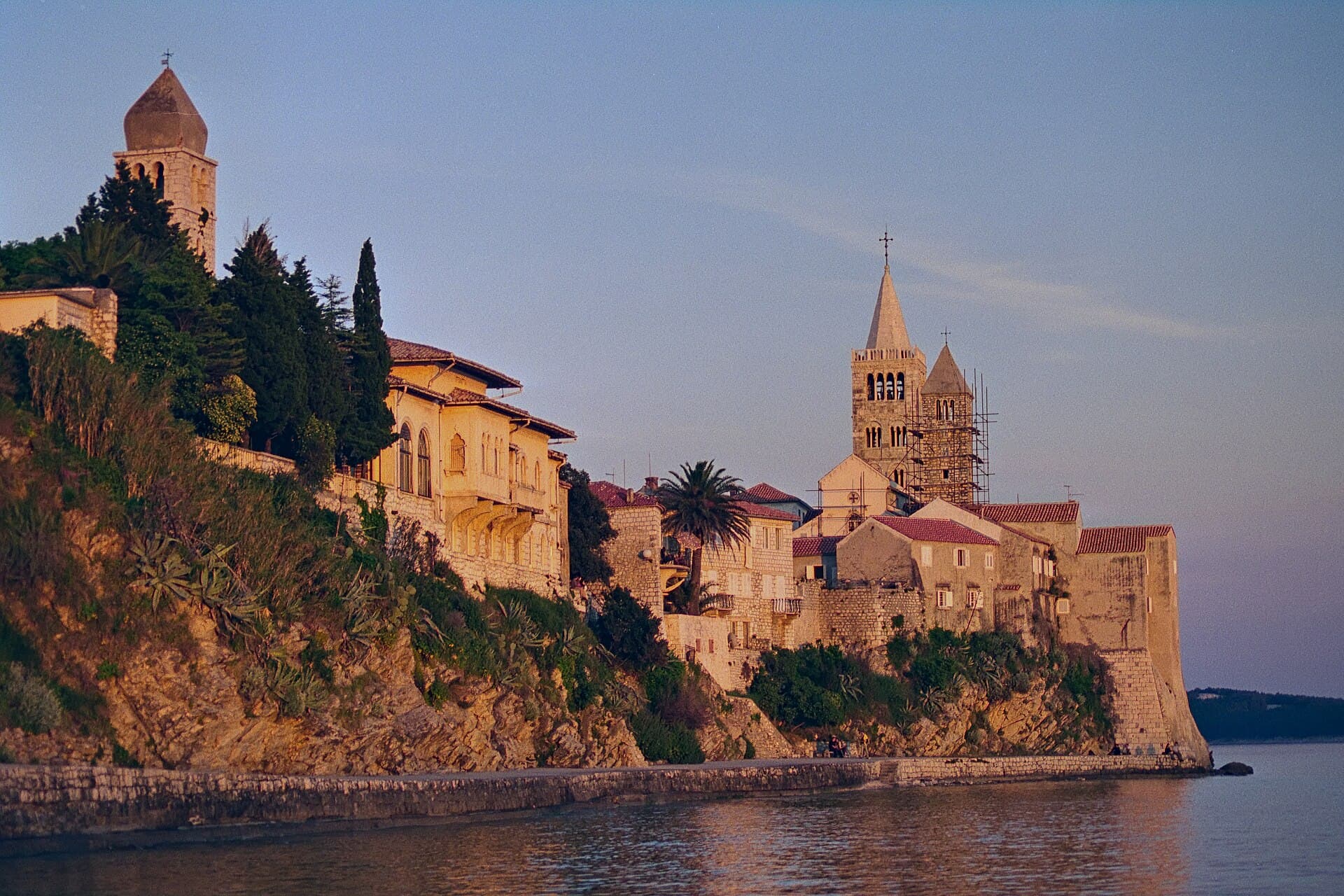
Rab town is recognisable by four bell towers above its narrow old-town peninsula. It is best explored on foot: leave the waterfront for stone lanes, churches and the remains of historic buildings, then continue into Komrčar Park. This combines architecture, sea views and a wooded break without turning every stop into a separate drive. The towers belong to different religious sites, not four parts of one church, so they provide a useful way to understand the town as you walk. Rab suits visitors who enjoy heritage, evening strolls and time beside the water. The broad sandy beaches around Lopar, however, require a separate outing. Rab town and the island of Rab are not interchangeable destinations. A ferry arrival at Mišnjak or Lopar does not deliver you to the old town, a distinction worth considering when choosing accommodation and planning your first day. For an unhurried stay, devote one morning to lanes and bell towers and another to Komrčar and the shoreline. Let wider island excursions complement the town rather than replace the experience of being there.
Rab's old town has a clear silhouette, but it rewards more than a postcard view. Its four towers mark distinct religious sites: the Assumption of Mary, St John the Evangelist, St Andrew and St Justine. Leave time between them for lanes, open views and changes of level instead of focusing solely on entry to buildings. Komrčar allows a walk through the built environment to continue into woodland, a useful arrangement when you do not want to alternate repeatedly between sightseeing, driving and distant beaches. The waterfront, historic centre and park can form one connected outing. Lopar, Kampor and other island settlements should be planned separately. Choose a stay in the town for this combination of walkability and heritage rather than on the assumption that every beach on Rab lies immediately outside your accommodation.
Stays nearby
 Apartment
Apartmeni Klenovica.eu
Klenovica
38.9 km from Rab
up to 4 guests · 1 bedroom
The host confirms the exact price for your dates and availability.
Things to see
Rab's four bell towers belong to separate religious complexes: the Assumption, St Andrew, St Justine and St John the Evangelist. Explore them as distinct stops rather than looking for one church with four towers. At St John, the surviving tower and the remains of the church form a particularly revealing contrast, while the cathedral complex presents a more complete architectural ensemble. St Christopher's offers another perspective as a museum and lapidarium devoted to stone heritage. The town walls, the Tower of the Brave and St Christopher's Tower introduce the defensive side of Rab's peninsula. For its secular history, include the Rector's Palace, the town loggia and the façades of the Dominis Nimira and Bakota palaces. These buildings shift attention from church towers to civic administration and the homes of earlier inhabitants. Finish towards Banova Vila, where the waterfront view places the towers together in a skyline after the close-up details of the narrow streets.

Beaches
Banova Vila offers the closest combination of swimming and a visit to Rab town, beneath the walls and Komrčar Park beside the waterfront path. Built bathing areas, a small beach and views of the towers characterise the spot; the official description also lists a ramp into the sea. For a more wooded shoreline, head towards Suha Punta near Kampor, where pebbles and rocks alternate beneath pines. Lopar's Paradise Beach is a separate excursion to the sandy north, with shallow water, sports facilities and the San Marino resort behind it. These three choices offer distinctly different settings: an urban bathing place, wooded coves or an extensive sandy beach, at different distances from Rab's old town.
Bathing water quality nearby
- Gradska plaža Rab · 149 mexcellent · season 2025
- Samostan Sv. Antuna · 439 mexcellent · season 2025
- Uvala Padova 1 · 512 mexcellent · season 2025
- Škver - plaža · 705 mexcellent · season 2025
- Uvala Padova 2 · 810 mexcellent · season 2025
- Barišići · 1.0 km
Things to do
Shape a one-day visit as a circuit: waterfront, old-town churches and towers, then Komrčar and a return beside the sea where public access allows. Choose one religious complex for closer attention; you do not need to climb every tower to understand the town. With three days, give the first to Rab itself, the second to a different part of the island according to your interests, and keep the third more relaxed. For sand and gently shelving shores, set aside a proper outing to Lopar instead of inserting it between two appointments in town. Photographing the skyline can remain part of a walk, without entering private property or searching for unsafe elevated edges.
Activities
Rab Archaeological (T)races gives island walks a focus beyond the old town. Epario follows roughly 10 kilometres of Lopar's coast, while the 6.5-kilometre Frux trail connects Lopar and Supetarska Draga through a dry-stone landscape. Capo Fronte is a substantially longer outing at about 22.5 kilometres, crossing Kalifront and Dundo Forest Reserve. Information points connect these landscapes with archaeological remains, small churches and earlier uses of the island's land. For a shorter active outing beside the sea, Suha Punta combines cycle access, pine woodland and rocky or pebbly coves. Within Rab town, the waterfront walk past Banova Vila allows a swim to complement a bell-tower circuit.
Day trips
An outing from Rab towards Kampor can pair the Monastery of St Euphemia with the wooded coast of Suha Punta. Keep that cultural stop separate from a longer Kalifront walk through Dundo's holm-oak and ash woodland. For a sandy beach day, choose Lopar and Paradise Beach in the north of the island rather than seeking the same shoreline beneath Rab's bell towers. Supetarska Draga offers a third theme through St Peter's Church and its indented bay. Archaeology enthusiasts can select one Rab Archaeological (T)races route, such as Frux between Lopar and Supetarska Draga. Each gives an excursion from Rab a clear focus: Kampor woodland, Lopar sand or the church heritage of the sheltered inlet.
Events
Rapska Fjera ran from 25 to 27 July in 2026, bringing craft demonstrations, historical dress and crossbow traditions into the old town. Its closing date coincides with the feast of St Christopher, Rab's patron saint, giving the fair a different character from a standard waterfront concert. The 2026 Rab Jazz Festival followed on 4–7 September, using St John the Evangelist, the open-air cinema and Pjaceta as venues. These events provide two distinct reasons to choose a stay in Rab: July's fair turns the streets into a historical setting, while September's jazz places live music among the town's towers and squares.
Food and drink
Rab cake is the town's most distinctive sweet souvenir, combining an almond filling with citrus zest and maraschino liqueur. Local confectionery also includes muštaćoni biscuits and smokvenjak fig cake, allowing a tasting to explore almonds, spices and dried fruit rather than one dessert alone. Dundovo's town market provides a different view of Rab's daily food shopping from the old town's restaurant terraces. Fish, olive oil and seasonal produce connect the island's fishing and farming traditions. Make the cake a separate stop after walking between the bell towers, particularly when choosing a packaged version to take home rather than a dessert to eat immediately.
Practical information
Practical information
Distinguish Rab's old town from Palit, Banjol and more distant Lopar when choosing accommodation: these names determine the starting point for bell towers, sandy beaches and ferry ports. Cultural walks in Rab use narrow streets and changes of level, while Banova Vila is reached along the shore. Reconstruction of Rab harbour and its approach road was announced in September 2026, with phased closures affecting parking zone 0. During those works, arriving drivers benefit from selecting parking away from the harbour project, including options in Palit. July's Rapska Fjera and September's Rab Jazz Festival also change the old town's evening rhythm, making a room beside a festival venue a different choice from accommodation in a quieter island settlement.
Parking
Dundovo manages Rab's public parking. Its 2026 list places Boškopin and Slavija in zone 1, with the sports-hall car parks and Mali Palit in zone 2. Brdo, Veterinarska and the clinic area fall in zone 3, while Škver uses seasonal zone-4 charging. Palit offers a walking approach to the old town and bell towers. Harbour zone 0 is affected by phased closures during reconstruction announced in September 2026, so the current works layout matters more than an older parking map.
Getting there and around
For arrival with a vehicle, distinguish two ferry connections. Stinica on the mainland links to Mišnjak on Rab, while Jadrolinija's Valbiska–Lopar service connects Rab with Krk. Neither ferry terminal is Rab's historic centre, so disembarkation is followed by a land journey. Jadrolinija publishes a 2026 schedule for Valbiska–Lopar and ties the ticket to the selected departure. Do not assume that the same booking rule applies to every island service. Without a car, check the arrival terminal and onward transport before purchasing a ticket. Once in Rab's old town, plan to explore on foot rather than trying to drive between its towers.
Frequently asked questions
Are Rab town and Rab island the same destination?
The town is one destination on the island. Plan Lopar and other settlements separately.
Does the ferry from Valbiska arrive in Rab town?
No. It arrives in Lopar; reaching Rab town requires onward travel by land.
What connects the four towers?
They form the familiar skyline but belong to different religious sites.
Where can I combine a town walk with greenery?
Combine the old town with Komrčar Park, adapting the route to its surfaces and your abilities.


Related guides

Krk
Kamplin makes a useful starting point because several aspects of the town meet in a small area. The castle's defensive architecture stands alongside the religious complex, while changes in…
Read the guide
Help improve this page
Spot something missing or wrong? Suggest a correction, add your photo or report a problem. Editors review every suggestion before it is published.
Photo credits
- Rab — Herbert Ortner · CC BY 4.0 · Wikimedia Commons
- Mundanije, Banjol — Zoran Kurelić Rabko · CC BY-SA 3.0 · Wikimedia Commons
- Barbat na Rabu — Aeroid · CC BY-SA 4.0 · Wikimedia Commons
- Supetarska Draga — Rabko · CC BY-SA 3.0