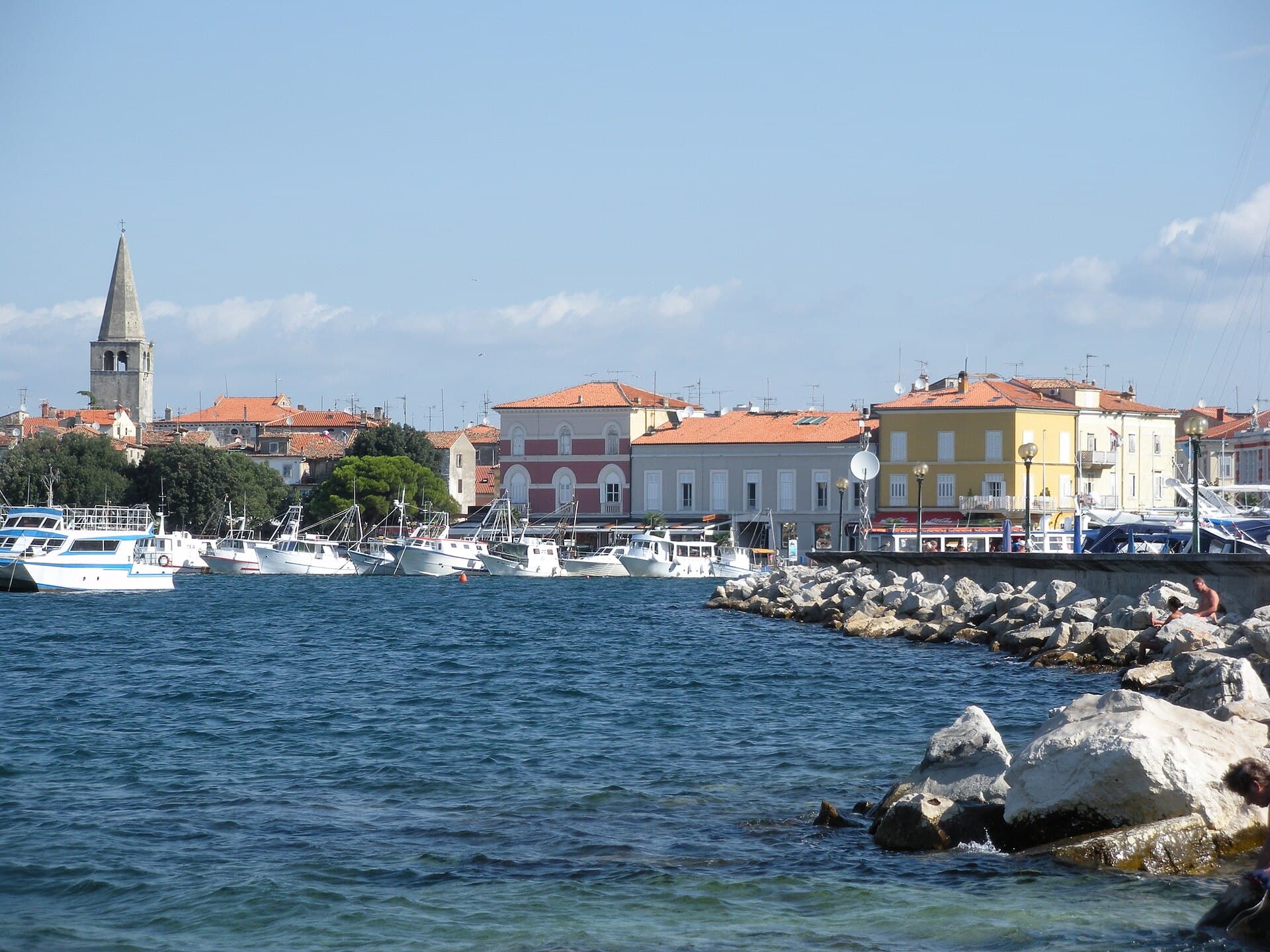
Peroj
About this place
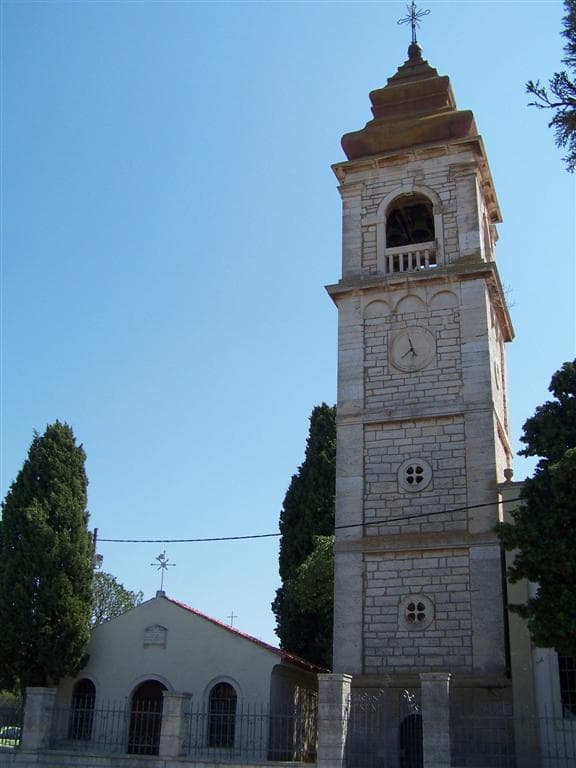
Peroj stands on the south-western coast of southern Istria, around five kilometres from Vodnjan and ten kilometres from Pula, overlooking the Fažana Channel and the Brijuni Islands. Its defining feature is a strong Montenegrin Orthodox heritage: families from Montenegro arrived on 21 July 1657, and their descendants preserved their faith, local speech and the use of Cyrillic on gravestones. The Church of St Spyridon acquired its present form in 1834, its domed bell tower was erected in 1860, and an Orthodox cemetery lies behind it. Simple stone houses form the old core, while newer residential and visitor accommodation extends towards the sea. Along the Peroj coast, limestone shelves alternate with pebble beaches as far as the coves of Portić and Marić; Marić served for centuries as Vodnjan’s trading harbour. Pulapromet route 21 provides access to Fažana and Pula, connecting Pula, Fažana, Peroj and Barbariga in 2026. Peroj therefore brings together an unusually resilient Orthodox tradition, views of the Brijuni archipelago and direct access to a varied Istrian shoreline.
Peroj belongs administratively to the Vodnjan area, yet its identity is strongly shaped by the Montenegrin Orthodox community established after families settled here in 1657. Over the centuries, residents preserved their Orthodox faith, a distinctive Peroj speech and Cyrillic inscriptions in the cemetery behind St Spyridon’s Church. Simple stone houses characterise the old core, while newer development descends towards the Fažana Channel. Views from the coast and higher parts of the village extend across to the Brijuni Islands. Rather than one continuous developed beach, the shoreline alternates between limestone shelves, pebble sections and coves reaching towards Portić and Marić. This meeting of Orthodox heritage, Istrian stone architecture and immediate proximity to Brijuni gives Peroj a profile unlike any neighbouring settlement in the Vodnjan area.
Stays nearby
 Apartment
Apartmeni Klenovica.eu
Klenovica
84 km from Peroj
up to 4 guests · 1 bedroom
The host confirms the exact price for your dates and availability.
Things to see
St Spyridon’s Church is Peroj’s central landmark and the clearest legacy of the Orthodox families who arrived from Montenegro in 1657. The Venetian Republic granted permission for a church only in 1788; the building took its present form in 1834 and the domed bell tower was completed in 1860. Inside are icons and a sixteenth-century iconostasis depicting Greek saints. Behind the church, an Orthodox cemetery with Cyrillic inscriptions records the community’s long preservation of its identity. Elsewhere in the old core, modest stone houses with balconies represent the local form of traditional Istrian architecture. On the coast, Portić and Marić add a maritime dimension: the small harbour at Marić connected Vodnjan with Venice and other Adriatic ports for centuries.
Beaches
Peroj’s shoreline consists of limestone slabs and rocky sections interrupted by smaller pebble beaches, extending towards Portić and Marić coves. This varied coast lets swimmers choose between more straightforward pebble entries and secluded rocky spots, although water shoes make access across limestone more comfortable. Portić is a useful landmark for a coastal walk from the village, while Marić connects the bathing landscape with the history of Vodnjan’s former harbour. The shore faces across the Fažana Channel towards the Brijuni archipelago, a view best appreciated from its more open rocky sections. As official descriptions do not list uniform facilities along every part of the coast, visitors heading towards the more distant coves should carry drinking water, sun protection and the equipment they need.
Bathing water quality nearby
- Peroj - Božinka · 1.0 kmexcellent · season 2025
- Fažana - Sjever · 2.2 kmexcellent · season 2025
- Fažana - Dječje igralište · 2.9 kmexcellent · season 2025
Source: European Environment Agency (EEA); data from Croatian authorities. · bathing water profile
Things to do
Begin in the old core among the stone houses that preserve the scale of historic Peroj. The essential stop is St Spyridon’s Church, which assumed its current form in 1834; its bell tower followed in 1860, while the interior contains icons and a sixteenth-century iconostasis. Continue behind the church to the Orthodox cemetery and look for Cyrillic inscriptions associated with Peroj’s Montenegrin community. After exploring the historic centre, descend to the coast and follow the alternating limestone and pebble shore towards Portić Cove. A longer walk or bicycle ride can continue to Marić, the small harbour that once served Vodnjan’s maritime trade. Return to an open stretch of the coast before sunset for views across the Fažana Channel towards the Brijuni Islands.
Practical information
Practical information
The Vodnjan Tourist Board office is at Narodni trg 10 in Vodnjan, roughly five kilometres from Peroj, and can be reached on +385 52 511 700. Anyone wishing to enter St Spyridon’s Church should consult current Tourist Board information because the published opening period is not daily. Bus route 21 connects Peroj with Pula, Fažana and Barbariga, although departures change with Pulapromet’s seasonal operating model. Facilities are not evenly distributed along the coast towards Portić and Marić, so carry drinking water and sun protection for a longer stay. Vodnjan is the nearest administrative centre, while Fažana provides the departure harbour for organised boat trips to Brijuni National Park.
Getting there and around
Pulapromet route 21 connects Pula, Fažana, Peroj and Barbariga. Under the regular 2026 network, variants 21a, 21b, 21c, 21d, 21g and 21h serve Peroj, with selected journeys continuing to Barbariga. The published winter timetable indicates about six minutes between Peroj and Fažana and roughly 25 minutes to central Pula, depending on the departure and traffic. By road, Vodnjan is approximately five kilometres away and Pula about ten kilometres. Travellers bound for Brijuni first need to reach Fažana, the departure point for the official excursion boats. A bicycle is useful for the coastal stretch towards Portić and Marić, although summer riders should allow for strong sun and limited continuous shade.
Frequently asked questions
When did Montenegrin families settle in Peroj?
Families from Montenegro arrived in Peroj on 21 July 1657.
What is kept inside St Spyridon’s Church?
The church contains icons and a sixteenth-century iconostasis depicting Greek saints.
Is there a bus from Peroj to Pula?
Yes. Pulapromet route 21 connects Peroj with Fažana and Pula.
What is Peroj’s coastline like?
The coast alternates between limestone rocks and smaller pebble beaches towards Portić and Marić coves.
How far is Peroj from Vodnjan?

Related guides

Novigrad
Novigrad-Cittanova developed on Istria’s north-western coast near the mouth of the Mirna, in a maritime setting that shaped centuries of fishing and trade. The historic centre still…
Read the guide
Help improve this page
Spot something missing or wrong? Suggest a correction, add your photo or report a problem. Editors review every suggestion before it is published.
Photo credits
- Peroj — Annebethmi · CC BY-SA 3.0 · Wikimedia Commons
- Fažana — ModriDirkac · CC0 · Wikimedia Commons
- Pula — Orlovic · CC BY-SA 3.0 · Wikimedia Commons
- Crkva sv. Foške — Žiga · CC BY-SA 3.0 · Wikimedia Commons
- Fort Brioni Minor — nikola_pu · CC BY-SA 3.0