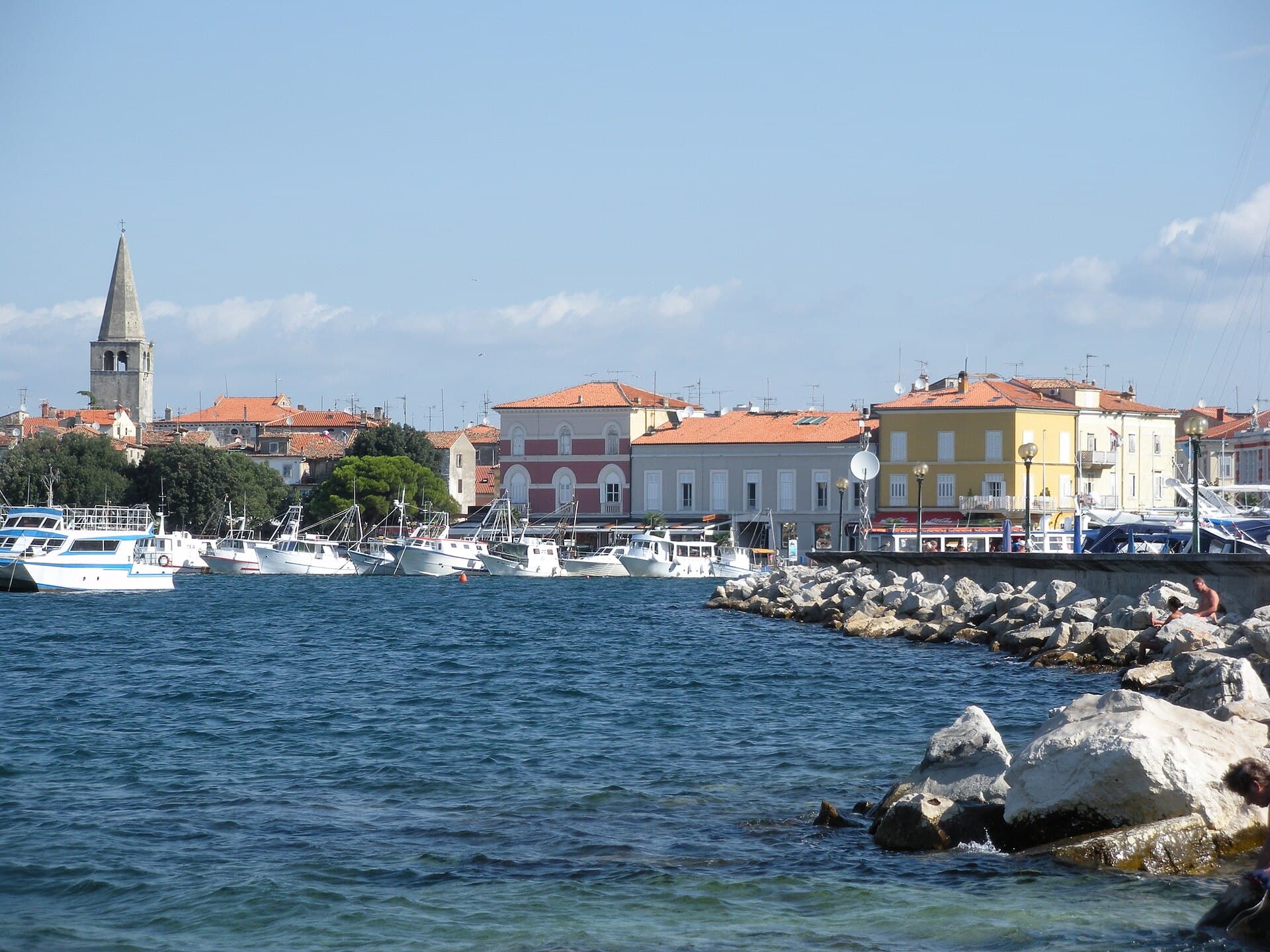
About this place
Labinci is an inland Istrian settlement that has almost merged with neighbouring Kaštelir, around ten kilometres north of Poreč. Vineyards, olive groves and vegetable fields shape the immediate landscape, while the west coast is close enough for regular trips to the sea. Its most important historic traces are two churches: the older Church of St Sunday, preserving frescoes from the first half of the 15th century, and the parish church of St John the Baptist, built in 1736. The latter’s 25-metre bell tower was erected in 1837 using stone from the ruined Benedictine monastery of St Michael. Local food culture centres on wine, olive and pumpkin-seed oils, spirits and produce from family farms; the destination map lists Legovina, Radoš and Cossetto wineries, alongside Žardin, Toni and Konoba Intrade. For swimming, visitors usually head towards Lanterna and Tar Bay, where sandy, pebble, rocky and paved shores offer different settings. Labinci has a bus stop on services linked with Poreč, but a car remains more convenient for combining churches, producers and beaches. Tourist information is available at the local board’s office at Kaštelir 30b.
Labinci and Kaštelir gradually grew towards one another over several centuries and now function almost as a single settlement, although each retains its own name. They stand roughly ten kilometres north of Poreč amid western Istria’s olive groves, vineyards and cultivated fields. Historical accounts describe Labinci as once larger than Kaštelir, with the area governed first through Motovun and later Vižinada. The Italian name Santa Domenica preserves the connection with the old Church of St Sunday, while the parish church of St John the Baptist remains the settlement’s principal religious landmark. Agriculture is still evident in local wine, olive oil, vegetables and spirits, as well as pumpkin-seed oil which the local tourist board describes as the only product of its kind made in Istria.
Stays nearby
 Apartment
Apartmeni Klenovica.eu
Klenovica
93 km from Labinci
up to 4 guests · 1 bedroom
The host confirms the exact price for your dates and availability.
Things to see
The Church of St Sunday in the Brnasi area is Labinci’s oldest prominent building. Dating from the 13th century and restored in 1623, it preserves wall paintings from the first half of the 15th century. The southern wall shows St Martin and the stoning of St Stephen, while the northern wall includes St George slaying the dragon. The parish church of St John the Baptist was built in 1736 and contains five marble altars, a 15th-century crucifix and objects transferred from the monastery of St Michael “under the earth”. Its 25-metre bell tower was completed in 1837 using stone recovered from the ruins of that Benedictine complex.
Beaches
Labinci is not directly on the coast, so swimming trips usually lead towards Lanterna and Tar Bay. Lanterna has about three kilometres of shoreline combining sandy, pebble, rocky and paved sections. The roughly 400-metre Marbello Family Beach has fine pebbles and a gentle entry into the sea, making it particularly suitable for families. Kras Beach mixes pebbles and rocks with pine shade and handrails for easier access; a designated section welcomes dogs. Tar Bay offers quieter rocky and pebble coves, while Tuna Bay adds pedal-boat, kayak and SUP rental to the bathing experience. Access to certain facilities and sun loungers may be reserved for resort guests or subject to an additional charge.
Things to do
Start a walk through Labinci at the parish church of St John the Baptist, where the interior includes marble altars, a 15th-century crucifix and remnants of an organ transferred from Božje Polje in 1838. Continue to the older Church of St Sunday in Brnasi; its early-15th-century frescoes depict St Martin, the stoning of St Stephen and St George with the dragon. Devote the afternoon to local flavours: the destination map links Labinci and Kaštelir with the Legovina, Radoš and Cossetto wineries and several olive-oil producers. For a more active finish, head towards Vrbanovica, an excursion area on the route of the historic Via Flavia which the municipality highlights for walking and cycling.
Food and drink
For a meal around Labinci and neighbouring Kaštelir, the local list includes Brava Centar in Labinci, Toni guesthouse restaurant in Brnobići, and Žardin in Kovači. The municipal register also names Kaštel guesthouse restaurant at Kaštelir 28. Stop by Butiga for local products; the tourist board presents it as a meeting point for Istrian produce, stories and aromas. In summer, Kaštelir’s Friday Tasting programme brings together local producers with the Vitis agricultural association; in 2026 it ran on Fridays through July and August.
Practical information
Practical information
The tourist office serving Labinci is in neighbouring Kaštelir at Kaštelir 30b; its published contact details include +385 52 463 141 and [email protected]. According to information available in 2026, the office opens on weekdays from 9 am to noon and from 5 pm to 8 pm, remaining closed at weekends. The official destination map marks the tourist office, medical practice, pharmacy, post office, Butiga shop and local producers, making it useful for navigating between Labinci and Kaštelir. Shoes suitable for uneven rural lanes help when visiting churches and farms, while a beach day at Lanterna requires a drive from the inland settlement and attention to the resort’s access rules.
Getting there and around
Labinci lies roughly ten kilometres north of Poreč and is most easily reached by road through western Istria. Arriva’s 2025/2026 documentation includes Labinci on its Poreč connection, while a 2026/2027 school timetable records a morning service from Kaštelir through Labinci and Višnjan to Poreč. These departures primarily serve pupils and should not be treated as a frequent tourist shuttle. A car is more practical for combining Labinci, the churches at Brnasi, producers in surrounding villages and the Lanterna beaches. The nearest major bus hub is in Poreč, whose station stands about 500 metres from the old centre and waterfront and offers onward intercity connections.
Frequently asked questions
What frescoes can be seen in the Church of St Sunday?
The early-15th-century frescoes depict St Martin, the stoning of St Stephen, several saints and St George with the dragon.
Does Labinci have its own seaside beach?
Labinci is inland; the usual swimming options are at Lanterna and Tar Bay, with sandy, pebble and rocky beaches.
Where can visitors buy local products?
The official map identifies the Butiga shop together with wineries, olive-oil producers, beekeepers and distilleries across Labinci and Kaštelir.
How tall is the bell tower in Labinci?
The bell tower of St John the Baptist parish church is 25 metres high and was built in 1837.
Nearby
Brnobići, Kaštelir-Labinci
Village · Istria
Kaštelir
Village · Istria
Related guides

Novigrad
Novigrad-Cittanova developed on Istria’s north-western coast near the mouth of the Mirna, in a maritime setting that shaped centuries of fishing and trade. The historic centre still…
Read the guide
Help improve this page
Spot something missing or wrong? Suggest a correction, add your photo or report a problem. Editors review every suggestion before it is published.
Photo credits
- Labinci — Petar Milošević · CC BY-SA 4.0 · Wikimedia Commons
- Apartmeni Klenovica.eu — Apartmani Klenovica.eu · courtesy of the property owner
- Novigrad — Sl-Ziga · Public domain · Wikimedia Commons
- Pula — Orlovic · CC BY-SA 3.0 · Wikimedia Commons
- Funtana — Tanya Dedyukhina · CC BY 3.0 · Wikimedia Commons
- Poreč