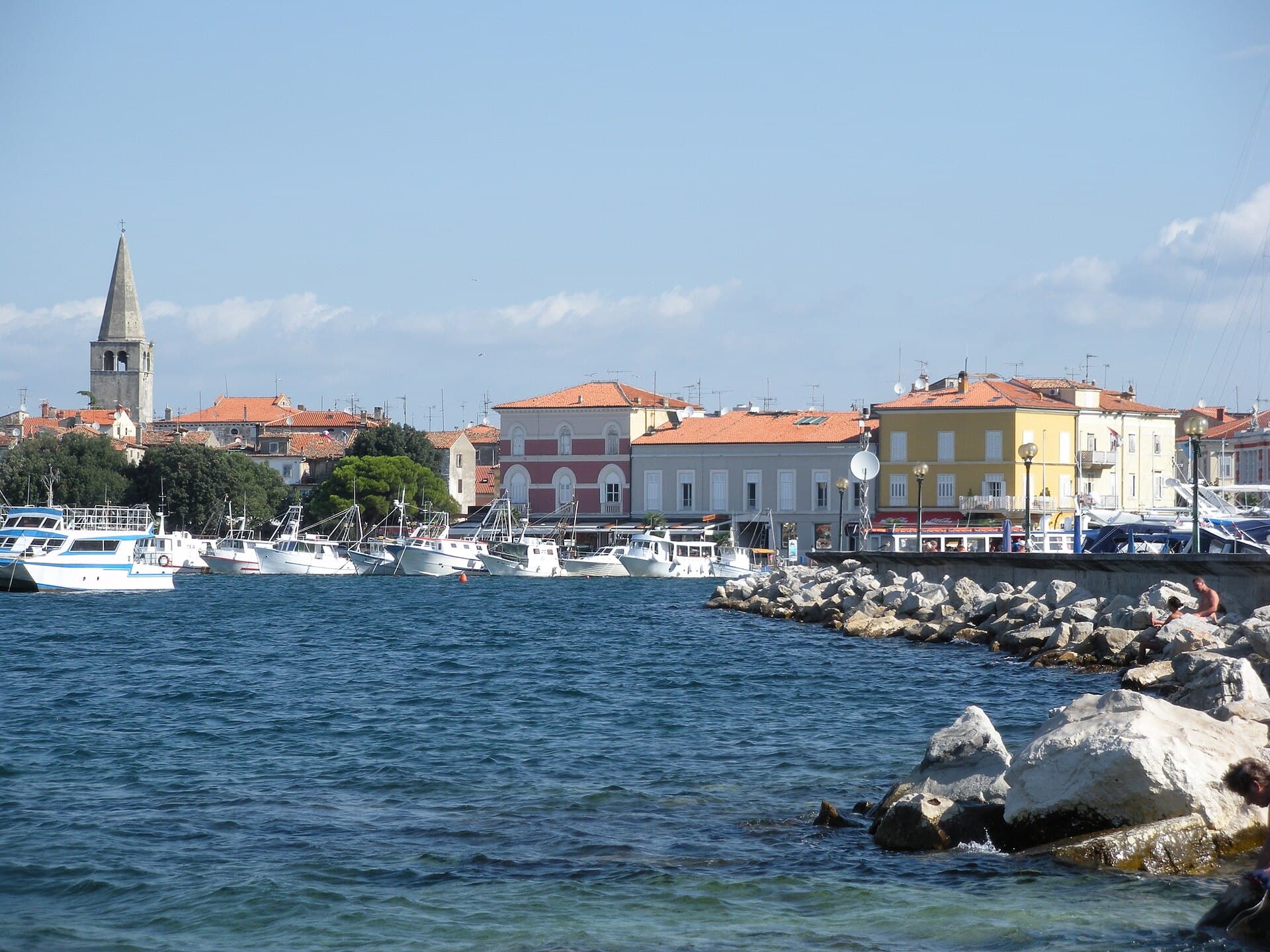
About this place
Kaštelir occupies a hilltop north of Poreč and forms a single municipality with neighbouring Labinci. Although only about ten kilometres from Poreč, it feels neither suburban nor coastal: vineyards, olive groves, vegetable plots and small family farms shape its surroundings. A church built in 1908 stands in central Kaštelir, while Labinci has the 1736 Church of St John the Baptist and the 13th-century Gothic Church of the Holy Trinity, whose frescoes date from the first half of the 15th century. Active visitors can set off from the Bike Centre in Labinci onto Poreč’s ten-route, 250-kilometre cycling network, or follow a walking trail beginning by the cemetery in Babići. Food provides another rewarding way into the village: local producers offer Malvasia wine, olive oil, honey, spirits, handmade pasta and pumpkin-seed oil from Rogovići, presented by the tourist board as the only one produced in Istria. Specific lunch stops include Toni in Brnobići, Žardin in Kovači and the Monte Formento tasting room. Since the sea does not reach the village itself, a stay here combines the quiet agricultural interior of Istria with short drives to the Poreč coast.
Kaštelir and neighbouring Labinci grew on a western Istrian ridge roughly ten kilometres from Poreč, historically looking first toward Motovun and later Vižinada. Agriculture remains central to Kaštelir’s identity: vineyards, olive groves and fields surround the settlement, while local farms supply the Butiga shop with wine, oil, vegetables, bread, cheese and other regional produce. The bilingual municipal name, Kaštelir-Labinci/Castelliere-Santa Domenica, reflects Istria’s Croatian and Italian heritage. Unlike coastal Poreč, Kaštelir offers an inland base with views across cultivated countryside and road access to the sea.
Stays nearby
 Apartment
Apartmeni Klenovica.eu
Klenovica
94 km from Kaštelir
up to 4 guests · 1 bedroom
The host confirms the exact price for your dates and availability.
Things to see
The oldest major monument close to Kaštelir is the Gothic Church of the Holy Trinity in Labinci, built in the 13th century and decorated with frescoes during the first half of the 15th. Labinci’s Church of St John the Baptist dates from 1736; it preserves part of the sanctuary from a former abbey south of the village as well as one of Istria’s oldest organs. The church in central Kaštelir is considerably younger, dating to 1908, so visiting all three traces local religious architecture from the Middle Ages to the early 20th century. The vineyards and olive groves between them are an equally defining part of the view.
Things to do
Start the morning at Kaštelir’s 1908 church, then continue into Labinci for the 1736 Church of St John the Baptist and the Gothic Holy Trinity Church with its late-medieval frescoes. After exploring the religious heritage, collect a bicycle at the Bike Centre, Labinci 143, and choose a section of the ten-route Poreč cycling network. Walkers can instead begin the local trail beside the cemetery in the hamlet of Babići, from where it threads through woodland, olive groves and vineyards. End the day with a tasting of Malvasia or olive oil at a listed local producer, or browse products from Kaštelir family farms at the Butiga shop.
Food and drink
For a conventional meal in Kaštelir, the tourist board lists Toni restaurant and guesthouse at Brnobići 23 and Žardin at Kovači 13b. Monte Formento, at Kovači 45, is an olive-oil tasting room and therefore suits visitors who want to explore a local product without sitting down to a full lunch. A meal here can centre on Istrian pasta such as fuži or pljukanci, olive oil, prosciutto and seasonal asparagus, paired with wine from a Kaštelir producer. Pumpkin-seed oil made in Rogovići is a particular local speciality, while the Butiga shop gathers locally made wine, craft beer, cheese, cured meat and vegetables under one roof.
Practical information
Practical information
The Kaštelir-Labinci Tourist Board is at Kaštelir 30 B, and its website provides contacts for local restaurants, producers, accommodation and the cycling centre. Cycling information is available from the Bike Centre at Labinci 143, the gateway to ten Poreč-area routes covering a combined 250 kilometres. There is no need to visit every farm separately for local produce: Butiga, at Kaštelir 29 b, stocks wine, olive oil, fresh bread, vegetables, cheese and locally made souvenirs. For medical, pharmacy and other larger-town services, visitors can plan around Poreč, approximately ten kilometres away.
Getting there and around
Kaštelir is a road-oriented inland settlement about ten kilometres from Poreč, making a car the simplest link between accommodation, the coast and producers scattered among the surrounding hamlets. Cyclists have a useful starting point at the Bike Centre, Labinci 143: the Poreč network contains ten routes totalling 250 kilometres, with some trails continuing all the way to Poreč. The principal churches, Butiga and village restaurants can be joined by short local trips, but visits to wine and olive-oil producers in Roškići, Cerjani and Kovači are best organised as a pre-planned circuit.
Frequently asked questions
How far is Kaštelir from Poreč?
The municipal website places Kaštelir approximately ten kilometres from Poreč.
Where does the Kaštelir walking trail begin?
The trail begins at Kaštelir’s north-eastern entrance, beside the cemetery in the hamlet of Babići.
Where can I buy local products?
Butiga at Kaštelir 29 b sells local farm products including wine, oil, vegetables, cheese and souvenirs.
What is the oldest church near Kaštelir?
The Gothic Church of the Holy Trinity in Labinci dates from the 13th century, with frescoes from the first half of the 15th.

Related guides

Novigrad
Novigrad-Cittanova developed on Istria’s north-western coast near the mouth of the Mirna, in a maritime setting that shaped centuries of fishing and trade. The historic centre still…
Read the guide
Help improve this page
Spot something missing or wrong? Suggest a correction, add your photo or report a problem. Editors review every suggestion before it is published.
Photo credits
- Labinci — Petar Milošević · CC BY-SA 4.0 · Wikimedia Commons
- Apartmeni Klenovica.eu — Apartmani Klenovica.eu · courtesy of the property owner
- Novigrad — Sl-Ziga · Public domain · Wikimedia Commons
- Pula — Orlovic · CC BY-SA 3.0 · Wikimedia Commons
- Funtana — Tanya Dedyukhina · CC BY 3.0 · Wikimedia Commons
- Poreč