Lovas
About this place
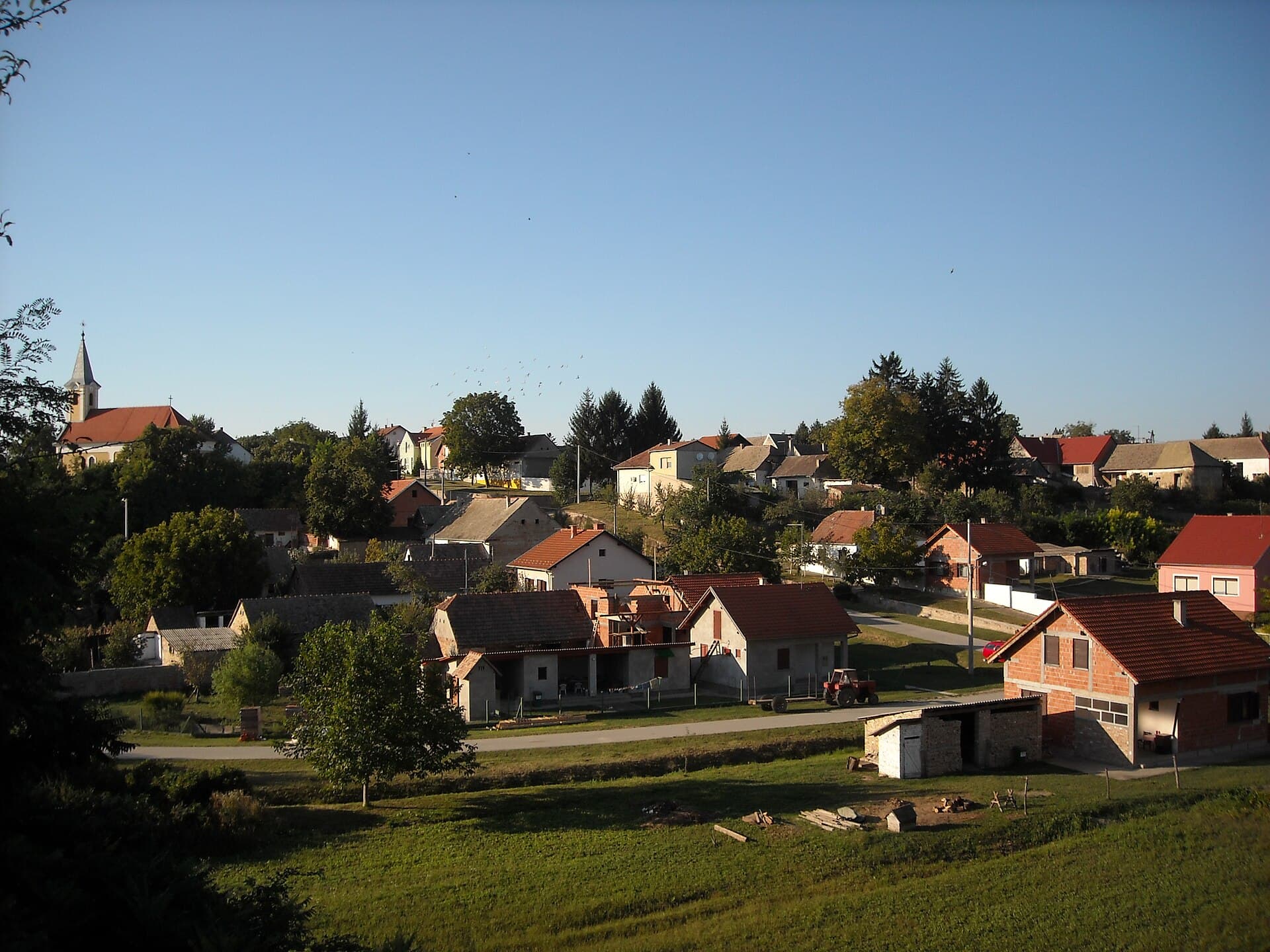
Lovas lies in western Syrmia, between Vukovar and Ilok, amid fields, vineyards and gentle slopes descending toward the Danube near neighbouring Opatovac. Archaeology is central to the village’s identity: the Lovas hoard, unearthed accidentally in 1939, contained bronze and gold objects from the Middle Bronze Age and is now held by the Archaeological Museum in Zagreb. Surveys conducted from 2011 to 2020 recorded more than twenty previously unknown sites across the municipality, including a triple burial associated with the Copper Age Kostolac culture at Kovači. The rebuilt Church of St Michael the Archangel, consecrated in 2005 after its eighteenth-century predecessor was destroyed during the Homeland War, stands in the village centre. Lovas’s wartime experience is commemorated at the mass-grave memorial in the local cemetery and by a cross at the former minefield. A visit here is therefore a quiet encounter with Syrmian landscape, deep prehistory and memorial sites that call for a respectful pace.
Lovas brings together three distinctly local strands: the farming landscape of western Syrmia, unusually rich archaeological ground and the painful memory of 1991. Its best-known prehistoric discovery is the Lovas hoard, Croatia’s largest group of Middle Bronze Age bronze objects, accompanied by around twenty gold pieces and a ceramic kantharos. The modern village gathers around the Church of St Michael the Archangel; its three removed bells returned in 2001, and the reconstructed church was consecrated four years later. In the Lovas cemetery, a memorial marks the mass grave from which 68 victims were exhumed, making remembrance essential to any understanding of the village.
Things to see


Šarengradska utvrda
Landmark · Šarengrad
Šarengrad Fortress is the ruin of a medieval stronghold above Danube-side Šarengrad, built in 1420 on the site of the older burg Athya.
9 km from Lovas

Stays
No stays listed here yet
Things to do
Lovas is best understood through the archaeological landscape of Gradac–Kalvarija, where finds point to the Kostolac and Vučedol cultures as well as the Late Bronze Age. Between 2011 and 2020, the Archaeological Museum in Zagreb recorded more than 20 newly identified sites across the municipality of Lovas, including Lovas and Opatovac. Use a walk through the village as an introduction to this long settlement history, then turn to museum material for the objects and their interpretation rather than entering cultivated fields or other private land.
Tours and activities
AdAd · partner offers: GetYourGuideThe partner handles booking, payment and support. StayBravo may earn a commission on bookings made through these links.How we choose offersGetYourGuide offers are selected and ordered by GetYourGuide based on the name of the nearest larger town or national park; we do not influence their selection and do not use data about you.GetYourGuide · Vukovar
We show GetYourGuide offers once you allow their cookies.
Practical information
Getting there and around
Lovas has no railway station, so driving from Vukovar or Ilok is the most practical way to explore it. Local roads connect the village with the main Vukovar–Ilok corridor and with Danube-side Opatovac. On 1 July 2025 the municipality introduced a weekday Lovas–Vukovar bus link, listing a 06:00 departure from Lovas and return services from Vukovar at 11:30 and 15:15. As this local timetable may change, departures should be confirmed with Lovas Municipality or the operator before travelling. A car also makes it much easier to combine the church, cemetery, former minefield and Opatovac than the single published morning departure allows.
Frequently asked questions
Where is the Lovas hoard kept?
The bronze and gold objects from the Lovas hoard are held by the Archaeological Museum in Zagreb.
When was the rebuilt Lovas church consecrated?
The rebuilt Church of St Michael the Archangel was consecrated on 25 September 2005.
Is there a bus from Lovas to Vukovar?
According to the municipality’s 2025 notice, a weekday morning departure from Lovas and two return services from Vukovar were introduced.
Nearby
Lovas
Open in OpenStreetMap(opens in a new tab)Larger towns
Smaller places
straight-line distance
Related guides

Osijek
Tvrđa and the centre around the main square are distinct starting points for understanding Osijek. The former emphasises the fortified historic quarter and Baroque architecture; the latter…
Read the guide

Vukovar
A cultural visit to Vukovar has several separate centres of gravity. Eltz Palace and the City Museum address the city and its inhabitants across different periods. Vučedol reaches much…
Read the guide

Stubičke Toplice
Stubičke Toplice derives almost its entire identity from thermal water and the Zagorje landscape. There is no large urban historic core; green spaces, bathing facilities and traces of the…
Read the guide
Slavonski Brod
Slavonski Brod developed around one of the major crossings of the Sava, and that border and transport role left a strong mark on the city. Brod Fortress represents the eighteenth-century…
Read the guide
Know Lovas? Correct us
Tell us in your own words what is not accurate. We check right away.Do not enter personal data. Corrections are checked by the StayBravo AI assistant; changes to the description are approved by an editor. Use the form instead
Do you know Lovas?
Help the guests who come after you.
Help us complete
Nothing is published without an editor’s review.Report illegal content
Photo credits: Lovas — slovas (CC BY-SA 3.0) · Opatovac, Lovas, Mohovo, Sotin — Roberta F. (CC BY-SA 3.0) · Tompojevci, Mikluševci, Bokšić, Tompojevci, Tovarnik, Ilača, Čakovci, Church of St. Nicholas, Church of St. George — MirkoS18 (CC BY-SA 4.0) · Šarengrad — Shabicht (CC0) · Šarengradska utvrda — Pudelek (Marcin Szala) (CC BY-SA 3.0) · St. Petka's Church — MirkoS18 (CC BY-SA 3.0) · Osijek — Rp031 (CC BY-SA 4.0) · Vukovar — Bybbisch94, Christian Gebhardt (CC BY-SA 4.0) · Stubičke Toplice — MOs810 (CC BY-SA 4.0) · Slavonski Brod — Petar Milošević (CC BY-SA 4.0)