Slavonski Brod
About this place
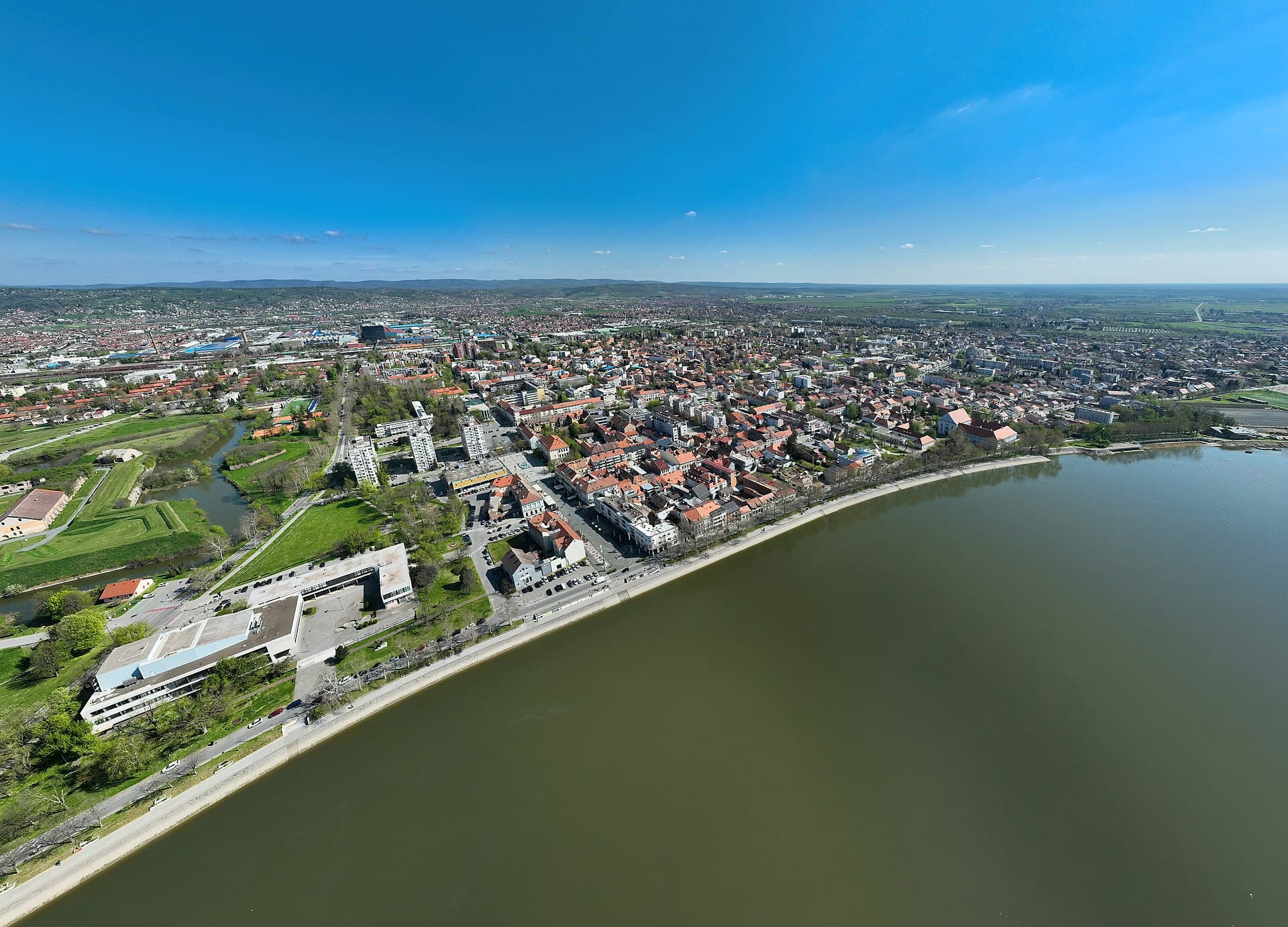
Slavonski Brod stands on the Sava opposite Bosanski Brod, and its main visitor zone stretches from the central Korzo square to the vast Baroque Brod Fortress. Ivana Brlić-Mažuranić Square, commonly called Korzo, opens toward the river and includes the Brlić family house associated with the celebrated Croatian writer. Only a few minutes away is Brod Fortress, whose construction began in 1715 and continued for roughly six decades; it was designed as a major defensive complex capable of supporting thousands of soldiers. In summer, the city’s relationship with the Sava becomes especially visible at Poloj, a sports and recreation area about three kilometres east of the centre with a sandy river beach, sports grounds, playgrounds and a route linking it with the urban riverfront. The food is unmistakably Slavonian, and the Tastes of Frontier Posavina project brings together restaurants focused on meat dishes, fish, cured products and regional wines. Slavonski Brod therefore offers far more than a motorway stop: Habsburg military heritage, literary history, the Sava and a distinctive Slavonian table can all fit into one day.
Slavonski Brod developed around one of the major crossings of the Sava, and that border and transport role left a strong mark on the city. Brod Fortress represents the eighteenth-century military layer, while Korzo and the Brlić house express the later civic and cultural identity. The Sava is more than a boundary: the river promenade, floating structures and Poloj show how closely the river is tied to everyday life in the city. Within a relatively compact central area, visitors therefore encounter fortifications, a representative square, literary heritage and a river landscape. This is practical for sightseeing because the main urban themes can be linked on foot, while Poloj requires a somewhat longer journey east from the centre.
Things to see
Brod Fortress is the city’s largest individual landmark. Construction began in 1715 as part of the Habsburg defensive system facing the Ottoman frontier and continued for roughly sixty years; the complex was designed for a large military garrison. On Korzo, the Brlić house represents a very different type of heritage: the family home associated with Ivana Brlić-Mažuranić has become an important cultural site in the city centre. The Sava riverfront and promenade fit naturally between these two locations. Poloj is recreational rather than monumental, but its sandy beach and sports facilities reveal the modern relationship between Brod and the river. Together, these places cover four distinct layers of the city: military, literary, urban and river-based.

 Significant landscape


Stays
No stays listed here yet
Beaches
Beach · Slavonski Brod
Poloj
Poloj is a maintained sandy riverside bathing area on a bend of the Sava, about three kilometres east of central Slavonski Brod.
Things to do
A first visit can begin on Korzo with the Brlić house, continue along the Sava and then turn toward Brod Fortress. In a short walk, this sequence connects the city’s literary, river and military stories. Enough time should be left for the fortress because the complex is far larger than a single monumental building. In summer, the second part of the day can shift to Poloj, three kilometres east of the centre, where a sandy beach, sports facilities and a jogging and cycling route provide a completely different atmosphere. The evening naturally returns to the centre for a Slavonian meal or local beer. This structure prevents Slavonski Brod from feeling like a checklist of historic buildings and brings the Sava into the visit as a living part of the city.
Food and drink
The Tastes of Frontier Posavina project provides a useful framework for local food because it brings together restaurants that emphasise Slavonian and Posavina traditions. In Slavonski Brod itself, Restaurant Uno is a concrete example: operating since 1988, it serves dishes including veal cooked under the bell, lamb, homemade breads and local wines. The county route also lists city venues such as Kuća piva, Oroz and Grozd, with more rural restaurants and excursion venues appearing in the surrounding area. Rather than one single signature ingredient, the regional table combines kulen and other cured meats, substantial meat dishes, river fish and cakes. In 2026, opening times and reservation requirements should be confirmed directly with the chosen venue, particularly on weekends and during larger city events.
Tours and activities
AdAd · partner offers: GetYourGuideThe partner handles booking, payment and support. StayBravo may earn a commission on bookings made through these links.How we choose offersGetYourGuide offers are selected and ordered by GetYourGuide based on the name of the nearest larger town or national park; we do not influence their selection and do not use data about you.GetYourGuide · Slavonski Brod
We show GetYourGuide offers once you allow their cookies.
Practical information
Practical information
The main city attractions between Korzo, the Sava and Brod Fortress are close enough to explore on foot, which allows a car to be reserved for Poloj or excursions into the county. The county tourist board publishes itineraries, food information and current events and is a practical starting point for planning. In 2026, the specific opening hours of the Brlić house and individual facilities inside the fortress should be checked before arrival because different spaces within the large complex do not necessarily follow the same visitor regime. Summer temperatures in Slavonia can be high, so a morning visit to the fortress followed by later time along the Sava is more comfortable than spending the middle of the day on exposed open areas.
Parking
From 1 January 2026, parking in Slavonski Brod costs €0.80 per hour in Zone 0 and €0.60 in Zone I. City documents also define Zone II along 108. brigade ZNG and Eugena Kumičića streets, charging €0.50 per hour on weekdays from 7:00 to 16:00. Depending on the signs at each location, tickets can be bought at a meter, by SMS or through the PayDo app. The municipal Sports Facilities Management Institution runs the system, with its parking office at Vukovarska 1. Drivers visiting Korzo, the Sava promenade and Brod Fortress should check the zone number on the street sign before paying, as the applicable tariff depends on the parking location.
Getting there and around
Slavonski Brod sits on the principal east–west corridor formed by the A3 motorway and the Posavina railway. The bus terminal at Trg hrvatskog proljeća 12 stands beside the railway station and close to the centre, making it possible to continue on foot towards Korzo and Brod Fortress. Arriva lists direct coach links from Slavonski Brod to Zagreb, Osijek, Đakovo, Požega, Rijeka, Zadar and Split; the terminal also provides parking, taxis, an ATM and a kiosk. Trains on the Vinkovci–Zagreb corridor serve the railway station. In the 2025/2026 timetable, HŽ’s daily train 210 runs from Vinkovci through Slavonski Brod and Zagreb before continuing to Ljubljana and Rijeka.
Frequently asked questions
When did construction of Brod Fortress begin?
Construction began in 1715, and the large fortress complex developed over roughly six decades.
Where is the house associated with Ivana Brlić-Mažuranić?
The Brlić family house stands on Ivana Brlić-Mažuranić Square, the Korzo, in central Slavonski Brod.
How far is Poloj from central Slavonski Brod?
Poloj sports and recreation centre is about three kilometres east of the city centre.
What is the beach at Poloj like?
Poloj has a developed sandy river beach on the Sava, with sports grounds, playgrounds and other recreational facilities.
Which project brings together restaurants serving the traditional cuisine of Brod Posavina?
The project is called Tastes of Frontier Posavina and includes restaurants in Slavonski Brod and across the wider county.
Nearby
Slavonski Brod
Open in OpenStreetMap(opens in a new tab)Larger towns
straight-line distance
Related guides

Osijek
Tvrđa and the centre around the main square are distinct starting points for understanding Osijek. The former emphasises the fortified historic quarter and Baroque architecture; the latter…
Read the guide

Vukovar
A cultural visit to Vukovar has several separate centres of gravity. Eltz Palace and the City Museum address the city and its inhabitants across different periods. Vučedol reaches much…
Read the guide

Stubičke Toplice
Stubičke Toplice derives almost its entire identity from thermal water and the Zagorje landscape. There is no large urban historic core; green spaces, bathing facilities and traces of the…
Read the guide
Vinkovci
Vinkovci developed along the Bosut on ground where settlement layers can be followed from the Neolithic through Roman Cibalae to the modern city. The official city history specifically…
Read the guide
Know Slavonski Brod? Correct us
Tell us in your own words what is not accurate. We check right away.Do not enter personal data. Corrections are checked by the StayBravo AI assistant; changes to the description are approved by an editor. Use the form instead
Do you know Slavonski Brod?
Help the guests who come after you.
Help us complete
Nothing is published without an editor’s review.Report illegal content
Photo credits: Slavonski Brod — Petar Milošević (CC BY-SA 4.0) · Podvinje, Gromačnik — Frka (CC BY 3.0) · Gornja Vrba, Tomica, Ruščica, Bukovlje, Rastušje, Vranovci, Bukovlje, Podcrkavlje, Grabarje, Podcrkavlje, Gajna — Frka (CC BY-SA 3.0) · Brod Fortress — Modzzak (CC BY-SA 3.0) · Požega Cathedral — Andres rus (CC BY-SA 3.0) · Đakovo Cathedral — Author's own photo (CC BY 2.5) · Osijek — Rp031 (CC BY-SA 4.0) · Vukovar — Bybbisch94, Christian Gebhardt (CC BY-SA 4.0) · Stubičke Toplice — MOs810 (CC BY-SA 4.0) · Vinkovci — IvanOS (CC BY-SA 3.0)