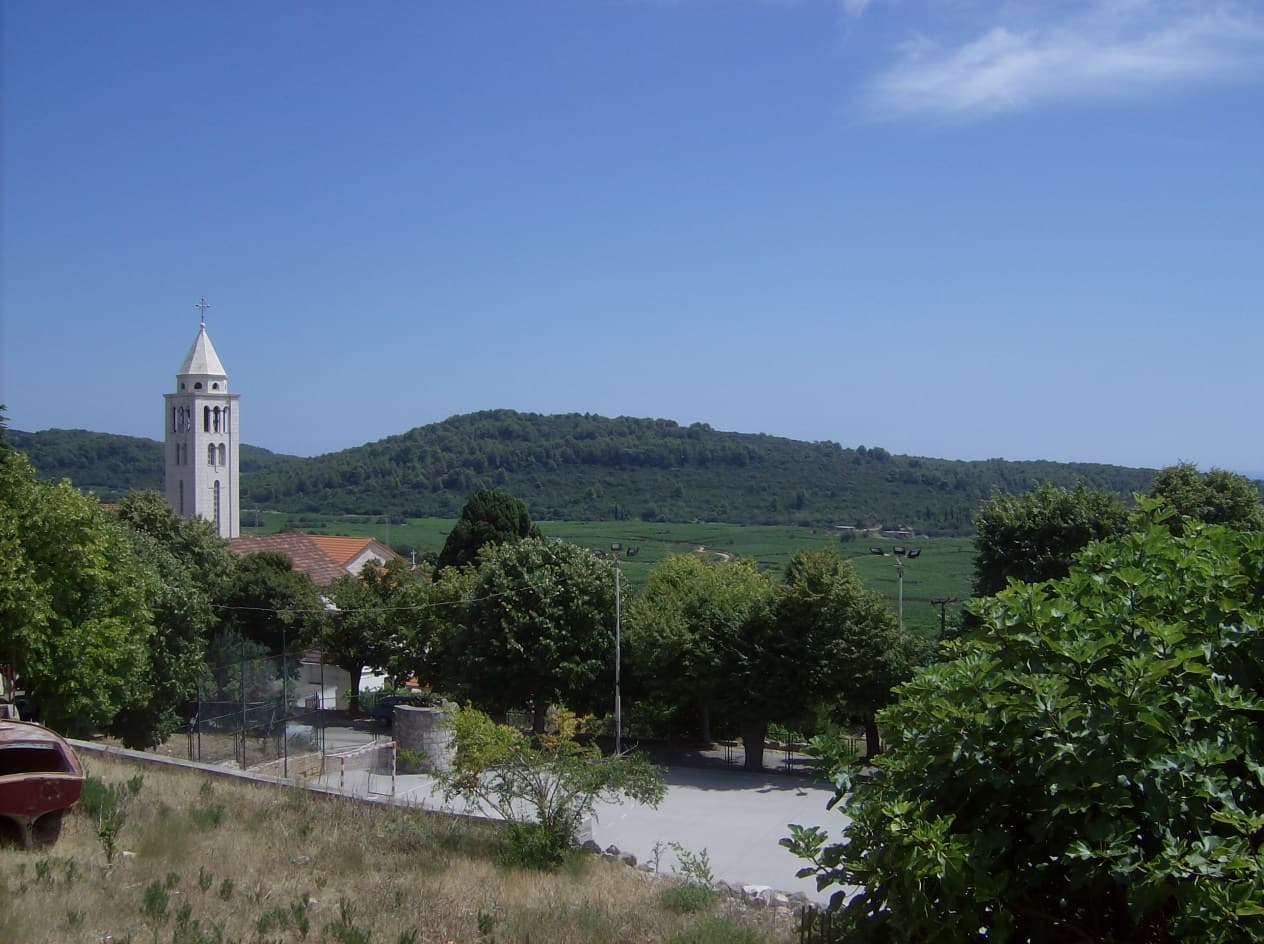
Račišće
About this place
Račišće is a small coastal village on the northern side of Korčula, about 12 kilometres west of Korčula Town, reached by road through Žrnovska Banja, Vrbovica and Kneže. The settlement was founded in the late 17th century by families who had fled the Makarska coast and Herzegovina, and it later developed a strong maritime tradition. The village bay has its own pebbly Račišće beach, suitable for families and accessible by car, while the better-known coves of Vaja and Samograd are reached on foot outside the built-up area. Two churches mark the religious heritage of the village: the older Church of Our Lady of Help and the parish Church of St Nicholas, patron saint of seafarers. The harbour remains the natural focus of Račišće, reinforced by the local “Harbour of Salvation” tradition. Short distances make Kneže and Korčula Town easy companions to a visit while Račišće keeps a quieter, more residential coastal atmosphere.
Račišće was founded in the late 17th century by refugees arriving from the Makarska coast and Herzegovina, setting it apart from Korčula’s older medieval settlements. Its sheltered bay on the island’s northern shore encouraged a maritime way of life, and local history is closely associated with captains and seafarers. The village centre gathers around the harbour and the parish Church of St Nicholas, while the older Church of Our Lady of Help adds another layer of religious heritage. Račišće lies about 12 kilometres by road from Korčula Town, on a route passing Žrnovska Banja, Vrbovica and Kneže. That geography keeps the village well connected to the island’s main town while preserving a clearly distinct coastal identity.
Stays
No stays listed here yet
Things to see
Račišće’s main historical landmarks are closely tied to its two churches and harbour. The older Church of Our Lady of Help recalls the early generations of a settlement founded in the late 17th century, while the parish Church of St Nicholas bears the name of the patron saint of seafarers, fitting the village’s maritime tradition. The harbour is not a monumental attraction, yet it forms the spatial heart of Račišće and is linked by the local tourism board with the “Harbour of Salvation” story. Outside the compact village, Vaja and Samograd provide a natural counterpoint to the religious heritage. Rather than one large sight, Račišće offers a clearly readable connection between churches, harbour, seafaring history and Korčula’s northern shore.
Beaches
Račišće beach lies directly inside the village’s sheltered bay and has a pebbly shoreline, making it the simplest swimming option without a longer walk. The local tourism board specifically describes it as suitable for families with children and notes that it can be reached by car. Outside the village, Vaja and Samograd are the better-known pebble coves associated with the Račišće area, but both require an approach on foot. Vaja and Samograd therefore suit visitors who want to combine swimming with walking, while the village beach is more convenient for a short stop. Together, the three locations show the typical northern Korčula pattern of rocky coast, clear water and small, enclosed bays.
Bathing water quality nearby
- Račišće · 302 mexcellent · season 2025
Source: European Environment Agency (EEA); data from Croatian authorities. · bathing water profile
Things to do
A day in Račišće can begin at the harbour and the Church of St Nicholas, the clearest place to connect the village with its seafaring past. For a swim without leaving the settlement, the pebbly Račišće beach sits directly in the bay and is described by the local tourism board as family-friendly and accessible by car. A more active option is to walk towards Vaja and Samograd, two well-known pebble coves in the Račišće area that require an approach on foot. Back in the village, the older Church of Our Lady of Help provides another short heritage stop. With extra time, the coastal road continues through Kneže, Vrbovica and Žrnovska Banja towards Korčula Town, about 12 kilometres away.
Practical information
Getting there and around
Račišće is connected by road with Korčula Town, about 12 kilometres away, and the local tourism description gives the route as Žrnovska Banja, Vrbovica, Kneže and then Račišće. This coastal road is the village’s main overland connection with the eastern part of the island. Račišće beach in the village can be reached by car, whereas Vaja and Samograd require a walk, so transport choices depend on which beach is planned. The reviewed sources do not provide a verified 2026 bus timetable, so departures and service frequencies are not quoted. For practical trip planning, the dependable reference points are the distance to Korčula Town and the sequence of settlements along the northern coast.
Frequently asked questions
How far is Račišće from Korčula Town?
Račišće is roughly 12 kilometres west of Korčula Town.
Which beaches are well known near Račišće?
Besides Račišće beach in the village bay, the nearby pebble coves of Vaja and Samograd are well known.
Is Račišće beach suitable for children?
Yes. The local tourism board describes it as a calm pebble beach suitable for families with children.
Which saint is the parish church dedicated to?
The parish church is dedicated to St Nicholas, patron saint of seafarers.


Related guides

Dubrovnik
Dubrovnik’s historic centre is organised around Stradun, yet its character changes within a few steps of that main street. At the western end beside Pile stand the Large Onofrio Fountain,…
Read the guide

Help improve this page
Spot something missing or wrong? Suggest a correction, add your photo or report a problem. Editors review every suggestion before it is published.
Photo credits
- Račišće — Quahadi Añtó 10:17, 15 December 2010 (UTC) · CC BY-SA 3.0 · Wikimedia Commons
- Pupnat, Čara, Korčula — Marijan · Public domain · Wikimedia Commons
- Lovište — Quahadi Añtó 17:58, 12 January 2013 (UTC) · CC BY-SA 3.0 · Wikimedia Commons
- Viganj, Kućište, Orebić