
About this place
Drežnik Grad is a rural settlement in the Kordun region, within the Municipality of Rakovica and close to the Korana valley, the D1 road and the Plitvice tourism area. Its defining landmark is not a conventional centre but Old Drežnik Castle, standing on a cliff above the river. Documentary references reach back to the 12th century, and the site later served successively as a Frankopan stronghold, an Ottoman fortress and a Military Frontier post. Those changes remain legible in its layered defensive architecture. The large round tower was restored in 2011, although access to the interior is not always available; the meadow and views over the Korana still make the site worth visiting. Cycling Route 33 passes through the village and uses a gravel interpretive trail to reach the castle, linking Drežnik with Rakovica, Selište Drežničko, Čatrnja, Lipovača and Grabovac. Barać Caves and the Speleon centre lie towards Nova Kršlja, while Plitvice Lakes are roughly ten kilometres southwest. Drežnik Grad consequently makes a quiet base for combining a medieval fortress, karst landscapes, cycling and the national park.
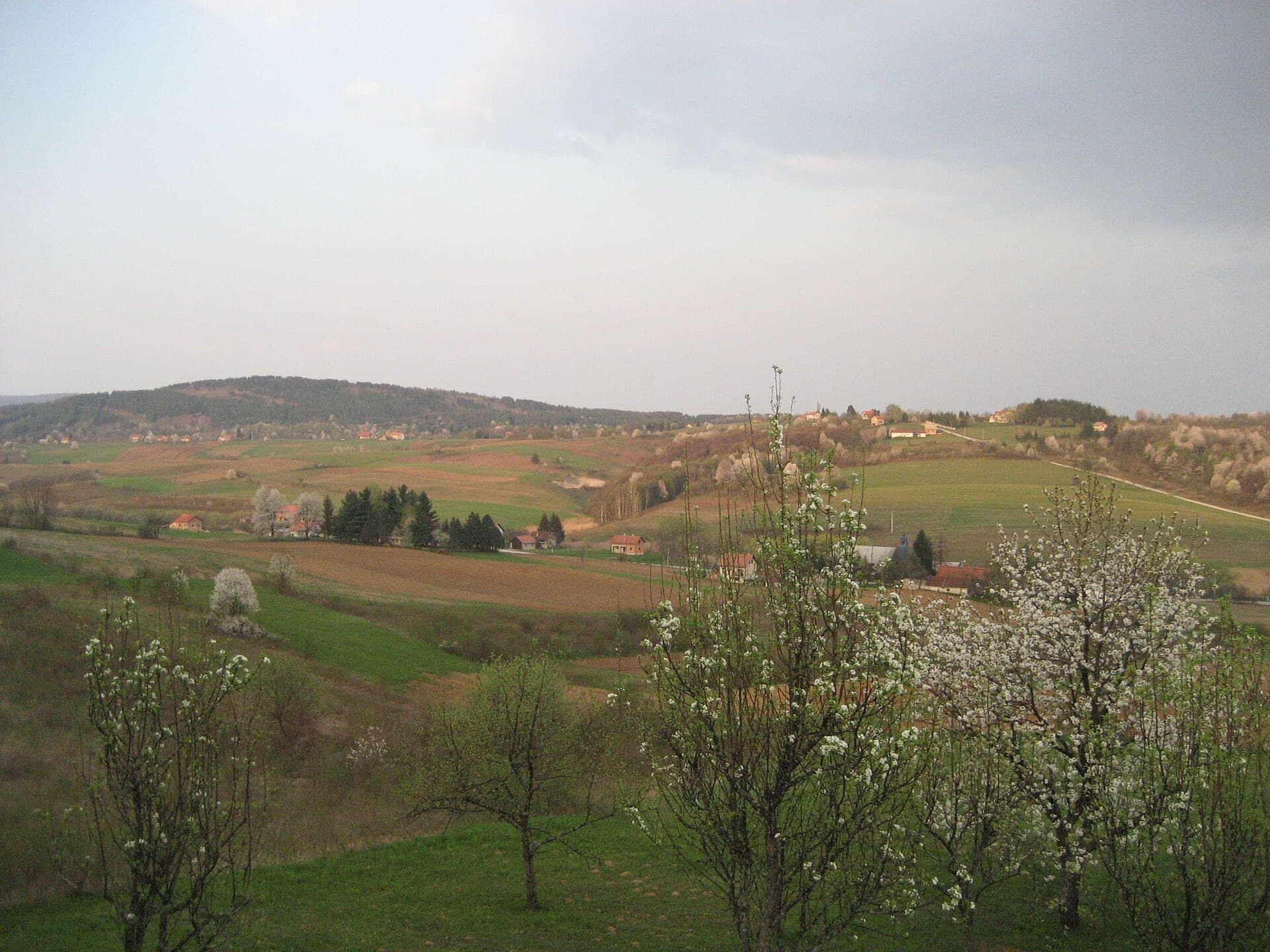
Drežnik Grad belongs to the Municipality of Rakovica and the historic Kordun region, where the Korana long formed part of a contested frontier landscape. The settlement is dispersed among meadows, orchards and houses, while its principal landmark stands apart above the river canyon. Old Drežnik Castle served as a defensive centre through the Frankopan, Ottoman and Military Frontier periods, giving the village a stronger fortress identity than the tourism settlements along the nearby D1. Modern Drežnik forms part of the Plitvice Valleys area, with local cycling and walking routes connecting it to Rakovica, Grabovac, Barać Caves and Plitvice Lakes. Its scattered layout and lack of a compact centre mean that individual sights are reached along local roads rather than through a single pedestrian core.
Stays
No stays listed here yet
Things to see
Old Drežnik Castle is the Municipality of Rakovica’s most important archaeological and architectural site. Sources mention Drežnik in the 12th century, while its round keep is characteristic of 15th- and 16th-century defensive architecture. The Ottomans controlled the fortress from 1592 until 1788, after which it was adapted as a Military Frontier post. The imperial treasury sold it in 1866, and the Croatian Parliament placed its remains in the care of the Drežnik municipality in 1917. The large tower was restored in 2011, with further conservation addressing walls and roofing. For visitors, the most memorable feature is the combination of the massive circular tower, the open grassy plateau and the dramatic position above the Korana.
Things to do
Start the morning on the meadow outside Old Drežnik Castle, where the cliff edge overlooks the Korana and the surrounding woodland. The exterior walls and round tower can be explored without a lengthy visit, leaving time to walk or cycle part of Route 33, which approaches the fortress along a gravel interpretive trail. In the afternoon, continue towards Nova Kršlja for a guided visit to Barać Caves, following a lit path past stalactites and other formations; the nearby Speleon centre interprets the wider underground landscape. If Plitvice Lakes follows on the same day, reserve an entrance and time slot in advance and allow for the drive towards the park entrances at Rastovača or Jezera.
Food and drink
Drežnik Grad has no large cluster of restaurants, so most dining options are found along the D1 in Selište Drežničko and Grabovac. Restaurant Degenija in Selište Drežničko serves Gacka trout, its signature veal steak with mushroom sauce and homemade gnocchi, and pizzas from a wood-fired oven. Veal cooked under a peka bell, spit-roasted lamb and suckling pig are offered seasonally or by advance arrangement. Its roadside position makes it a practical stop after Plitvice Lakes or Old Drežnik Castle. A peka meal should be reserved ahead because of the preparation involved, while opening hours are best checked for the actual day of the visit.
Practical information
Practical information
Tourist information for Drežnik Grad is provided by the Plitvice Valleys destination office in Rakovica. Because the village is dispersed, a car or bicycle is the most practical way to link the castle, accommodation and services along the D1. The meadow outside the fortress can still be visited when the tower interior is closed, although access conditions should be checked because conservation is ongoing. Barać Caves are visited with a guide, and the underground temperature calls for an extra layer even in summer. Tickets for Plitvice Lakes should be matched to a specific entrance and admission time, particularly during the busiest months.
Getting there and around
The most practical approach to Drežnik Grad branches from the D1 near Grabovac or Selište Drežničko. Local roads connect the village with Rakovica, Lipovača and Nova Kršlja, home to Barać Caves; official directions from Plitvice lead through Grabovac and a turn before reaching Drežnik Grad. Cycling Route 33 links Rakovica, Jelov Klanac, Selište Drežničko, Čatrnja, Drežnik Grad, Lipovača and Grabovac, using a gravel interpretive trail for the final approach to the fortress. Public transport does not function as a frequent local sightseeing network, so accommodation away from the D1 is best combined with a private vehicle, bicycle or arranged taxi.
Frequently asked questions
Can visitors enter the tower at Old Drežnik Castle?
Interior access depends on conservation work; the official local listing for 2025 stated that the tower was closed, while the meadow and exterior viewpoint remained accessible.
When was the main tower restored?
The main tower at Old Drežnik Castle was restored in late 2011.
Does a cycling route pass through Drežnik Grad?
Yes. Route 33 passes through Drežnik Grad and approaches the castle along a gravel interpretive trail.
How do you reach Barać Caves from Drežnik?
From Drežnik Grad, drive towards Lipovača and Nova Kršlja and follow the signs for Barać Caves.


Related guides

Senj
Senj occupies a narrow strip between the sea and the Velebit foothills, so its streets climb quickly from the harbour towards Nehaj Fortress. The Uskoks, the fierce bura wind, seafaring and…
Read the guide
Help improve this page
Spot something missing or wrong? Suggest a correction, add your photo or report a problem. Editors review every suggestion before it is published.
Photo credits
- Drežnik Grad — David Franjković · CC BY-SA 3.0 · Wikimedia Commons
- Smoljanac — ANDREJ NEUHERZ · CC BY-SA 3.0 · Wikimedia Commons
- Čatrnja — Erik van Luxzenburg · CC BY-SA 3.0 · Wikimedia Commons
- Grabovac — INSAR · Public domain · Wikimedia Commons
- Senj


