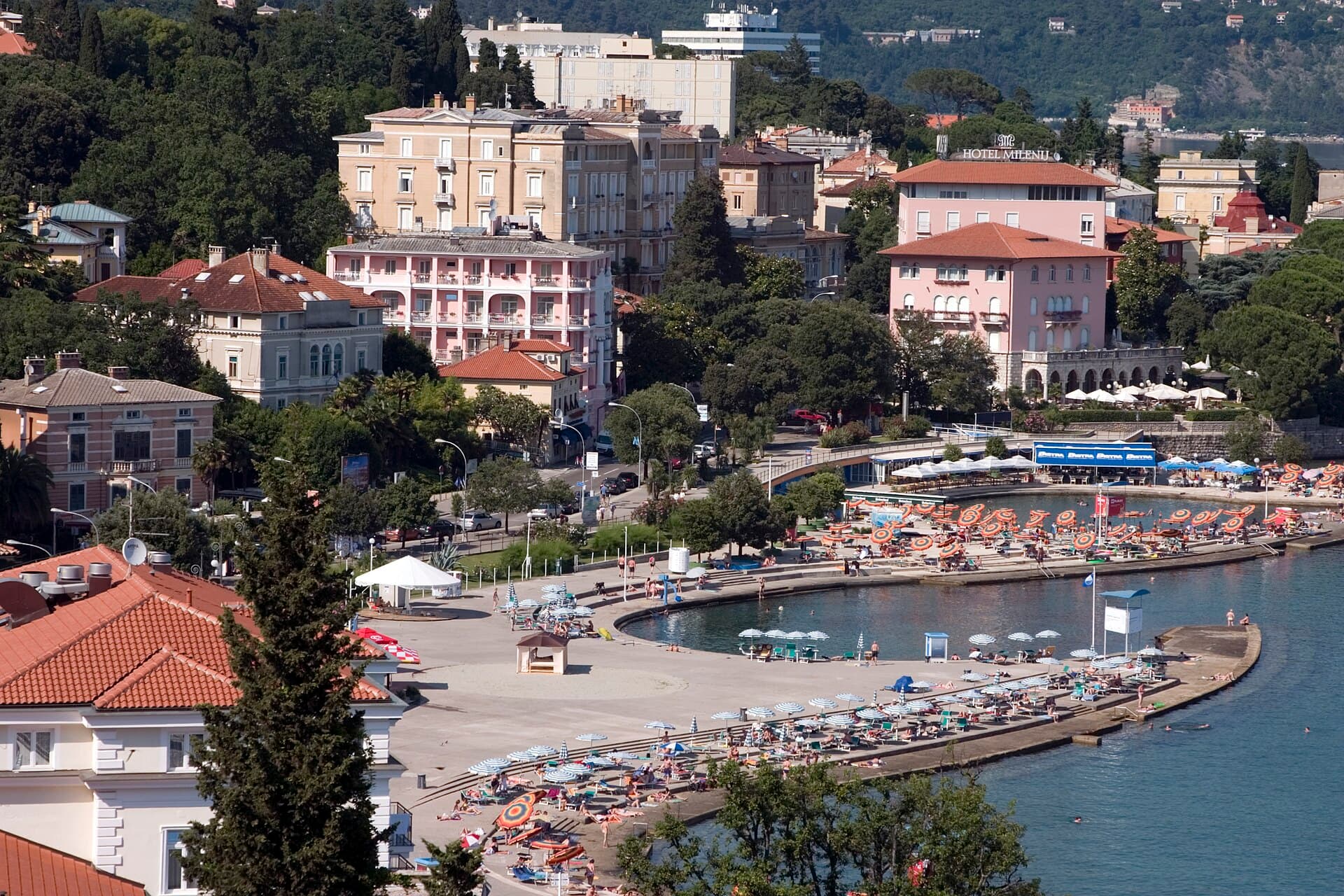
About this place
Viškovo is the busy centre of Halubje, spread across the hills behind Rijeka roughly ten kilometres from both central Rijeka and Opatija. The municipality covers about 20 square kilometres, while its civic life follows the main road lined with the municipal offices, post office, school, library, healthcare facilities and St Matthew’s Church. Its defining tradition belongs to the Halubje Bell Ringers, whose carnival procession forms part of UNESCO’s intangible heritage, alongside the region’s distinctive two-part singing in close intervals. Their story is presented at the House of the Halubje Bell Ringers, a contemporary interpretation centre near the village centre. Viškovo has no coastline of its own; its outdoor landmarks are the Plešivac and Milohni trails, woodland tracks, old communal cisterns and the Kapitovac pond. Southern Marinići was traditionally called Smokvarija because its warmer ground favoured figs, while Marčelji rises above 400 metres. What makes a visit unusual is the overlap between Rijeka’s expanding suburban belt and the villages still crossed by bell ringers during the annual carnival round.
Viškovo is not a seaside resort but Rijeka’s hilly hinterland, shaped by the villages of Halubje, newer residential districts and a powerful carnival tradition. It became the administrative centre of a municipality created on 15 April 1993 by joining the Viškovo and Marinići areas. The southern neighbourhoods almost merge with Rijeka’s Pehlin, Škurinje and Zamet districts, whereas northern Marčelji stands above 400 metres. The bell on the municipal coat of arms represents the Halubje Bell Ringers, and their procession together with local two-part singing links Viškovo to two traditions inscribed on UNESCO’s intangible heritage lists.
Stays nearby
 Apartment
Apartmeni Klenovica.eu
Klenovica
48 km from Viškovo
up to 4 guests · 1 bedroom
The host confirms the exact price for your dates and availability.
Things to see
The House of the Halubje Bell Ringers is Viškovo’s principal visitor attraction, interpreting the masks, bells and procession that define Halubje. In Ronjgi, the Ivan Matetić Ronjgov Memorial Centre occupies the composer’s birthplace and explores the musical heritage of Kvarner and Istria. Older and quieter traces of village life survive in local communal cisterns, at Kapitovac pond and beside the walled pond near Milohni. St Matthew’s Church anchors the settlement centre, while the exposed rock and woodland around Lončeva griža and Plešivac reveal a very different Viškovo beyond its densely developed main road.
Things to do
Begin at the House of the Halubje Bell Ringers, where the village procession is interpreted beyond the brief carnival season. Continue through the centre to St Matthew’s Church and a nearby communal cistern around 250 years old, associated with a local story about Empress Maria Theresa’s journey. Spend the afternoon in Ronjgi at the birthplace of composer Ivan Matetić Ronjgov, whose work is inseparable from the music of Istria and Kvarner. Finish on the Plešivac walking trail or follow the Bell Ringers cycling circuit through Breg, Bezjaki, Marinići, Ronjgi, Marčelji and neighbouring Kastav.
Food and drink
Dining in Viškovo ranges from Halubje comfort food to notably ambitious contemporary cooking. Restaurant Ronjgi, in Ivan Matetić Ronjgov’s native village, makes a natural lunch stop after the composer’s memorial centre and serves dishes influenced by both local and Mediterranean kitchens. J-I-S-T occupies an old stone house in Široli and specialises in dry-aged steaks, including certified Japanese Kobe beef, while also using Kvarner ingredients such as scampi and cheese from Grobnik. Restaurant Zvončar sits inside the House of the Halubje Bell Ringers, allowing visitors to combine lunch with the exhibition on the area’s signature carnival tradition.
Practical information
Practical information
The Viškovo Tourist Board is at Viškovo 31, on the settlement’s main axis alongside the post office, pharmacies, healthcare services, banks and fuel stations. Because the municipality is dispersed across separate locations such as Ronjgi, Marčelji and Milohni, a car or bicycle makes it easier to combine cultural sites with the walking trails. A GPX file is available for the Bell Ringers route, while HALUbike terminals stand at Milihovo and Ronjgi. Visitors should distinguish the year-round interpretation of the bell-ringer tradition from the procession itself, which takes place only during the local carnival period.
Getting there and around
Viškovo lies roughly ten kilometres from Rijeka and is served by Rijeka’s Autotrolej bus network. Municipal documentation lists route 11 via Drenova, routes 18 and 18B via Kastav, and routes 19, 20 and 21 linking Rijeka with Viškovo and settlements towards Klana, Studena, Brnčići and Kudeji. School services 11Š and 17 operate under a separate timetable. For shorter journeys across the hilly municipality, the HALUbike scheme provides both electric and mountain bicycles at its Milihovo and Ronjgi terminals, although the gradients and dispersed villages reward some advance route planning.
Frequently asked questions
Does Viškovo have its own beach?
Viškovo has no coastline of its own; swimming requires a trip towards Rijeka, Opatija or the Rijeka Riviera.
Where does the Bell Ringers route begin?
The circular cycling route begins at Breg in Viškovo, the traditional finishing point of the bell ringers’ procession.
What can visitors see in Ronjgi?
Ronjgi is home to composer Ivan Matetić Ronjgov’s birthplace and memorial centre, as well as a HALUbike terminal.
Which bus links Rijeka and Viškovo via Drenova?
The municipal transport document lists Autotrolej route 11 from Rijeka through Drenova, Garići and Mladenići to Viškovo.
Related guides
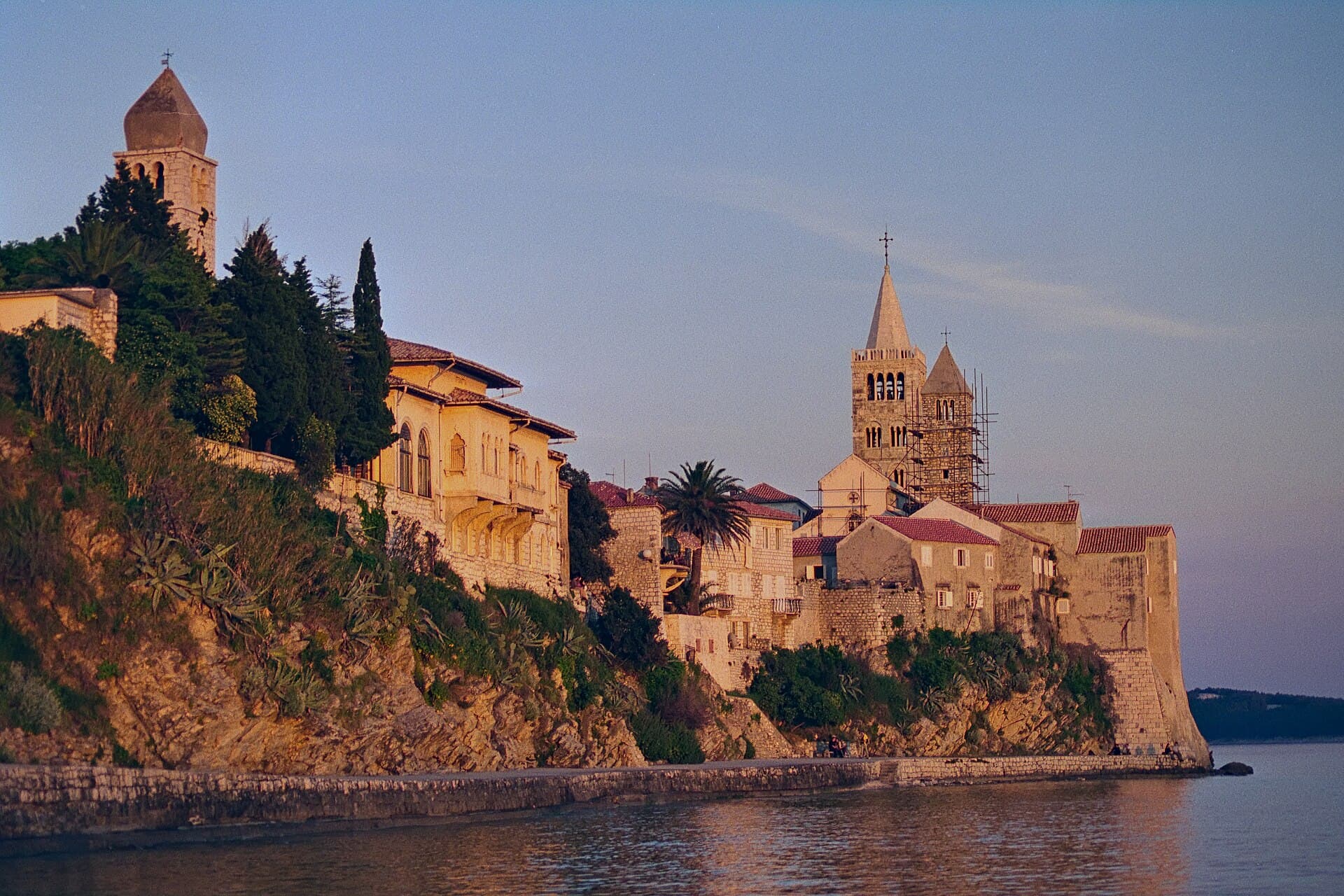
Rab
Rab's old town has a clear silhouette, but it rewards more than a postcard view. Its four towers mark distinct religious sites: the Assumption of Mary, St John the Evangelist, St Andrew and…
Read the guide
Help improve this page
Spot something missing or wrong? Suggest a correction, add your photo or report a problem. Editors review every suggestion before it is published.
Photo credits
- Viškovo — Roberta F. · CC BY-SA 3.0 · Wikimedia Commons
- Kastav — Modzzak · CC BY-SA 3.0 · Wikimedia Commons
- Apartmeni Klenovica.eu — Apartmani Klenovica.eu · courtesy of the property owner
- Rab — Herbert Ortner · CC BY 4.0 · Wikimedia Commons
- Mali Lošinj — K. Korlevic · Public domain · Wikimedia Commons
- Opatija — Jimmy Harris · CC BY 2.0