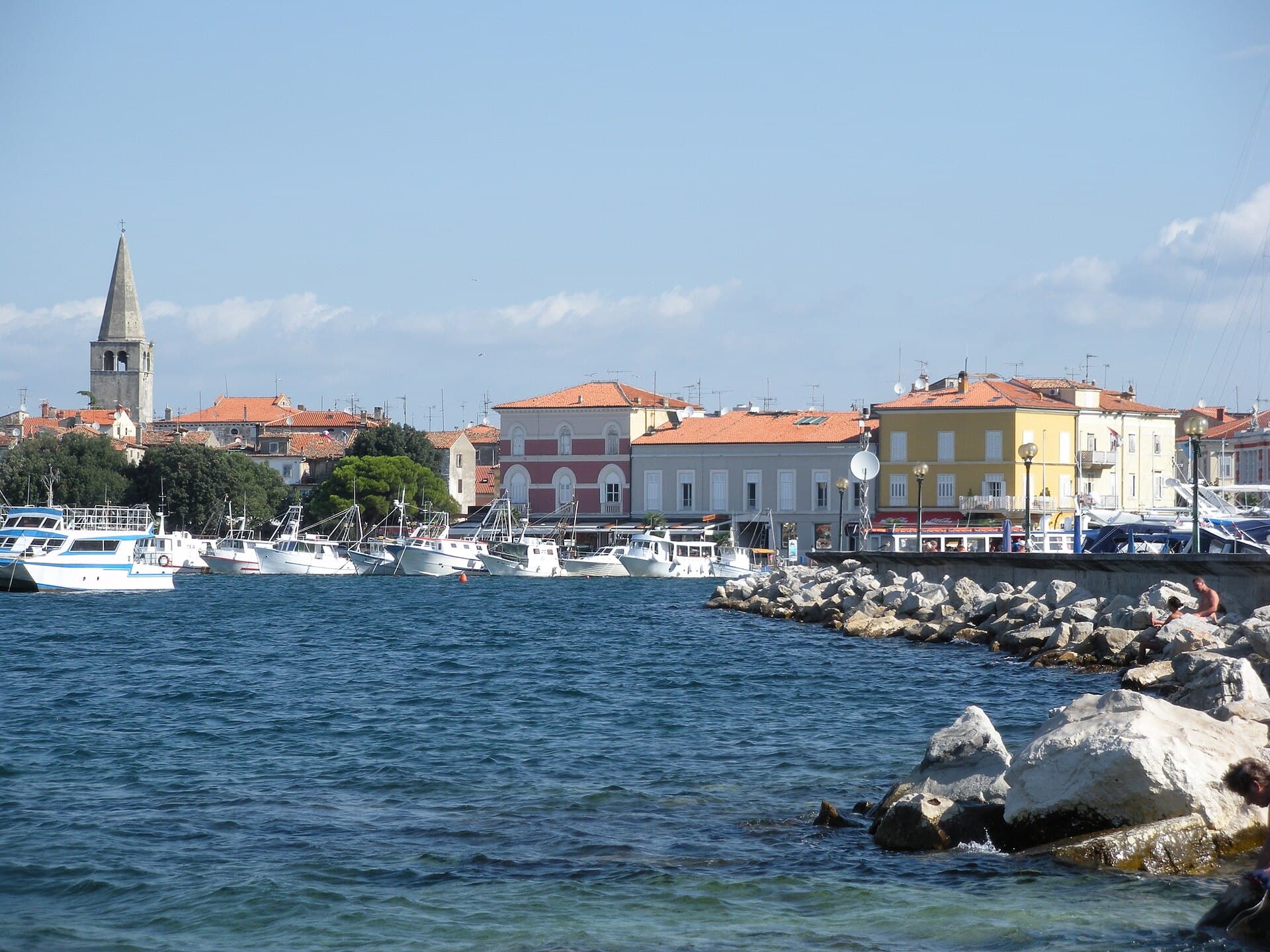
About this place
Krnica sits above Istria’s quiet eastern shore, with its historic link to the sea running down to Krnički Porat. This deeply sheltered inlet once connected the surrounding villages with trading routes across the northern Adriatic; fishing boats and small craft now line the waterfront where merchant vessels formerly sought refuge. The village consequently offers two contrasting settings: stone-built rural streets on higher ground and a secluded maritime landscape below. A white track follows the northern side of the inlet to pocket-sized pebble beaches, while snorkellers can explore boulders, shoals of small fish and traces of earlier seafaring, including fragments of Roman amphorae. Luka Krnica, the local maintained beach, is reached from the village by a paved road, and walkers can continue to quieter coves beyond it. Food also reflects Krnica’s position between countryside and coast: Konoba Da Rocco serves Istrian and Mediterranean dishes in the village, while PortoRiko stands directly on the harbour where local fishermen land fish and Kvarner scampi.
Krnica is a village in the Municipality of Marčana, with Krnički Porat counted among the localities within its area. Its identity is closely tied to the inlet below the village: it reaches far inland, is sheltered from both the southerly wind and bora, and remains a mooring place for fishing boats and small craft. A white track along the harbour’s northern shore leads to a small pebble cove, giving Krnica a direct maritime counterpart to its quieter inland village core.
Stays
No stays listed here yet
Beaches
Luka Krnica is officially listed as a maintained local beach of pebbles and rock, reached from Krnica by a paved road. A white track along the harbour’s northern shore links several smaller bathing spots; at its far end is a tiny pebble cove with benches and shade for only a limited number of visitors. The underwater landscape is particularly rewarding around the first two coves: fine stones in the shallows change into large boulders before the bottom becomes sandy farther out. The sheltered inlet suits unhurried snorkelling, although these compact beaches offer neither the capacity nor the facilities associated with Istria’s larger resort beaches.
Things to do
Begin in upper Krnica, then follow the road downhill to the waterfront at Krnički Porat, where fishermen land fish and Kvarner scampi. On the inlet’s northern side, a short walk along a white track reaches a small pebble cove with benches and limited natural shade. This is the place to use a mask and snorkel: fine stones in the shallows give way to larger boulders descending towards the sandy floor of the bay. After swimming, return to the harbour for seafood at PortoRiko, or end the day back in the village at Da Rocco, whose listed specialities include cuttlefish brodet with polenta and lamb flavoured with Istrian herbs.
Food and drink
Da Rocco, at Krnica 11 b, concentrates on Istrian and Mediterranean cooking; listed specialities include cuttlefish brodet and scampi with polenta, plus lamb prepared with local aromatic herbs. It accepts Visa, Mastercard and Maestro, seats 30 indoors and 50 outside, and welcomes dogs. PortoRiko provides a distinctly maritime alternative on the waterfront at Krnički Porat. The family establishment began in 1968 under the name K ribaru, and its cooking now revolves around fish, squid, shellfish, seafood pasta and Kvarner scampi landed by fishermen beside the restaurant. The two addresses neatly divide a meal in Krnica between village-style Istrian cooking and the working harbour’s daily catch.
Practical information
Getting there and around
Krnica village and its shoreline sit at different elevations: a paved road descends from the settlement to Luka Krnica and the harbour. For the final stretch along the inlet’s northern edge, driving gives way to walking on a white track, as the small coves lie a few minutes beyond the waterfront. This layout favours visitors arriving by car but makes the uphill return to the village worth planning. Krnički Porat is now used by fishing vessels and small private boats rather than scheduled passenger services. Travellers combining a swim with a meal can leave their vehicle by the harbour and explore both the bathing spots and the waterfront restaurants on foot.
Frequently asked questions
Where is the best snorkelling in Krnica?
The described snorkelling area runs from the small cove past the first and second beaches on the northern shore of Krnički Porat.
What is Luka Krnica beach like?
Luka Krnica is a maintained local beach with pebble and rocky sections, reached by a paved road from the village.
Where can I eat seafood by the water in Krnica?
PortoRiko sits directly on the Krnički Porat waterfront and serves fish, shellfish, squid and Kvarner scampi.
Does Da Rocco accept cards?
Da Rocco lists Visa, Mastercard and Maestro alongside cash payments.
Related guides

Novigrad
Novigrad-Cittanova developed on Istria’s north-western coast near the mouth of the Mirna, in a maritime setting that shaped centuries of fishing and trade. The historic centre still…
Read the guide
Help improve this page
Spot something missing or wrong? Suggest a correction, add your photo or report a problem. Editors review every suggestion before it is published.
Photo credits
- Krnica, Marčana — gabberzon · CC BY 3.0 · Wikimedia Commons
- Rakalj — Nobility of Europe · CC BY-SA 4.0 · Wikimedia Commons
- Novigrad — Sl-Ziga · Public domain · Wikimedia Commons
- Pula — Orlovic · CC BY-SA 3.0 · Wikimedia Commons
- Funtana — Tanya Dedyukhina · CC BY 3.0 · Wikimedia Commons