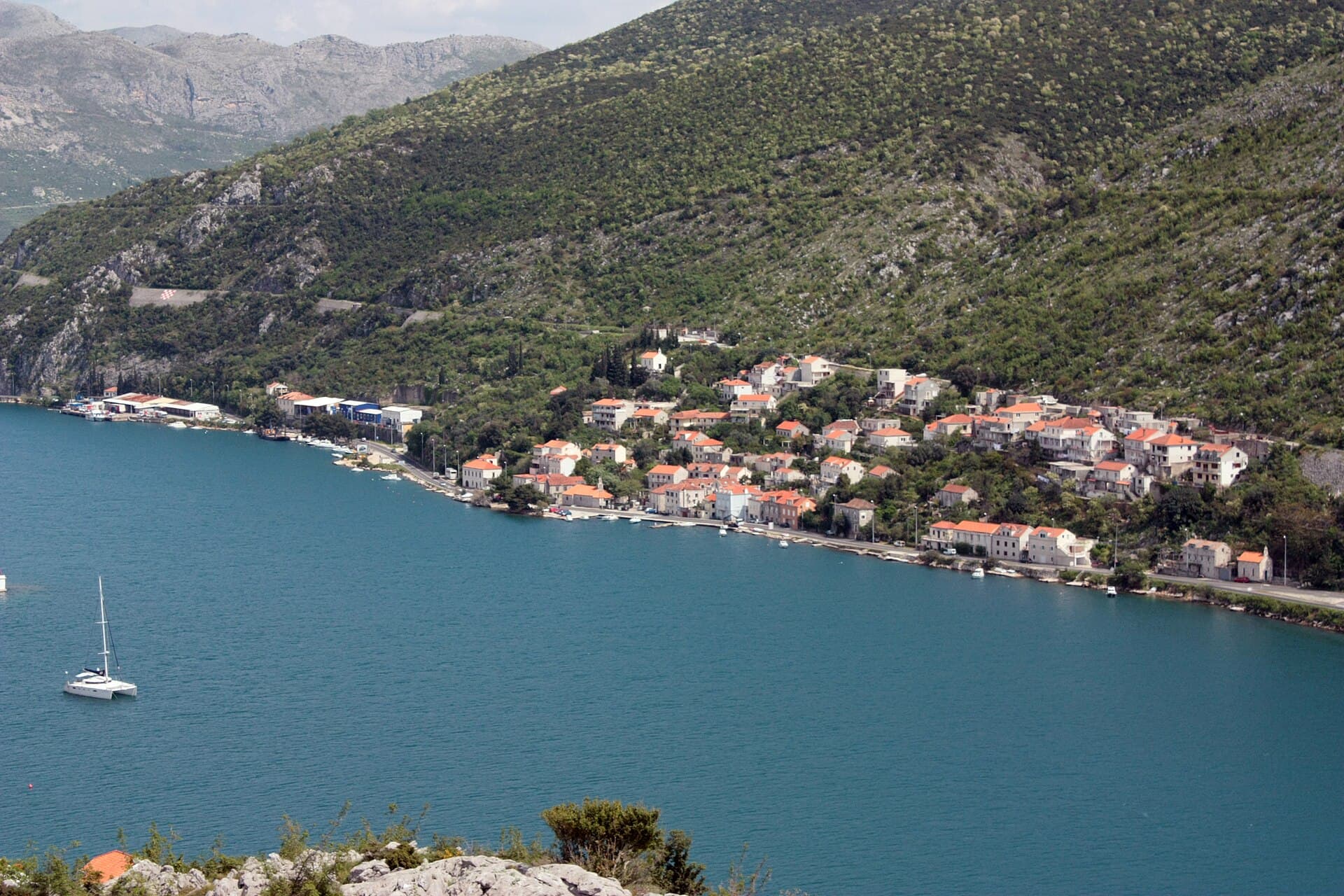
Nova Mokošica
About this place
Nova Mokošica is a large residential district on the northern shore of the Ombla estuary, west of central Dubrovnik. Unlike the Renaissance summer residences of old Mokošica, its defining layer is the group of apartment blocks developed from 1979, when construction of the new settlement began. Its position above the deep, fjord-like inlet brings views towards Sustjepan, Komolac and the Franjo Tuđman Bridge, while the nearby Ombla spring offers a short excursion to Dubrovnik’s principal drinking-water source. Local bathing places along the Mokošica shore include Ispod bora and ex-Ambulanta, whereas the district’s historic story is clearest at the Gučetić-Đurđević summer residence, where Dubrovnik nobles held their final council in 1814. Nova Mokošica works primarily as a quieter residential base: city bus 1B connects it directly with Pile, the main gateway to Dubrovnik’s historic centre. The district contains the Holy Family parish, while greater Mokošica has a primary school and two kindergartens. Staying here reveals Dubrovnik’s everyday, non-resort rhythm, with the Ombla waterfront, neighbourhood shops and straightforward bus access to the city walls.
Nova Mokošica belongs to greater Dubrovnik, yet its physical setting is the Rijeka Dubrovačka—the Ombla estuary—rather than the open sea beneath the city walls. Planning documents date the new district’s development to 1979 and describe an apartment-building settlement averaging ground floor plus eight storeys, in contrast with the lower family houses of old Mokošica. The name Mokošica is associated with Mokoš, the Slavic goddess of fertility and protector of women. Everyday services cluster among the residential blocks, while the older landscape of aristocratic summer houses and gardens descends closer to the Rijeka Dubrovačka waterfront.
Stays
No stays listed here yet
Beaches
Nova Mokošica’s swimming places are not broad, serviced beaches on the open Adriatic but small neighbourhood access points within sheltered Rijeka Dubrovačka. Dubrovnik City identifies Ispod bora and ex-Ambulanta among the Mokošica sites it has improved, including work on waterfront platforms and approaches to the water. Bathing here takes place in an estuary influenced by both the freshwater Ombla and the sea; the city’s landscape study therefore classifies these waters as transitional or brackish. For a conventional pebble beach with visitor facilities, travellers should continue towards Zaton, Lapad or other Dubrovnik bathing areas; the Mokošica shore is better suited to a quick local swim.
Bathing water quality nearby
- Stara Mokošica · 1.6 kmnot classified · season 2025
Source: European Environment Agency (EEA); data from Croatian authorities. · bathing water profile
Things to do
Walk down from Nova Mokošica to the Rijeka Dubrovačka waterfront, where traces of the Renaissance country-estate landscape face the later apartment blocks. Make the Gučetić-Đurđević summer residence the historical focus; Dubrovnik’s nobility held its final council there in 1814. For a natural continuation, head towards Komolac and the Ombla spring, Dubrovnik’s principal drinking-water source and an estuary used by resident and migratory birds. The second half of the day can be given to the Old Town: bus 1B runs from Nova Mokošica towards Pile, reaching the western gateway to the historic centre without the difficulty of finding central Dubrovnik parking.
Practical information
Getting there and around
Libertas city route 1B officially links Pile with Nova Mokošica, making the bus the most practical way to reach Dubrovnik’s historic centre. Its route runs through Lozica, across the Franjo Tuđman Bridge and via Nuncijata and Ilijina glavica, although special traffic measures occasionally alter the city-centre terminus. Route 1A serves neighbouring Mokošica, while route 1E connects the wider district with the general hospital. Passengers should distinguish Nova Mokošica from the final section serving old Mokošica when checking their direction. Current departure times are published by Libertas, which also operates a ticket counter in Mokošica.
Frequently asked questions
Which bus runs from Nova Mokošica to Pile?
City route 1B connects Nova Mokošica with Pile; current departures are published by Libertas Dubrovnik.
Where are Mokošica’s local swimming spots?
Dubrovnik City identifies Ispod bora and ex-Ambulanta among the local swimming places on the Mokošica waterfront.
When was Nova Mokošica developed?
A Dubrovnik planning document dates the beginning of the new residential district’s construction to 1979.


Related guides

Dubrovnik
Dubrovnik’s historic centre is organised around Stradun, yet its character changes within a few steps of that main street. At the western end beside Pile stand the Large Onofrio Fountain,…
Read the guide

Help improve this page
Spot something missing or wrong? Suggest a correction, add your photo or report a problem. Editors review every suggestion before it is published.
Photo credits
- Nova Mokošica, Gornje Obuljeno, Donje Obuljeno, Sustjepan, Čajkovica — Bracodbk · CC BY-SA 3.0 · Wikimedia Commons
- Prijevor, Komolac — August Dominus · CC BY-SA 3.0 · Wikimedia Commons
- Rožat