Kupari
About this place
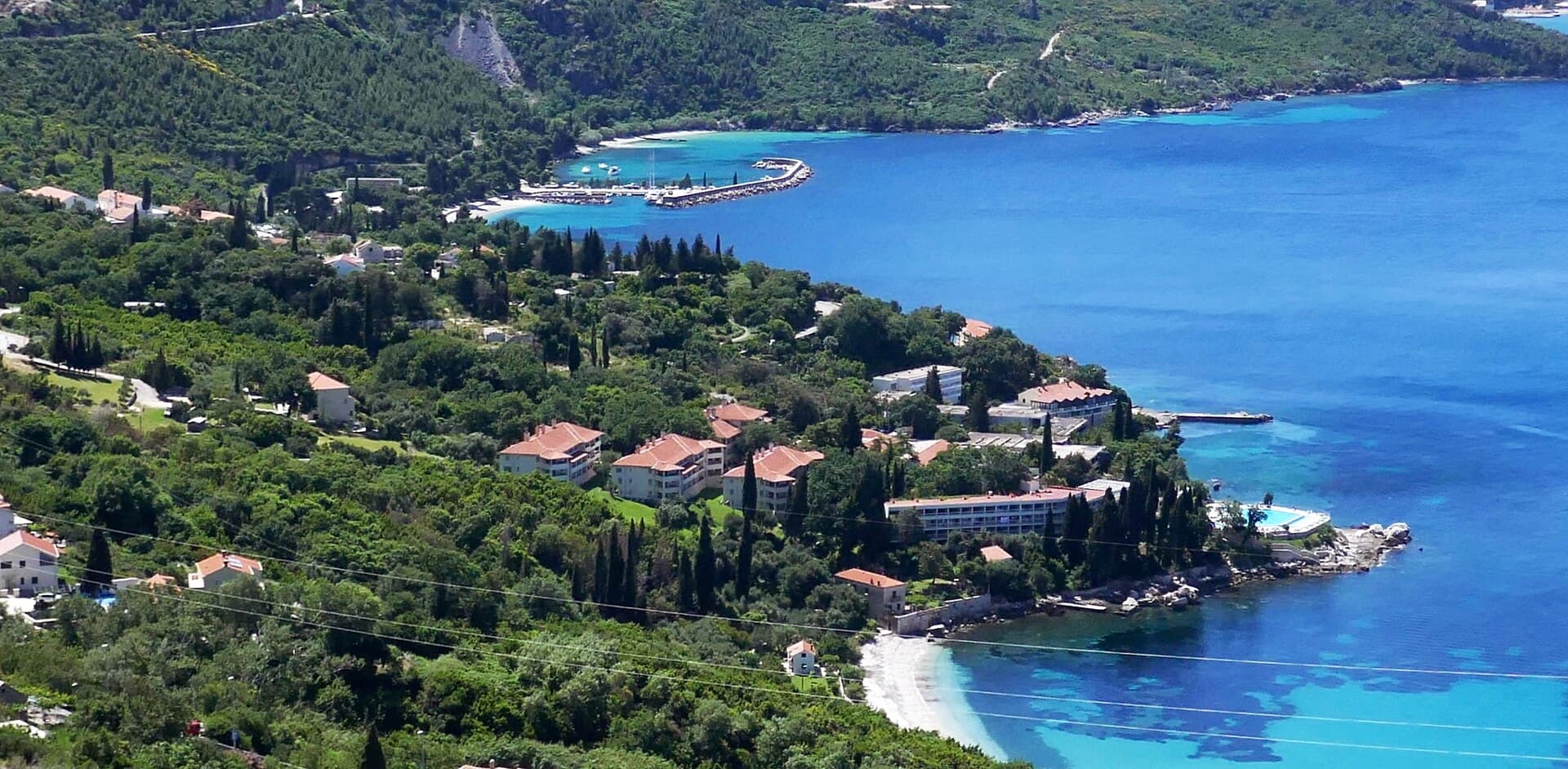
Kupari occupies a deep bay in Župa dubrovačka between Dubrovnik and Cavtat. Its name recalls the production of kupe, traditional roof tiles: the Republic of Ragusa supervised a local works with twelve kilns and controlled the pricing, transport and sale of its output. Kupari tiles were in particular demand during reconstruction after Dubrovnik’s devastating 1667 earthquake. Tourism arrived with the Grand Hotel, completed with Czech investment in 1920, and the bay later gained landscaped parks, promenades and a substantial resort complex. The surviving former hotel buildings now give the beach a striking and unconventional backdrop. Older landmarks rise above the water: St Stephen’s Church is recorded in 1279, while the 16th-century Church of St Peter occupies the top of Trapit with a view across Župa Bay. Kupari is 11 kilometres from Dubrovnik’s Old Town and 16 kilometres from the international airport at Čilipi.
Kupari was not created solely as a Dubrovnik beach resort: before the landscaped hotel grounds, its bay was an industrial site known for clay, bricks and roof tiles. Clay extraction formed the Kupari pit, while the documented twelve kilns reveal the scale of the former works. Twentieth-century tourism reshaped the shore again, beginning with the Grand in 1920 and followed after the Second World War by the Pelegrin, Goričina and Kupari developments. An earlier layer survives at Goričina between Kupari and Srebreno, where fragments of amphorae, pottery and Roman coins point to an ancient settlement and harbour.
Stays nearby
 Apartment
Apartmeni Klenovica.eu
Klenovica
Klenovica, 390 km from Kupari
up to 4 guests · 1 bedroom
The host confirms the exact price for your dates and availability.
Things to see
Beaches
Kupari’s principal beach follows the sheltered, horseshoe-shaped bay in front of the former resort. The immediate meeting of shoreline, old hotel façades and mature greenery distinguishes it from the more developed bathing areas in neighbouring Mlini and Srebreno. Government documentation for Kupari confirms that the hotels were built very close to the water with direct beach access, while the local tourist board links the landscaping of beaches and promenades to tourism’s growth after the Grand opened in 1920. A longer seaside walk can continue towards Srebreno and its extended pebble beach within the same Župa Bay coastal strip.
Bathing water quality nearby
- Hotel Cavtat · 248 mnot classified · season 2025
- Kupalište VK Cavtat · 352 mexcellent · season 2025
- Ht. Croatia · 631 mexcellent · season 2025
- Ht. Albatros · 712 mexcellent · season 2025
- Ht. Supetar · 716 mexcellent · season 2025
- Ht. Epidaurus · 948 mexcellent · season 2025
Things to do
Start along the shore of Kupari Bay, where the beach, Mediterranean greenery and façades of the former resort appear in a single view. Then climb to the Church of St Peter on Trapit; its elevated position reveals a panorama of Župa Bay that is hidden at water level. A second historical stop is St Stephen’s Church, with its confraternity cemetery and stone crosses dating from the 15th to the 17th centuries. Extend the walk towards neighbouring Srebreno and Goričina, the area associated with finds from a former Roman harbour, before returning to Kupari Bay for a swim.
Practical information
Getting there and around
Kupari lies on the corridor between Dubrovnik and Cavtat, about 11 kilometres from Dubrovnik’s Old Town and 16 kilometres from Dubrovnik Airport at Čilipi. Libertas suburban route 10 links Dubrovnik and Cavtat through the settlements of Župa dubrovačka; its active 2026 timetable provides numerous daily departures in both directions. Contactless card payment was introduced on all route 10 buses in 2024. Drivers approach along the main road through Župa, while local roads and the bay-side walking route provide the onward connection between Kupari and Srebreno.
Frequently asked questions
When did Kupari’s first hotel open?
The Grand Hotel was completed in 1920, marking the beginning of Kupari’s organised development as a resort.
Which bus links Kupari and Dubrovnik?
Kupari is served along Libertas route 10 between Dubrovnik and Cavtat; consult the active 2026 timetable before travelling.
Where does the name Kupari come from?
The name is associated with kuparice, workers at the factory whose twelve kilns produced traditional roof tiles known locally as kupe.


Related guides

Dubrovnik
Dubrovnik’s historic centre is organised around Stradun, yet its character changes within a few steps of that main street. At the western end beside Pile stand the Large Onofrio Fountain,…
Read the guide

Help improve this page
Spot something missing or wrong? Suggest a correction, add your photo or report a problem. Editors review every suggestion before it is published.
Photo credits
- Kupari — Gzzz · CC BY-SA 4.0 · Wikimedia Commons
- Cavtat, Zvekovica — Bracodbk · CC BY-SA 3.0 · Wikimedia Commons
- Plat, Župa dubrovačka, Soline, Župa dubrovačka, Župa dubrovačka, Zavrelje