About this place
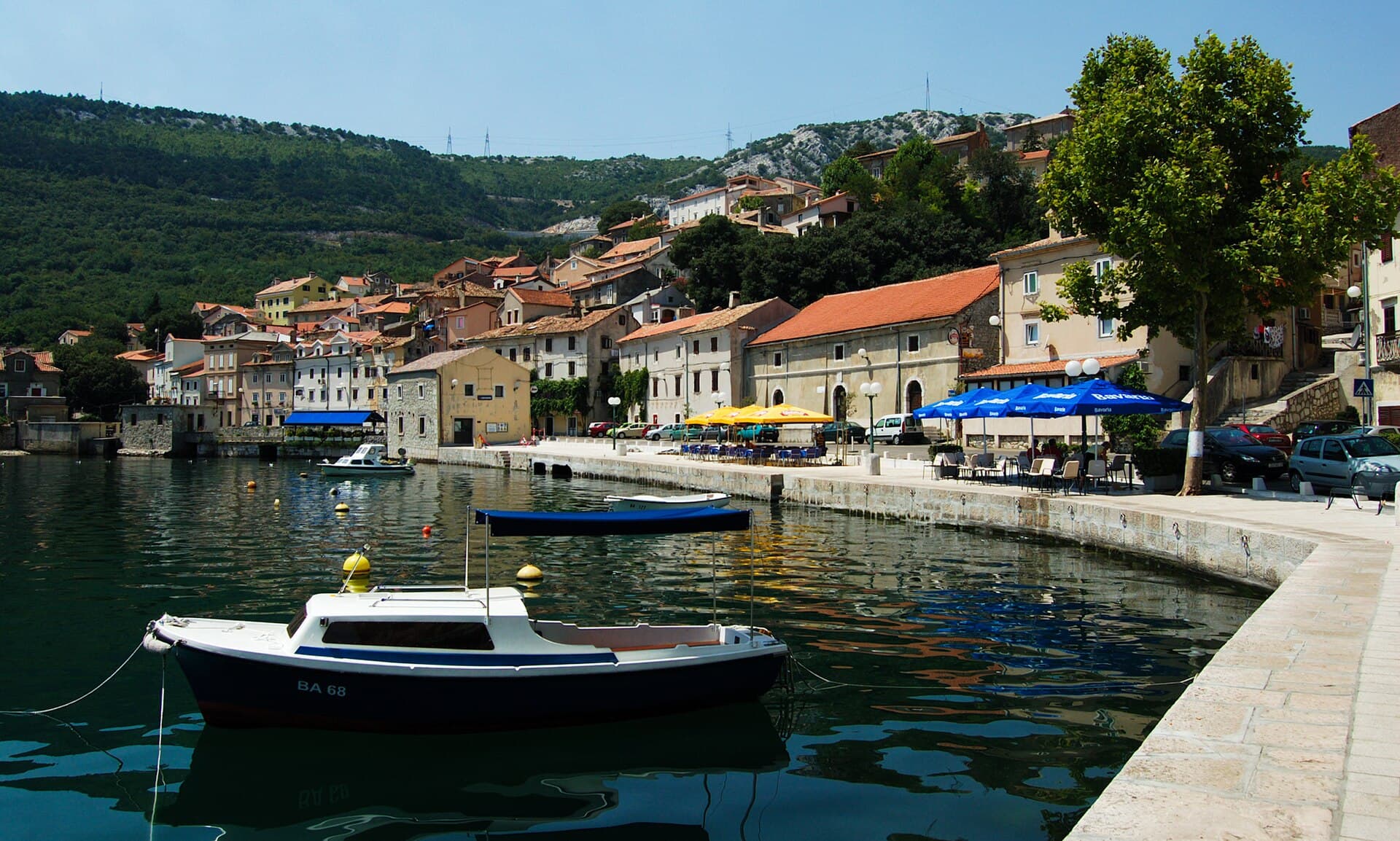
Bakar descends in tiers towards its deep namesake bay, with an identity shaped by seafaring, Frankopan heritage and an unmistakable industrial setting. Stone lanes climb from the waterfront to the Frankopan Castle and St Andrew’s Co-Cathedral, a three-aisled church with nine altars and a crypt containing 85 tombs. Near the shore stand Our Lady of the Port and St Margaret’s Church, while the Upper Town provides broad views across the harbour and the bay’s steep slopes. Opposite the town, the dry-stone terraces known as Bakarski prezidi recall the vineyards once associated with the rare sparkling wine Bakarska vodica. Bakar’s maritime story also has a flavour: bakarski baškot is a ring-shaped, twice-baked bread that remained edible during long fishing and sailing voyages. This is not a conventional Kvarner beach resort; its appeal lies in tracing churches, narrow passages, the Jaz freshwater spring and remnants of the working port. A floating promenade and a reconstructed tuna lookout at Žal ribara add new layers to the waterfront, while nearby Hreljin Castle, the intermittent karst lake at Ponikve and the Risnjak mountain area broaden the visit beyond the old town.
Bakar occupies an amphitheatre-like position at the head of its bay, so exploring the medieval core means climbing through the Upper Town rather than following a level seafront. The Frankopan Castle and St Andrew’s Co-Cathedral rise above tightly packed stone houses, while the harbour below preserves the town’s long association with trade and seafaring. Industrial structures and the steep vineyard terraces of Bakarski prezidi create an unusual visual counterpoint across the water. The wider municipal area includes eight other settlements, among them Hreljin, Praputnjak, Škrljevo and Zlobin, linking Bakar’s Kvarner shoreline with a distinctly mountainous hinterland.
Stays nearby
 Apartment
Apartmeni Klenovica.eu
Klenovica
34 km from Bakar
up to 4 guests · 1 bedroom
The host confirms the exact price for your dates and availability.
Things to see
Bakar’s principal religious landmark is St Andrew’s Co-Cathedral, whose present form dates from the turn of the 19th century; beneath it, two corridors contain 85 tombs. Our Lady of the Port, documented by 1445, served as a votive church for sailors and retains old gravestones set into its walls. St Margaret’s Church was enlarged in 1658 with the support of Petar Zrinski and houses a painting by Valentin Metzinger. The Frankopan Castle commands the Upper Town, while the unusually shaped Turkish House ranks among the most immediately recognisable secular buildings in Bakar’s historic core.
Things to do
Begin by the Church of Our Lady of Porto, once a votive place for Bakar’s seafarers, then cross to St Margaret’s Church opposite. Follow the lanes uphill to the co-cathedral of St Andrew and its crypt, which has two corridors and 85 tombs; entry is arranged as part of a guided town tour. Finish in the Upper Town at the 1764 Chapel of the Holy Cross, whose altar unusually faces west. The Frankopan Castle on the way is part of the Frankopan Routes interpretation trail.
Food and drink
Two products anchor Bakar’s culinary identity in the town’s maritime and viticultural past. Bakarski baškot is a twice-baked, ring-shaped bread whose dryness allowed it to last for more than six months, making it practical food for fishermen and sailors. Bakarska vodica is the historic sparkling wine associated with grapes cultivated on the steep Bakarski prezidi terraces and is now available only in limited quantities. Local dining ranges from fish lunches to meat dishes and pizza, but the baškot and the story of the terraced vineyards remain the flavours most clearly tied to Bakar itself.
Practical information
Getting there and around
Bakar forms part of the suburban network operated by Rijeka’s Autotrolej, which links Rijeka with surrounding towns and municipalities. Earlier timetables identify routes 27, 29 and 29A on the Rijeka–Bakar–Hreljin corridor and onward towards Kraljevica, but current departures should always be checked through the operator’s live passenger-information system. Drivers approach the historic town from the eastern Rijeka area and then explore its steep core on foot. The railway crosses the wider municipal territory near Škrljevo; there is no passenger station on Bakar’s waterfront itself.
Frequently asked questions
Can visitors enter St Andrew’s crypt?
The crypt containing 85 tombs is visited on a guided tour arranged through the Bakar Tourist Board.
What is bakarski baškot?
It is a twice-baked ring-shaped bread once carried by Bakar’s sailors and fishermen on long voyages.
Is there a bus from Rijeka to Bakar?
Bakar is served by the Autotrolej network; check the operator’s current timetable before travelling.
Where are the Bakarski prezidi?
The terraces descend the steep side of Bakar Bay opposite the town, towards Praputnjak.
Nearby

Škrljevo, Bakar
Village · Kvarner

Related guides
Rab
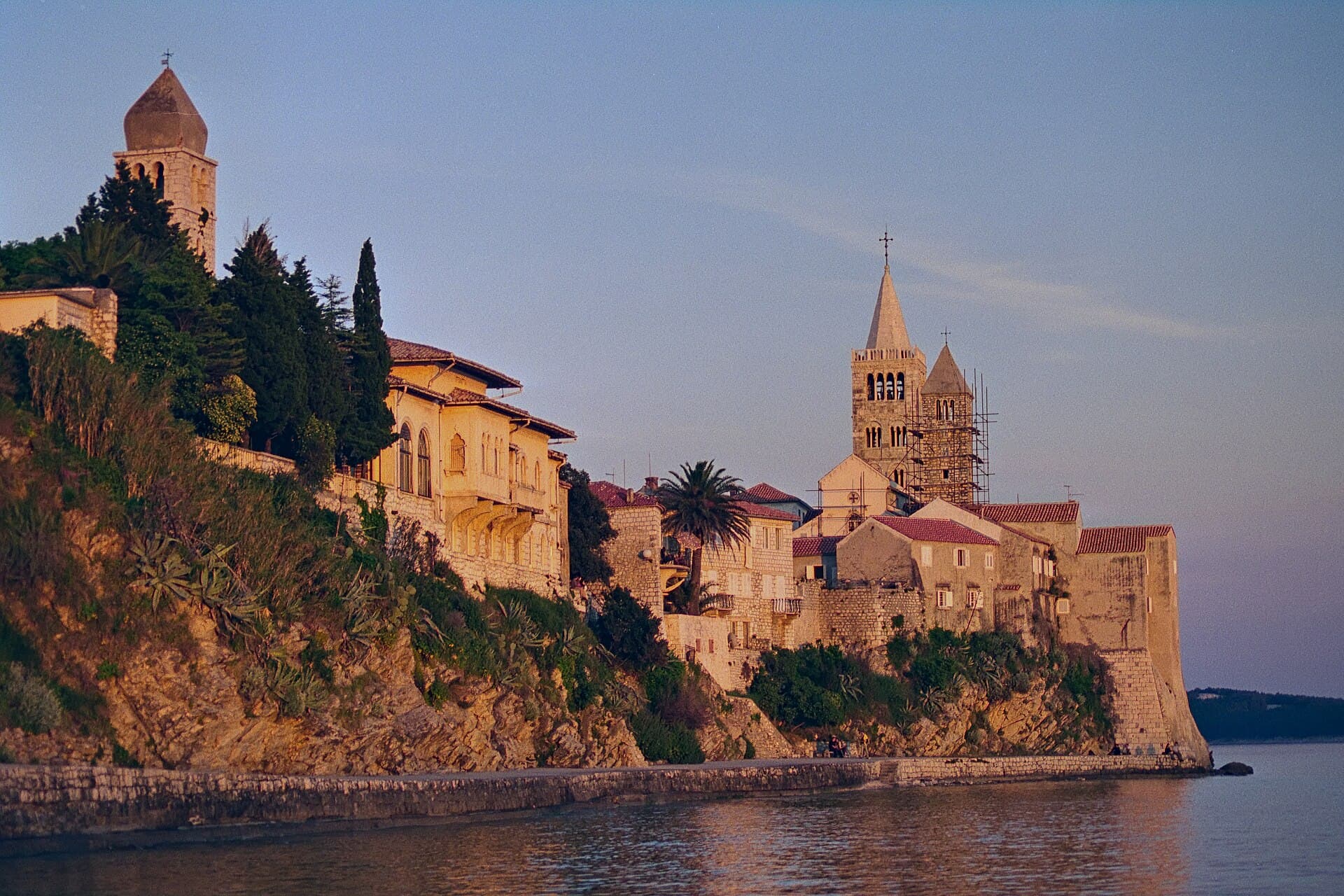
Rab's old town has a clear silhouette, but it rewards more than a postcard view. Its four towers mark distinct religious sites: the Assumption of Mary, St John the Evangelist, St Andrew and…
Read the guide
Help improve this page
Spot something missing or wrong? Suggest a correction, add your photo or report a problem. Editors review every suggestion before it is published.
Photo credits
- Bakar — Aqwis · CC BY-SA 3.0 · Wikimedia Commons
- Škrljevo, Bakar — velfran · CC BY-SA 3.0 · Wikimedia Commons
- Krasica, Bakar — Roberta F. · CC BY-SA 3.0 · Wikimedia Commons
- Kukuljanovo — Zoran Kurelić Rabko · CC BY-SA 3.0 · Wikimedia Commons
- Kostrena