Labin
About this place
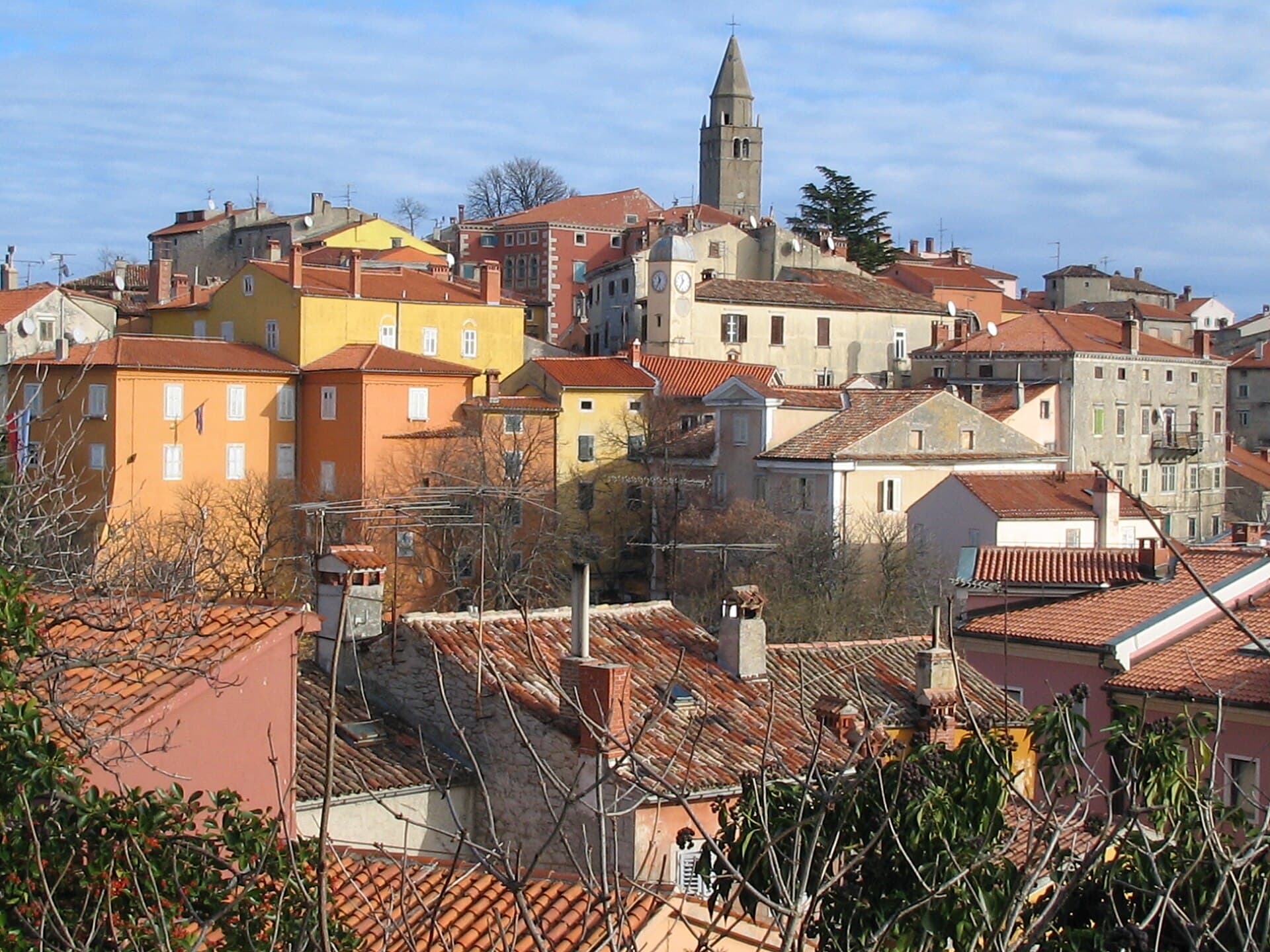
Labin stands on a hill above Istria’s eastern coast, about three kilometres from Rabac, combining a medieval core with a strong modern mining story. The old town leads through historic gates towards the square and loggia, while Fortica opens views towards Rabac and the island of Cres. The Town Museum is particularly notable for its miniature coal mine, making Labin more than a backdrop of stone lanes and providing a direct introduction to the industrial history of the Labin area. The town is also the birthplace of reformer Matthias Flacius Illyricus, commemorated in a dedicated collection. A few kilometres away, Dubrova contains a sculpture park with more than seventy stone works created through the Mediterranean Sculpture Symposium. For swimming, visitors descend towards Rabac and its pebble beaches. A strong day therefore pairs the old town and museum in the morning with the coast later, leaving Dubrova or longer walks for another part of the stay.
Labin developed on a hill about 320 metres above Rabac, and its historic name Albona appears in ancient records. The modern visitor experience is divided between the old town on the hill and Podlabin, which strongly reflects the mining development of the twentieth century. In the old town, the loggia, gates, palaces and Fortica shape the historic walk, while mining heritage explains the economic identity of the wider Labin area. Matthias Flacius Illyricus, born in Labin in 1520, also connects the town with the history of the European Reformation and is commemorated in a dedicated collection.
Stays
No stays listed here yet
Things to see
Labin Town Museum occupies the historic centre and stands out for its reconstructed mine in the basement, an unusual way of presenting the area’s mining history. Fortica is another key stop because its position at the edge of the old town opens views towards Rabac and Kvarner. The Matthias Flacius Illyricus Memorial Collection focuses on the Labin-born reformer and his work. Outside the centre, Dubrova Sculpture Park contains more than seventy stone sculptures associated with the Mediterranean Sculpture Symposium. Together, these places reveal four distinct layers of Labin: urban heritage, mining, Reformation history and contemporary sculpture.
Beaches
Labin’s hilltop centre has no swimming spot of its own; the city’s beaches lie downhill in Rabac. Maslinica is a 500-metre pebble beach with water sports, a slide and an adapted entrance for visitors with disabilities. Girandella mixes pebbles, rocks and paved sunbathing areas, with a diving centre, restaurants and rentals for loungers, parasols and pedal boats. Snorkellers can explore the reef below Girandella, where a rocky spine drops into a fissured underwater wall covered with algae and sponges; currents from the open Kvarner can make the water noticeably cooler. Lanterna offers pebbles and an easy entry, and both Lanterna and Girandella appeared on Istria’s 2026 Blue Flag list.
Bathing water quality nearby
- Rabac naselje - AC Maslinica I · 2.9 kmexcellent · season 2025
- Rabac naselje - AC Maslinica II · 2.9 kmexcellent · season 2025
Source: European Environment Agency (EEA); data from Croatian authorities. · bathing water profile
Things to do
Start on Titov trg and work through Labin’s old town towards the Town Museum and Fortica, avoiding a second climb through the same lanes. From the edge of the historic centre, descend the Sentona Trail to Maslinica Bay in Rabac. The route is almost 2.5 kilometres long and crosses seven bridges beside streams, waterfalls, tufa formations, mill remains and Negri Cave. Allow one to two hours and wear proper shoes because some sections are steep. Return by road or taxi rather than retracing the uphill path. For an evening visit to the old town, Labin’s 2026 electric Karocela shuttle linked Titov trg with the cemetery car park at intervals of roughly ten minutes.
Food and drink
For a meal in Labin, choose between addresses inside the hilltop core and those on the descent towards the modern town. Kvarner on Šetalište San Marco serves local krafi pasta and dry-aged meat within steps of the historic streets. Velo Kafe occupies an early-19th-century building on Titov trg, with the restaurant upstairs, the café below and a summer terrace shaded by a mature wisteria. Its published specialities include Istrian meat dishes, beef fillet with truffles and slow-baked octopus or veal prepared under a črepnja. After a beach day, Ferali at Maslinica and the restaurants lining Rabac’s Obala Maršala Tita are more convenient than climbing back to the old town.
Practical information
Practical information
The Labin Tourist Board is based at Alda Negrija 20, close to the approach to the old town and the upper end of the Sentona Trail. It provides maps of Labin and Rabac, walking-route guidance and current information on museums and events. Expect steep stone-paved lanes inside the historic centre and wear sports shoes for Sentona, whose descent towards Maslinica is sharp in places. Because Rabac falls within the City of Labin, municipal traffic, parking and closure notices cover both the hilltop town and the resort below. During the 2026 season, the Rabac waterfront between Kvarnerska Street and the Lanterna lighthouse was designated a pedestrian zone from 1 April to 30 September.
Parking
Parking around Labin’s old town is split between several zones. Titov trg and Paola Sfecija Street form red Zone 1, the open Stari Grad car park belongs to blue Zone 3, while Šetalište San Marco and Fortica make up the separate gated Starogradska jezgra zone. The municipal company Labin 2000 operates the system and publishes an interactive map and current parking documents. Leaving the car outside the narrowest lanes and walking in is usually simplest, particularly when events occupy Titov trg. Rabac uses different designations: Obala Maršala Tita is Zone 2, Prohaska and parts of Slobode Street are Zone 3, and Girandella has its own gated parking area.
Getting there and around
Labin bus station is on Trg 2. ožujka. Arriva connects Labin with Pula throughout the year; the 44-kilometre station-to-station journey usually takes about one hour. To reach the coast, use a local connection, taxi or car, as Rabac lies roughly three kilometres below the old town and the Sentona route is a walking trail. In 2026, Rabac’s tourist road train ran between Maslinica, the waterfront, the Lanterna lighthouse and Girandella; a one-way ride cost €3 for adults and €2 for children under ten. Within old Labin, the electric Karocela shuttle linked Titov trg with the cemetery parking area.
Frequently asked questions
How far is Labin from the sea?
Old Labin is about three kilometres from coastal Rabac.
What is unusual about Labin Town Museum?
The museum contains a reconstructed mine presenting the mining history of the Labin area.
Where is a good viewpoint in old Labin?
Fortica at the edge of the old town overlooks Rabac and Cres.
Who was Matthias Flacius Illyricus?
He was a Reformation scholar born in Labin in 1520 and is commemorated by a local collection.
What is Dubrova near Labin?
Related guides

Novigrad
Novigrad-Cittanova developed on Istria’s north-western coast near the mouth of the Mirna, in a maritime setting that shaped centuries of fishing and trade. The historic centre still…
Read the guide
Help improve this page
Spot something missing or wrong? Suggest a correction, add your photo or report a problem. Editors review every suggestion before it is published.
Photo credits
- Labin — A. Rehazek (user Senne) · Public domain · Wikimedia Commons
- Vinež — Lan G. · CC BY-SA 4.0 · Wikimedia Commons
- Novigrad — Sl-Ziga · Public domain · Wikimedia Commons
- Pula — Orlovic · CC BY-SA 3.0 · Wikimedia Commons
- Funtana — Tanya Dedyukhina · CC BY 3.0 · Wikimedia Commons