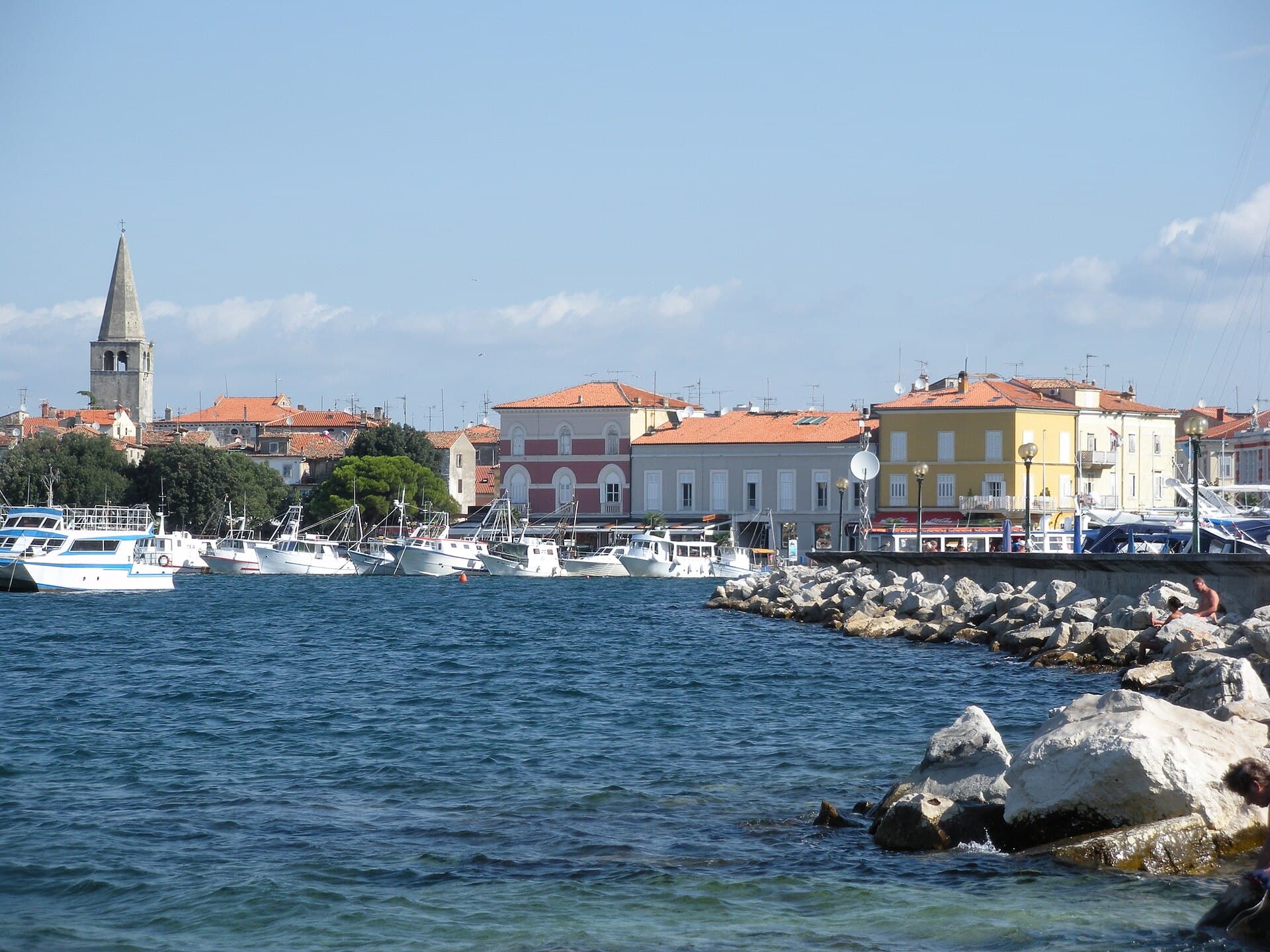
Barban
About this place
Barban is a medieval settlement in the southern part of eastern Istria, set above the Raša valley. Its historic centre preserves the Great and Little Gates, sections of the defensive walls, the Loredan Palace, and the Church of St Anthony the Abbot with wall paintings from the early 15th century. The town is especially known for the Ring Race, a chivalric equestrian competition first recorded in 1696 and revived in 1976. Riders gallop along a 150-metre track and aim at a ring with a lance. Barban is a fine choice for exploring the cultural heritage and rural landscapes of eastern Istria.
Barban is more than a historic hilltop settlement: it is the centre of a municipality stretching from the Istrian interior to a short section of coastline on Raša Bay. That geography links the stone-built town with rural houses, equestrian activities, walking and cycling routes and the secluded Blaz cove. The local tourist board describes an area of 31 settlements, with roads leading towards Žminj, Vodnjan, Labin and Pula. For visitors, this means Barban works best as a base for exploring a wider landscape rather than as a brief stop in the old centre. Within a relatively compact area, medieval heritage gives way to adventure attractions and then to the wooded slopes descending towards the Raša valley.
Stays nearby
 Apartment
Apartmeni Klenovica.eu
Klenovica
65 km from Barban
up to 4 guests · 1 bedroom
The host confirms the exact price for your dates and availability.
Things to see
Barban’s most important cultural sights are concentrated in its compact historic centre. The Great and Little Gates and sections of the defensive walls recall its former fortified character, while the Loredan Palace reflects the Venetian period. The Church of St Anthony the Abbot, outside the main town gate, preserves medieval wall paintings from the early 15th century. The Ring Race links this heritage with a living tradition: its first known record dates from 1696, and it was revived in 1976. Riders use lances to strike a ring on a 150-metre track.
Beaches
The Municipality of Barban has only a short stretch of coastline on Raša Bay, so this is not a destination built around a chain of developed resort beaches. Its most distinctive coastal location is Blaz cove below Puntera on the municipality’s eastern side. The tourist board highlights freshwater springs and the remains of five former mills around the cove, giving Blaz both natural and historical interest. The area can be incorporated into a walk or drive through the rural landscape above Raša Bay. Visitors looking specifically for a full day on a highly serviced beach will find a much broader selection in the neighbouring coastal resorts than within Barban itself.
Things to do
A visit can begin in Barban itself and at the local visitor centre before moving on to the more active attractions outside the historic core. Glavani Park, around six kilometres from Barban, covers roughly 1.5 hectares and includes three aerial adventure courses set at different heights together with zip-line activities. For a quieter outdoor day, paths lead towards Puntera and Blaz cove, where the landscape descends towards Raša Bay. This arrangement makes it possible to combine a historic Istrian settlement, an adventure park and a rural walking route in one outing without having to cross the peninsula to the better-known resorts of the western coast.
Food and drink
Barban’s food scene is worth exploring beyond the settlement centre. The local tourist board features Konoba Vorichi in Orihi, focused on Istrian and home-style cooking, and Stefanija’s Kitchen in Puntera, where seasonal local ingredients and recipes connected with the area’s culinary tradition are emphasised. The wider gastronomy directory includes additional rural households and hospitality venues distributed around the municipality. This scattered pattern suits Barban’s countryside character: lunch can naturally be combined with a drive towards Glavani, Puntera or Raša Bay rather than expecting the entire dining offer to be concentrated around the main square of Barban itself.
Practical information
Practical information
The Barban Tourist Board operates in the centre of the settlement, while the visitor centre introduces local heritage and the Ring Race tradition. Because Glavani Park, Puntera, Blaz and many rural hospitality venues lie outside the historic core, a car is more practical than relying only on walking. The official tourism website publishes thematic walking and cycling routes, including routes towards the Puntera–Blaz area. Barban itself is small, but the tourism area of the municipality is considerably larger, so planning should distinguish between a short visit to the historic settlement and a full day exploring its villages, countryside and small section of eastern coastline.
Getting there and around
Barban lies on a road corridor linking southern and eastern Istria. The local tourist board places Pula, Labin, Rabac and several other larger Istrian centres roughly twenty to thirty kilometres away and notes local roads towards Žminj and Vodnjan. Brioni’s current Pula–Rijeka timetable includes services running through Marčana, Barban and Labin, providing a public bus connection in both directions. For visiting Blaz cove, Glavani Park and the municipality’s smaller villages, however, a private car is considerably more flexible because these attractions are dispersed and are not concentrated along a single public-transport route.
Frequently asked questions
From what year is the earliest record of Trka na prstenac?
The earliest surviving record of Barban’s Trka na prstenac dates from 1696.
When was Trka na prstenac revived in Barban?
The equestrian competition was revived in 1976 after a long interruption.
Which Barban church preserves 15th-century frescoes?
The frescoes are in the Church of St Anthony the Abbot outside the historic core.
How long is the Trka na prstenac course?
The competition course is 150 metres long.
Nearby
Koromani
Village · Istria
Prhati, Barban
Village · Istria
Related guides

Novigrad
Novigrad-Cittanova developed on Istria’s north-western coast near the mouth of the Mirna, in a maritime setting that shaped centuries of fishing and trade. The historic centre still…
Read the guide
Help improve this page
Spot something missing or wrong? Suggest a correction, add your photo or report a problem. Editors review every suggestion before it is published.
Photo credits
- Barban — Wistula · CC BY-SA 4.0 · Wikimedia Commons
- Apartmeni Klenovica.eu — Apartmani Klenovica.eu · courtesy of the property owner
- Novigrad — Sl-Ziga · Public domain · Wikimedia Commons
- Pula — Orlovic · CC BY-SA 3.0 · Wikimedia Commons
- Funtana — Tanya Dedyukhina · CC BY 3.0 · Wikimedia Commons
- Poreč