Sinj
About this place
Sinj is best understood through a compact sequence of places where the 1715 defence, Marian devotion and Alka tradition meet. The Alka Museum occupies the Alkarski dvori, a former Venetian cavalry quarter, and displays costumes, weapons and riding equipment alongside a life-size Alka procession and a multimedia interpretation of the Battle of Sinj. From there, follow the racecourse towards the Basilica of Our Miraculous Lady of Sinj on the main square. Built between 1699 and 1712, it centres on an image by an unknown 15th- or 16th-century painter. Above the square rises Kamičak, a bastioned fort built in 1712, whose tower holds a bell dated 1828. The annual Sinjska Alka commemorates the Cetina region’s victory over the Ottoman army in 1715. For a distinctly local meal, look for protected Sinj arambaši—meat parcels wrapped in sour cabbage leaves—and almond-filled Sinj rafioli.
Sinj is the historic centre of the Cetina region, shaped by its racecourse, the sanctuary on the main square and the forts overlooking the old core. The Sinjska Alka preserves the memory of the 1715 victory over the Ottoman army and is rooted in four authentic settings: Grad Fortress, Kamičak, the Alkarski dvori and the racecourse. Kamičak was built in 1712 under Venetian rule, while the adjacent Palacina now houses the Museum of the Cetina Region. Together, these landmarks give Sinj its distinctive blend of jousting tradition, pilgrimage heritage and fortified townscape.
Stays
No stays listed here yet
Things to see
The Alka Museum occupies a preserved Venetian cavalry quarter, with a life-size procession and a multimedia reconstruction of the Battle of Sinj among its standout displays. The Basilica of Our Miraculous Lady of Sinj was built from 1699 to 1712 and preserves the image of Our Lady of Sinj by an unknown 15th- or 16th-century artist; its present 43.5-metre bell tower was completed in 1927. Kamičak is a 1712 bastioned fort transformed into a landscaped viewpoint in 1890. Its tower contains an 1828 bell cast by the Colbachini foundry of Bassano.
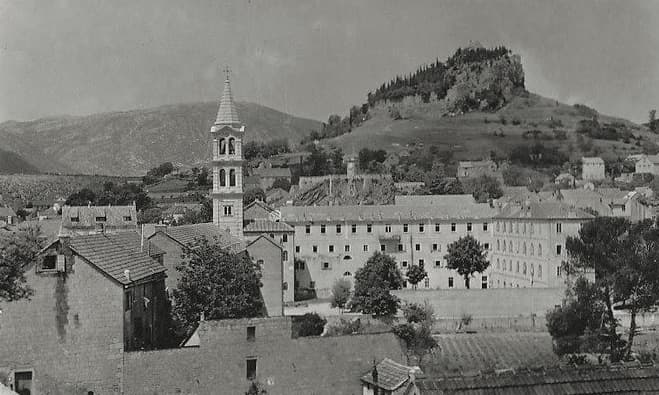
Stari grad
Landmark · Sinj
The remains of Sinj Fortress rise above the town as a place of history and pilgrimage.
Beaches
Sinj has no sea beach, so its organised summer swimming venue is the municipal outdoor pool. At the start of the 2025 season, the city announced swimming lessons, non-swimmer training and evening and themed programmes there, making the pool a more practical family option than informal river access. The Cetina remains a setting for activities such as canoe safaris and fishing rather than a substitute for a supervised bathing facility. Reaching the sea requires a drive towards the Split coast; on a shorter stay, the pool fits neatly between the museum circuit and an evening climb to Grad fortress.
Things to do
Begin at the Alka Museum in the Alkarski dvori, where costumes, lances, rulebooks and a reconstruction of the 1715 battle put the tournament in context. Continue to the Alka racecourse to connect the exhibits with the ground on which the contest is held. Then cross to the main square and the Basilica of Our Miraculous Lady of Sinj, recognisable by Stipe Sikirica’s bronze doors and home to the revered image of Our Lady of Sinj. Finish on Kamičak, redesigned in 1890 as a park and lookout, where the tower’s clock and 1828 bell remain defining details.
Food and drink
Sinj’s signature dish is arambaši: finely chopped beef seasoned with a herb-and-garlic mixture, lemon zest and spices, then wrapped in sour cabbage leaves. The preparation was entered on Croatia’s list of protected cultural goods in 2007 and remains associated in the Cetina region with Christmas, Alka festivities and the Assumption feast. For dessert, seek out Sinj rafioli—thin pastry parcels filled with almonds, sugar, egg, lemon, maraschino and chocolate. Together, these two recipes offer a far more specific taste of Sinj than a generic Dalmatian menu.
Practical information
Practical information
The Sinj tourist office is at Put Petrovca 12 and lists 2026 opening hours of 8am–4pm, Monday to Friday. The heaviest crowds occur during the Alka period and around the Feast of the Assumption on 15 August, when traffic arrangements change and pilgrims and spectators fill the centre. For an independent visit, collect information first and then connect the Alka Museum, basilica, Kamičak and racecourse on foot. Museum access, the municipal pool and organised Cetina activities use seasonal schedules, so their current times should be checked before arrival.
Getting there and around
Sinj has bus links with Split via Solin, with separate timetables published for weekdays, Saturdays, and Sundays or public holidays. The published network also includes direct directions towards Zagreb, Vrlika, Trilj, Otok and Aržano. A published Promet Sinj schedule lists Sinj–Split departures from 05:00 to 21:00 and Split–Sinj departures from 06:00 to 22:00; for a 2026 journey, check the operator’s timetable for the travel date. Once in town, the Alka Museum, racecourse, basilica and Kamičak can be linked on foot through the centre.
Frequently asked questions
Where can you swim in Sinj?
Organised swimming is available at the municipal pool, which hosted lessons and non-swimmer training during the 2025 season.
Which historic event is reconstructed at the Alka Museum?
The multimedia display reconstructs the 1715 Battle of Sinj.
Who created the basilica’s bronze doors?
Stipe Sikirica created the bronze doors of the Basilica of Our Miraculous Lady of Sinj.
When was the basilica’s present bell tower completed?
The present 43.5-metre bell tower was completed in 1927.
Related guides

Split
In Split, the transition from ancient monument to ordinary street is almost imperceptible: entering the southern part of Diocletian’s Palace from the Riva leads towards the Peristyle, then…
Read the guide

Help improve this page
Spot something missing or wrong? Suggest a correction, add your photo or report a problem. Editors review every suggestion before it is published.
Photo credits
- Stari grad — Unknown authorUnknown author · Public domain · Wikimedia Commons
- Museum of the Cetinska Krajina Region — Völkerwanderer · CC0 · Wikimedia Commons
- Split — dronepicr · CC BY 2.0 · Wikimedia Commons
- Baška Voda — Mario Žamić · CC BY-SA 3.0 · Wikimedia Commons
- Tučepi