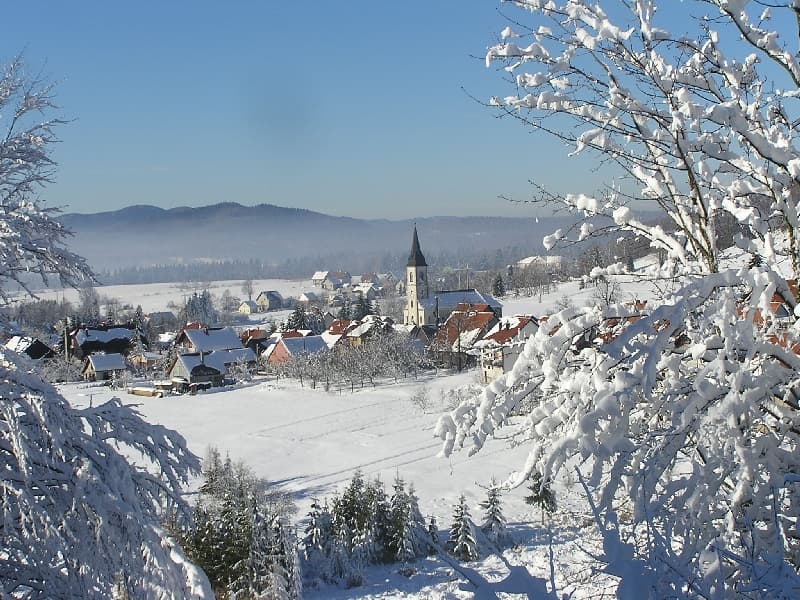
About this place
Set at 824 metres above sea level, Mrkopalj occupies a Gorski kotar basin where roads branch towards Tuk, Begovo Razdolje, Bjelolasica, and the Bijele and Samarske stijene formations. Its defining story is Croatian skiing: a course for fourteen skiers was organised here in 1913, followed in 1914 by the first Croatian and Slavonian skiing championship, raced over seven kilometres. The Pod Vrhin ski jump, built in 1934, further explains why Mrkopalj is known as a cradle of Croatian skiing. Čelimbaša, immediately beside the settlement, provides the most accessible introduction to its winter landscape. In warmer weather, marked cycling routes lead through Matić poljana, while experienced hikers use the wider Mrkopalj area to approach the strict reserve of Bijele and Samarske stijene. Fortica preserves archaeological traces of a small medieval church dating from the fourteenth or fifteenth century, and the historic Karolina road has crossed Mrkopalj since 1732. At Matić poljana, 26 stone monoliths commemorate 26 fighters who died in a snowstorm in 1944, giving the mountain scenery a poignant historical dimension.
Mrkopalj is a mountain settlement shaped by the historic Karolina road, forestry and winter sports. It first appears in records in 1477 and was granted the status of a privileged royal market town in 1785, complete with its own coat of arms and seal. The present parish church of Our Lady of the Seven Sorrows dates from 1854; it became the parish church after the bombing of 6 April 1944 destroyed the Church of St Philip. Mrkopalj’s sporting identity rests on the 1913 ski course, the 1914 Croatian and Slavonian championship and the local ski jump built in 1934. This blend of former market-town history, pioneering ski heritage and high Gorski kotar terrain gives Mrkopalj a character quite distinct from coastal Kvarner.
Stays nearby
 Apartment
Apartmeni Klenovica.eu
Klenovica
24 km from Mrkopalj
up to 4 guests · 1 bedroom
The host confirms the exact price for your dates and availability.
Things to see
Fortica is an archaeological site on the rise above Mrkopalj, preserving the remains of a small church of the type the Frankopans built for their serfs in the fourteenth or fifteenth century. The Church of Our Lady of the Seven Sorrows dates from 1854 and maintained parish life after wartime destruction of the older Church of St Philip. Matić poljana is marked by 26 stone monoliths commemorating 26 fighters who died in a 1944 blizzard. Čelimbaša is the settlement’s principal sporting landmark, with slopes used for skiing and sledging immediately beside Mrkopalj. Farther into the mountains, Bijele and Samarske stijene form the area’s outstanding natural destination, a strictly protected karst landscape reached by demanding hiking routes from the wider Mrkopalj area.
Things to do
Begin at Fortica, where the remains of a fourteenth- or fifteenth-century church introduce Mrkopalj’s Frankopan-era story. Continue to the foot of Čelimbaša; in winter, skiing and sledging depend on the resort’s current snow and operating conditions. For a full cycling day, follow the Široka draga circuit from the centre through Tuk and past the Bijele stijene mountain lodge to Matić poljana, returning through the forest towards Čelimbaša. Properly equipped, experienced hikers can tackle the Mrkopalj Mountain Trail through Samarske stijene; the route was marked in 1988 and officially opened on 1 July 1990. End with a quieter visit to Matić poljana, where 26 stone memorials stand starkly against the open mountain landscape.
Frequently asked questions
Why is Mrkopalj called a cradle of Croatian skiing?
Mrkopalj hosted a ski course for 14 participants in 1913 and the first Croatian and Slavonian skiing championship over seven kilometres in 1914.
What do the 26 stones at Matić poljana represent?
The monoliths commemorate 26 fighters who died in a 1944 snowstorm at Matić poljana.
When did the Mrkopalj Mountain Trail open?
The trail through the Samarske stijene area was marked in 1988 and formally opened on 1 July 1990.
How far is Begovo Razdolje from Mrkopalj by bicycle?
The marked route is about six kilometres long, climbing from central Mrkopalj at 824 metres to Begovo Razdolje at roughly 1,076 metres.

Related guides
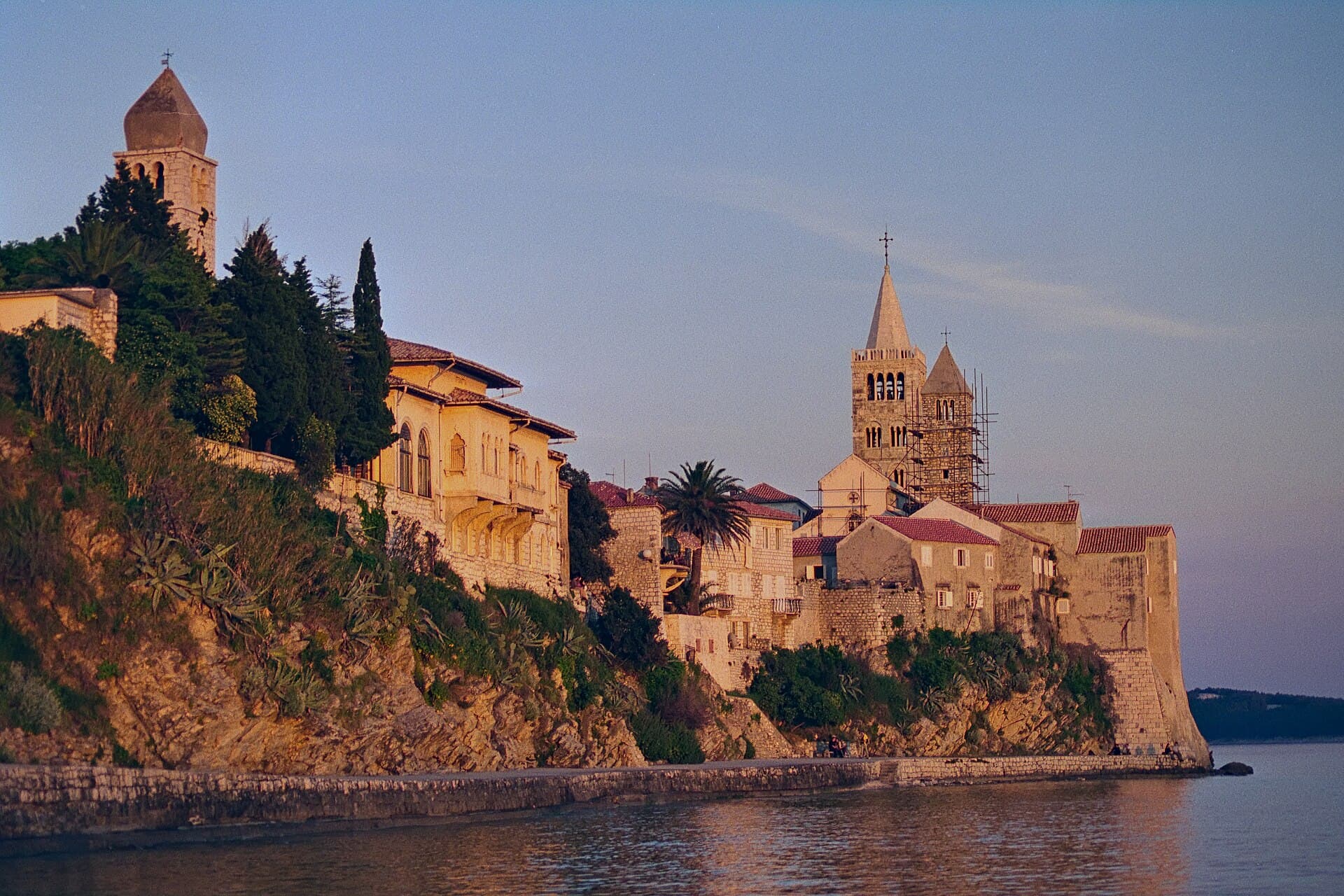
Rab
Rab's old town has a clear silhouette, but it rewards more than a postcard view. Its four towers mark distinct religious sites: the Assumption of Mary, St John the Evangelist, St Andrew and…
Read the guide
Help improve this page
Spot something missing or wrong? Suggest a correction, add your photo or report a problem. Editors review every suggestion before it is published.
Photo credits
- Mrkopalj — Mr. Mrko. · CC BY-SA 4.0 · Wikimedia Commons
- Kupjak, Ravna Gora — Martinarg · CC BY-SA 3.0 · Wikimedia Commons
- Delnice — Lan Glad · CC BY-SA 4.0 · Wikimedia Commons
- Apartmeni Klenovica.eu — Apartmani Klenovica.eu · courtesy of the property owner
- Rab — Herbert Ortner · CC BY 4.0