Lišane Ostrovičke
About this place
Lišane Ostrovičke lies on the eastern edge of Ravni Kotari, where northern Dalmatia’s fertile, gently rolling plain gives way to the rockier terrain of Bukovica. The village developed beside a freshwater spring and the Lišane–Ostrovica field, and its character is expressed through churches, stone-built hamlets and close ties with neighbouring Ostrovica. Its principal landmark is the Church of St Nicholas Tavelić. The original votive shrine was built in 1975–77 to a design by architect Vinko Galić and consecrated in 1978; it was destroyed in 1991 and subsequently rebuilt. Above nearby Ostrovica stand the remnants of a medieval fortress held by the Bribir princes until 1347. Its steep setting and broad views across Ravni Kotari immediately reveal why this was once such an important defensive site. Lišane is inland and has no developed seaside beach, making it a rural and historical base for exploring the hinterland between Zadar and Šibenik. Roads lead towards Benkovac and Skradin, while the municipality lists a Lišane–Benkovac–Zadar bus route. A private car remains the simplest option for linking the scattered sites.
Lišane Ostrovičke occupies the transition between Ravni Kotari and Bukovica, a landscape of cultivated fields, limestone rises and traditional stone hamlets such as Mamići, Nimci and Stipići. The village name preserves its link with nearby Ostrovica, once a major medieval stronghold on a steep rock above the settlement. The Church of St Nicholas Tavelić supplies Lišane’s modern architectural signature: it was conceived as an octagonal concrete votive shrine clad in stone. Another unmistakably local landmark is the hillside inscription “Hajduk–Split–Lišane”, roughly 100 metres long and accompanied by a crest about nine metres across.
Stays
No stays listed here yet
Things to do
Lišane Ostrovičke brings together two unusual stops: the stone-cut “Hajduk–Split–Lišane” mural on the railway embankment and Ostrovica Fortress. Created in 1967, the mural is about 100 metres long, with letters nine metres high. Continue to Ostrovica, where the remains of a fortress first mentioned in 1198 stand on a hill; the Bribir princes surrendered it to King Louis I in 1347. Back in Lišane, the parish church of St Nicholas Tavelić, consecrated in 1978, is recognisable by its octagonal form and stone cladding.
Practical information
Getting there and around
Lišane Ostrovičke is connected by road with Benkovac and the Skradin area, while local road L63177 links the village to the D56 state road. The municipal website lists a Lišane–Benkovac–Zadar bus route, although departures should be confirmed directly before travelling. The former Zadar–Knin railway corridor crosses this area, but visitors should not plan their trip around a regular passenger-rail service. A car is therefore the most practical way to connect Lišane with Ostrovica, Dobropoljci and the other scattered sites along the boundary of Ravni Kotari and Bukovica.
Frequently asked questions
Where is the Hajduk–Split–Lišane inscription?
The inscription lies on the rocky slope below the railway and above the Nimci hamlet; it is about 100 metres long, with a crest roughly nine metres across.
When was the Church of St Nicholas Tavelić consecrated?
The votive church was built between 1975 and 1977 and consecrated in 1978.
Does Lišane Ostrovičke have a seaside beach?
No. Lišane Ostrovičke is an inland village on the eastern edge of Ravni Kotari, so a seaside swim requires a trip towards the coast.

Related guides
Novalja
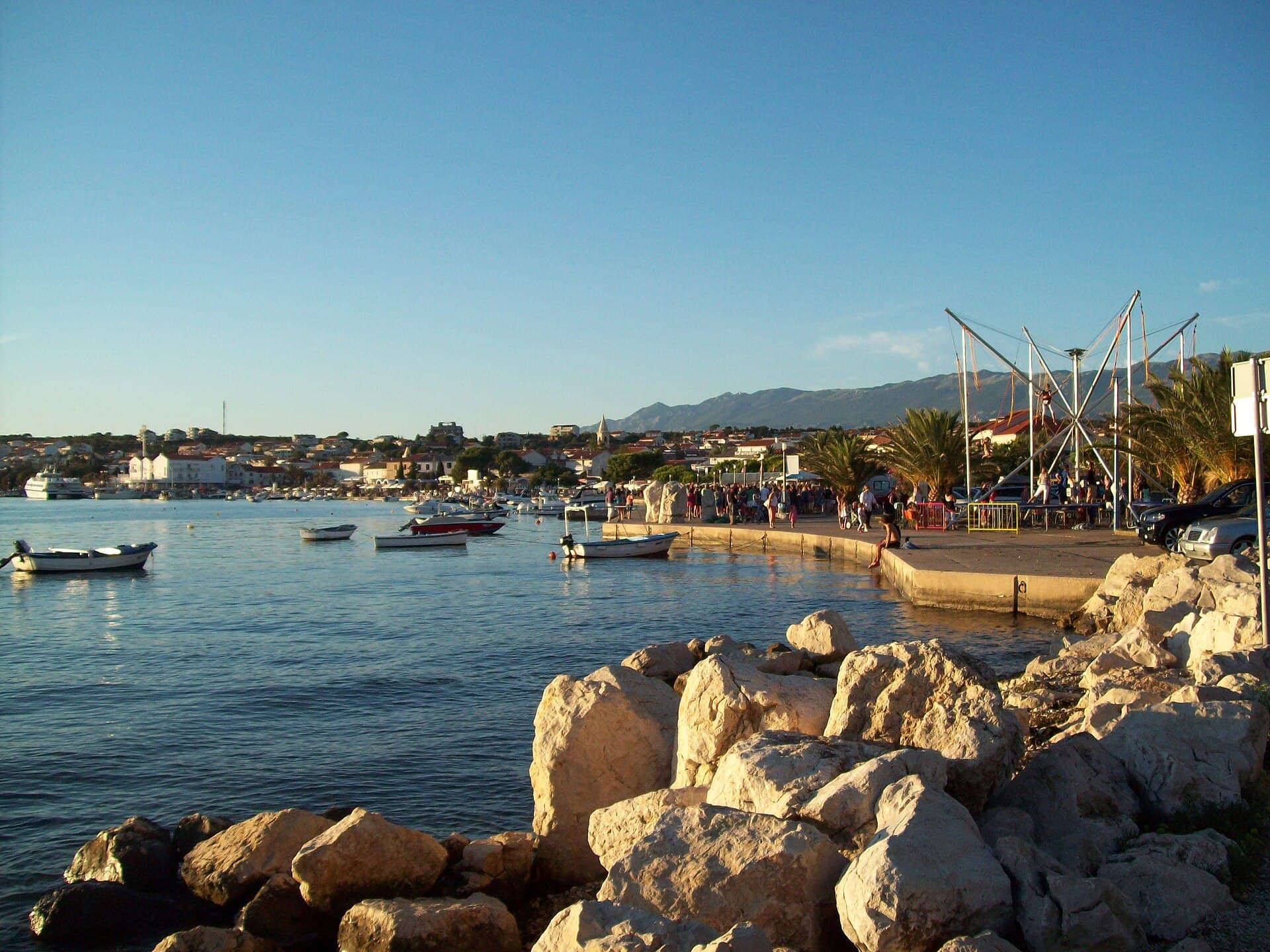
Novalja curves around a bay on Pag’s western shore, with the waterfront, Trg Bazilike and streets around Mala crikva forming the centre. Landing places and restaurants line the water, while…
Read the guide
Help improve this page
Spot something missing or wrong? Suggest a correction, add your photo or report a problem. Editors review every suggestion before it is published.
Photo credits
- Ostrovica — Silverije · CC BY-SA 3.0 · Wikimedia Commons
- Novalja — JoeTimBlackMax · CC BY-SA 3.0 · Wikimedia Commons
- Nin — Amphisbène · CC BY 2.5 · Wikimedia Commons
- Pakoštane — Roman Klementschitz, Wien · CC BY-SA 3.0 · Wikimedia Commons
- Pag