Ružić
About this place
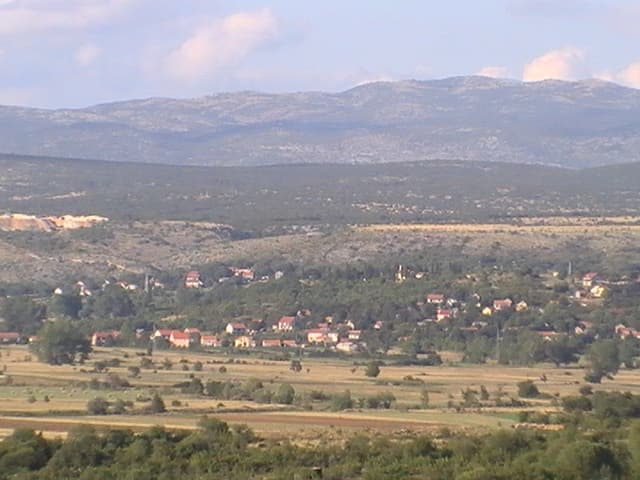
Ružić is a Dalmatian hinterland village in Petrovo Polje, roughly 10 kilometres south-east of Drniš and 42 kilometres north-east of Šibenik. Although administrative descriptions can cause confusion, the municipal offices are in neighbouring Gradac; Ružić itself lies by the Čikola between the Svilaja and Moseć slopes. Its essential sight crowns Paraćeva Glavica: the Church of the Most Holy Redeemer, Ivan Meštrović’s family mausoleum. The building stands cadastrally within Ružić, although museum and visitor information commonly associates it with Otavice, the village of Meštrović’s childhood across the Čikola. Construction lasted from 1926 to 1930, with work on the interior and grounds continuing through the 1930s. Built with stone from Svilaja, the church contains the remains of Meštrović and members of his family. Ružić is not a seaside settlement; its scenery consists of fields, river country, rocky hills and agricultural villages. The meeting of Meštrović’s architecture with the broad view over Petrovo Polje gives this small place its distinctive identity.
Ružić belongs to inland Dalmatia rather than the Šibenik coast, occupying the south-eastern side of Petrovo Polje at about 279 metres above sea level. The Čikola separates Paraćeva Glavica on the Ružić side from Otavice, where Ivan Meštrović grew up and where his family house stands. This explains why the mausoleum is often labelled as an Otavice attraction, although land and conservation records place it within Ružić cadastral territory. Svilaja and Moseć frame the wider municipality, while the Čikola crosses the field after rising near Čavoglave. Ružić’s Chapel of Saint Mary, originally built in 1900, was demolished during construction of the Drniš–Split road and rebuilt in the late 1980s.
Stays nearby
 Apartment
Apartmeni Klenovica.eu
Klenovica
Klenovica, 181 km from Ružić
up to 4 guests · 1 bedroom
The host confirms the exact price for your dates and availability.
Things to do
Start on Paraćeva Glavica at the Church of the Most Holy Redeemer, where Meštrović combined architecture, sculpture and his family burial place in a single ensemble. Look for the stone quarried on nearby Svilaja and the bronze portraits of family members on the entrance doors. After seeing the interior, pause on the hill for the broad view across Petrovo Polje towards Drniš and the surrounding mountains. Then cross the Čikola towards Otavice and Meštrović’s family home, revealing the physical relationship between his childhood village and the mausoleum. End beside the Čikola and the fields between Ružić and Otavice, where the river marks the boundary between the two settlements and shapes the principal view of Paraćeva Glavica.
Practical information
Getting there and around
Ružić stands on the D56 state road, about 10 kilometres from Drniš and, according to the geographical reference, roughly 42 kilometres from Šibenik. For the Church of the Most Holy Redeemer, follow the approach signposted towards Otavice and Paraćeva Glavica; vehicles can reach the church entrance and the museum has parking. The ŠIKBUS county network serves communities across Šibenik-Knin County, but travellers should select the relevant Ružić connection, zone and interchange from the timetable published for 2026. A car remains the most direct way to combine Ružić with Otavice, the Čikola source near Čavoglave and Drniš, as these Petrovo Polje sights are spread across several settlements.
Frequently asked questions
Is Meštrović’s mausoleum in Ružić or Otavice?
The Church of the Most Holy Redeemer stands cadastrally in Ružić, on Paraćeva Glavica beside Otavice, which is why museum information often uses both place-names.
When was the Church of the Most Holy Redeemer built?
The main structure was built between 1926 and 1930, while the interior and grounds continued to take shape during the 1930s.
Can visitors drive to the mausoleum?
A vehicle access road reaches the church entrance, and parking is available at the museum.


Related guides

Šibenik
Three contrasting areas help explain Šibenik's historic centre: the steep lanes of Gorica, waterfront Dolac and the central streets around Kalelarga. In Gorica, stone steps climb towards St…
Read the guide
Help improve this page
Spot something missing or wrong? Suggest a correction, add your photo or report a problem. Editors review every suggestion before it is published.
Photo credits
- Ružić — bruno.kostovic · CC BY 3.0 · Wikimedia Commons
- Otavice, Kričke, Kadina Glavica — Zrno at Serbian Wikipedia · Public domain · Wikimedia Commons
- Umljanović — MasterAltair1 · CC BY-SA 4.0 · Wikimedia Commons
- Sedramić