About this place
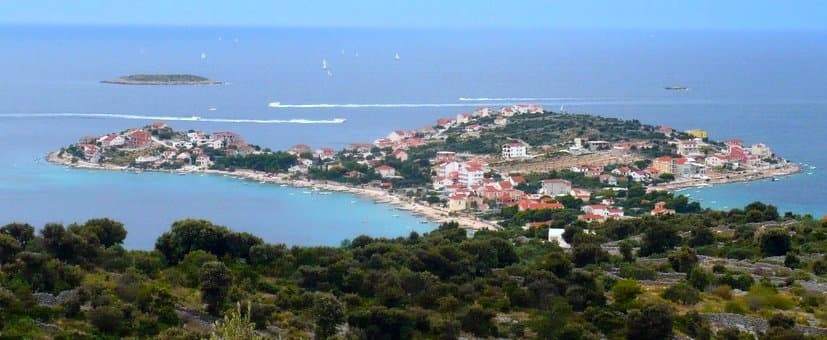
Ražanj occupies an indented peninsula south of Rogoznica, with sheltered coves facing the Rogoznica waters and a more exposed shore towards Cape Ploča. This small Dalmatian settlement is defined by houses lining narrow coastal lanes, rocky swimming spots and views of the islets scattered off the Rogoznica coast. The dominant landmark is Movar hill, a natural lookout over both sides of the peninsula and the shipping passage around Punta Planka. At the southern end stands the Church of St John of Trogir, a protected heritage site associated with the notoriously demanding waters off Cape Ploča. Movar Cove also contains the Chapel of St Anthony, thoroughly restored in 1998 by members of the local Gof sport-fishing club. A seasonal passenger boat links Ražanj with Rogoznica; the official 2024 timetable gave a crossing time of 15 minutes, making the boat a useful shortcut to the shops and services of the municipal centre. Ražanj consequently suits travellers who want to swim close to their accommodation, climb Movar in the morning and visit Rogoznica by boat instead of repeatedly negotiating the peninsula’s narrow roads by car.
Although Ražanj belongs to the Municipality of Rogoznica, its character comes from occupying a separate peninsula south of the municipal centre. Small coves, rocks and paved sea entrances beside holiday homes alternate along its shore, while the interior rises towards Movar. Its position across the bay from Rogoznica explains why the seasonal boat is more convenient than driving around the inlet. The Chapel of St Anthony in Movar Cove preserves a distinctly local maritime tradition: following its 1998 restoration, Mass is celebrated there on the saint’s feast day when weather permits, recalling an older custom in which fishermen donated part of their catch to the chapel.
Stays
No stays listed here yet
Things to see
Ražanj’s principal landscape landmark is Movar, a hill above the peninsula overlooking the Rogoznica archipelago and the open Adriatic. In the cove of the same name, the Chapel of St Anthony recalls the village’s fishing heritage; members of the Gof sport-fishing club restored it through voluntary work in 1998. Farther south, the Church of St John of Trogir stands at Cape Ploča, also known as Punta Planka, and is recorded among Šibenik-Knin County’s cultural properties. Its position on the prominent headland reveals exactly where the more sheltered Rogoznica waters meet the exposed sea beyond the cape.
Beaches
Bathing water quality nearby
- Gornji muli · 1.5 kmexcellent · season 2025
- Rogoznica mjesto · 1.5 kmexcellent · season 2025
- Račice · 1.7 kmexcellent · season 2025
- Kopača · 2.8 kmexcellent · season 2025
Source: European Environment Agency (EEA); data from Croatian authorities. · bathing water profile
Things to do
Begin beside the village waterfront, then head up Movar early in the morning before the rocky path is exposed to the midday heat. After taking in the peninsula views, descend towards Movar Cove and the Chapel of St Anthony, restored in 1998. Reserve the afternoon for swimming in one of Ražanj’s coves, where access to the water is typically from rocks, pebbles or paved platforms. When the seasonal passenger boat is running, finish with the 15-minute crossing to Rogoznica and a walk towards the Gradina peninsula, the Dragon’s Eye lake and the shrine of Our Lady of the Chapel.
Practical information
Practical information
For a broader choice of shops, cash machines and everyday services, visitors generally rely on Rogoznica, the municipal centre across the bay. The official 2024 boat fare was €3 for adults and €2 for children aged five to twelve, while younger children travelled free; bicycles cost €2. The service did not operate on Sundays and its timetable was subject to change. Shoes suitable for rocky ground are useful around Ražanj’s shore and on the approaches to Movar, while carrying water is sensible for Punta Planka because the headland is exposed to both sun and wind.
Frequently asked questions
How long is the boat trip from Ražanj to Rogoznica?
The official 2024 schedule gave a one-way crossing time of 15 minutes on the Cape of Hope service.
Can bicycles be taken on the boat to Rogoznica?
Yes. The official 2024 fare for carrying a bicycle on the Ražanj–Rogoznica route was €2.
When was the Chapel of St Anthony in Movar Cove restored?
The chapel was thoroughly restored in 1998 through voluntary work by members of the Gof sport-fishing club.
What can be visited across the bay in Rogoznica?
The Gradina peninsula contains the Dragon’s Eye lake and the shrine of Our Lady of the Chapel, with Marina Frapa nearby.
Nearby
Stivašnica
Village · Dalmatia – Šibenik

Related guides

Šibenik
Three contrasting areas help explain Šibenik's historic centre: the steep lanes of Gorica, waterfront Dolac and the central streets around Kalelarga. In Gorica, stone steps climb towards St…
Read the guide
Help improve this page
Spot something missing or wrong? Suggest a correction, add your photo or report a problem. Editors review every suggestion before it is published.
Photo credits
- Ražanj — Vedrangf · CC BY-SA 4.0 · Wikimedia Commons
- Stivašnica — Sudic2020 · CC BY-SA 4.0 · Wikimedia Commons
- Rogoznica — Ante Perkovic · CC BY-SA 3.0 · Wikimedia Commons
- Zečevo Rogozničko — MarSafranco · CC BY-SA 4.0 · Wikimedia Commons
- Podorljak — SpeedyGonsales · CC BY-SA 3.0