
Marija Gorica
About this place
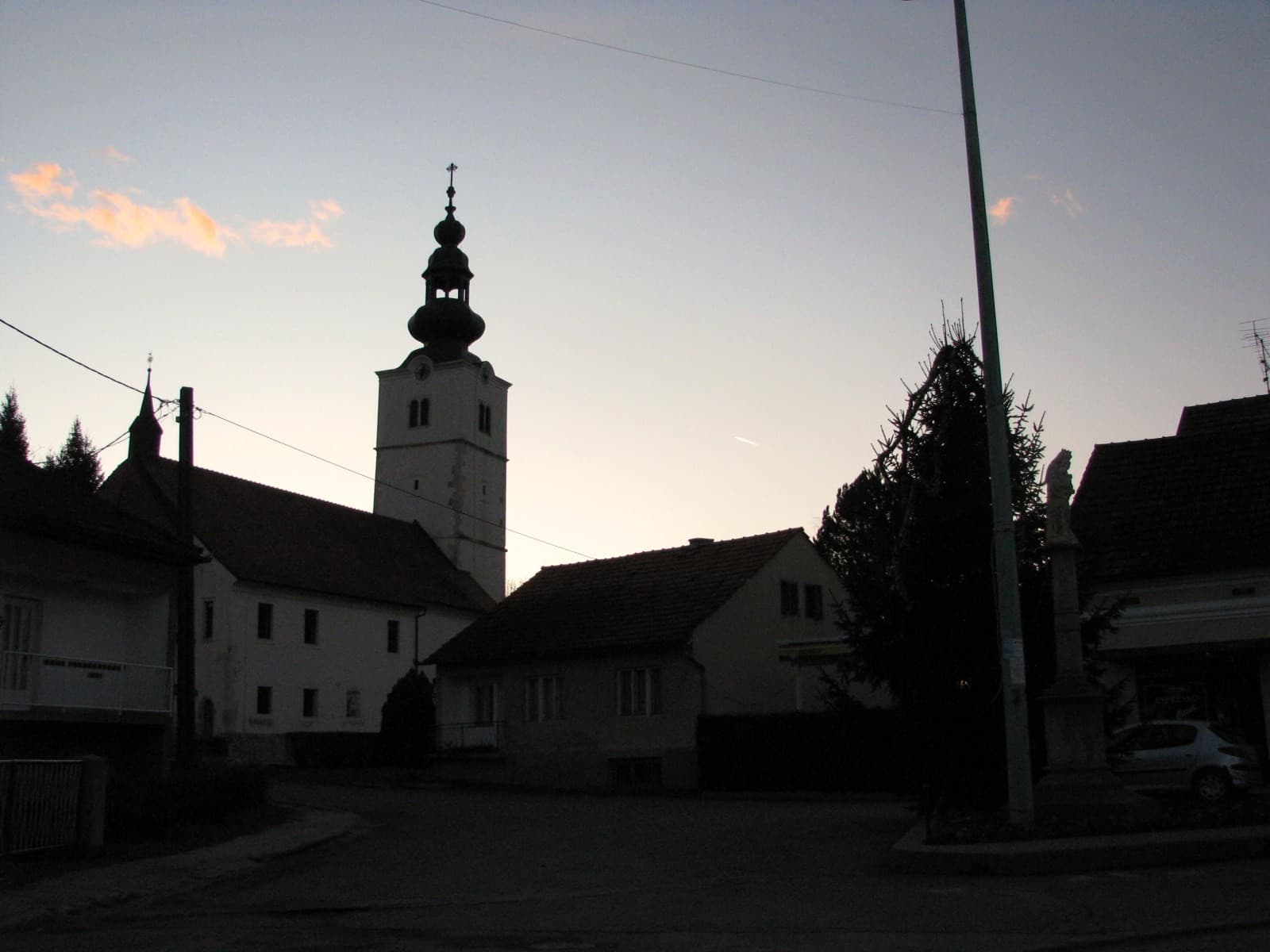
Marija Gorica is a small municipal centre set among the hills between Zaprešić and the River Sutla, nine kilometres northwest of Zaprešić. The municipality’s western edge descends towards the river and the Slovenian border, while vineyards and green slopes shape the surrounding Marijagorica uplands. The village centre is marked by the Baroque Church of the Visitation of the Blessed Virgin Mary, an 18th-century landmark containing both Gothic and Baroque furnishings. Local identity is also tied to literature and palaeontology: Croatian realist writer Ante Kovačić was born in nearby Oplaznik in 1854 and attended the village school, while the stylised prehistoric elephant on the municipal coat of arms recalls Deinotherium giganteum fossils discovered in the area. At Sveti Križ, a Gothic chapel recorded as early as 1334 preserves another layer of the district’s history. The hill of Lipa, meanwhile, opens views across the Sutla valley towards the Slovenian hills. Marija Gorica therefore suits a compact outing built around sacred heritage, Kovačić’s home landscape and the distinctive relief of Croatia’s western border country.
The village anchors a ten-settlement municipality extending from the Sutla lowlands to the local summits of Kipišče, Sveti Križ and Lipa. Its present name is associated with the Franciscans and devotion to the Virgin Mary, while the parish of Marija Gorica was established in 1789 after separating from Brdovec. Croatian realist Ante Kovačić turned the area’s ravines, meadows and cultivated slopes into the setting of his story “Zagorski čudak”. An even older local emblem appears on the municipal coat of arms: a prehistoric elephant inspired by fossils studied in the late 19th century by palaeontologist Dragutin Gorjanović-Kramberger.
Stays nearby
 Apartment
Apartmeni Klenovica.eu
Klenovica
Klenovica, 114 km from Marija Gorica
up to 4 guests · 1 bedroom
The host confirms the exact price for your dates and availability.
Things to do
Begin at the Church of the Visitation of the Blessed Virgin Mary, whose present Baroque appearance dates from a major rebuilding completed in 1758. Continue to the former village school, founded in 1854 and attended by writer Ante Kovačić, before tracing his connection with nearby Oplaznik. The next stop is Sveti Križ, where a Gothic chapel documented in 1334 stands above the surrounding slopes. Finish on Lipa hill with a view towards the Sutla valley. Cyclists can fold Marija Gorica into Zagreb County’s 29.3-kilometre mapped route, which links chapels and viewpoints across the hilly countryside west of Zaprešić.
Practical information
Getting there and around
Meštrović prijevoz bus 403 links Zaprešić ZELENGAJ with Marija Gorica and Žlebec, with selected circular services continuing through Kraj Gornji to Harmica. From Zagreb, a workable public-transport option is a suburban train to Zaprešić followed by a transfer to route 403; the operator publishes separate timetables for school terms and holidays. Marija Gorica lies nine kilometres northwest of Zaprešić, making the local roads from that town the most direct approach by car. Cyclists arriving from the Zaprešić side must climb into the Marijagorica hills, whereas the approach towards Harmica follows the flatter landscape near the Sutla.
Frequently asked questions
Why is there a prehistoric elephant on Marija Gorica’s coat of arms?
The emblem recalls Deinotherium giganteum fossils discovered in the Marijagorica uplands.
Which school did Ante Kovačić attend?
He attended the village elementary school in Marija Gorica, founded in 1854.
Is there a bus from Zaprešić?
Route 403 connects Zaprešić ZELENGAJ with Marija Gorica and Žlebec according to the operator’s published timetable.
Nearby

Celine Goričke
Village · Central Croatia

Related guides
Tuhelj
The population of the municipality has fallen from a peak of 3,780 in 1971 to 2,043 in 2021, and 61 people were lost in the last census decade alone. Eleven settlements, from Banska Gorica…
Read the guide

Help improve this page
Spot something missing or wrong? Suggest a correction, add your photo or report a problem. Editors review every suggestion before it is published.
Photo credits
- Marija Gorica — Janezdrilc · CC0 · Wikimedia Commons
- Celine Goričke, Kraj Gornji, Kraj Donji, Bijela Gorica, Oplaznik, Žlebec Pušćanski — Suradnik13 · CC BY-SA 4.0 · Wikimedia Commons
- Apartmeni Klenovica.eu — Apartmani Klenovica.eu


