
About this place
Krapina is a compact Zagorje town whose story stretches from the Neanderthals of Hušnjakovo to Ljudevit Gaj and the Croatian National Revival. Opened beside the original site in 2010, the Krapina Neanderthal Museum explores people who lived here around 125,000 years ago; the collection associated with the site includes roughly 900 human fossil remains. From the museum valley, it is an easy walk into the historic centre, where Gaj’s birthplace, Ljudevit Gaj Square, Magistratska Street and narrow Uska Street form a coherent urban route. Above them, the ruins of Krapina’s Old Town recall the medieval fortress visited by King Béla IV in 1225. Steep wooded hills frame the town: Josipovac contains the Forma Prima open-air sculpture park, while a Stations of the Cross path climbs to Trški Vrh and the Baroque Church of Our Lady of Jerusalem, built between 1750 and 1761. Trains connect Krapina with Zagreb via Zabok, while a car is useful for continuing to Trakošćan, Krapinske Toplice and Zagorje’s wine country.
Krapina is the administrative centre of Krapina-Zagorje County, yet its visitor identity rests on two stories found nowhere else. Hušnjakovo ranks among the world’s major Neanderthal sites, while Ljudevit Gaj’s birthplace links the town to the Illyrian movement and the development of modern Croatian. The historic centre grew below the fortified Old Town, beside the Krapinica stream and between steep Zagorje hills. This geography keeps the central sights close together, although the climbs towards Josipovac, the Old Town and Trški Vrh are considerably steeper than the stroll along Gajeva and Magistratska streets.
Stays nearby
 Apartment
Apartmeni Klenovica.eu
Klenovica
Klenovica, 142 km from Krapina
up to 4 guests · 1 bedroom
The host confirms the exact price for your dates and availability.
Things to see
The Krapina Neanderthal Museum opened beside Hušnjakovo in 2010; its multimedia exhibition connects directly with Croatia’s first protected palaeontological site. The Old Town preserves remnants of a fortress associated with a 1225 charter and a visit by King Béla IV. The Ljudevit Gaj Museum has occupied his birthplace since 1966, displaying family portraits, manuscripts and publications. The parish Church of St Nicholas is documented in 1311, while Trški Vrh is crowned by the richly decorated Church of Our Lady of Jerusalem, completed in 1761 and consecrated the following year.

Stari grad Krapina
Landmark · Krapina
Stari grad Krapina is a multi-layered medieval fortified settlement with remains situated on a hill above the town of Krapina.
Things to do
Spend the morning at the Krapina Neanderthal Museum and on the path to the Hušnjakovo site, then descend along Hrvatskih Branitelja Street towards the town centre. In Matica Hrvatska Park, visit Ljudevit Gaj’s birthplace before crossing his square and following Magistratska and Uska streets towards the Old Town. In the afternoon, walk through the Josipovac woods among the timber sculptures of Forma Prima. If time and energy allow, finish with the Stations of the Cross climb to Trški Vrh, where the Baroque Church of Our Lady of Jerusalem overlooks the Krapina valley.
Food and drink
Krapina belongs to the Zagorje food tradition of štrukli, turkey or duck with mlinci, pumpkin-seed oil, buckwheat and pork dishes. Kramberger Pub & Restaurant stands at 1 Ljudevit Gaj Square, directly on the walking route through the historic centre, and combines local ingredients with more contemporary plates. For a countryside setting, Vuglec Breg in nearby Škarićevo occupies a restored Zagorje hamlet with its own vineyard and cellar. Its regional repertoire includes štrukli, cornmeal cake, meat served with mlinci, and wines and sparkling wines produced on the estate.
Practical information
Practical information
Under its published 2026 schedule, the Krapina Neanderthal Museum opens Tuesday to Sunday from 9 a.m. to 5 p.m. between November and March, and from 9 a.m. to 7 p.m. between April and October; it closes on Mondays and specified public holidays. Last admission is one hour before closing, while group and expert tours require advance booking. Shoes with reliable grip are useful for Trški Vrh because the Stations of the Cross climbs a steep Zagorje hillside. Tourist information is available through the Krapina Tourist Board, and the museum, centre and Old Town can be linked on foot.
Parking
In 2026, Krapina operated three paid parking zones. The red first zone, covering Gajeva Street, Ljudevit Gaj Square and Magistratska Street, cost €0.70 per hour with a 120-minute limit. The yellow second zone charged €0.40 per hour, while the green third zone cost €0.30 with no time limit. For the Krapina Neanderthal Museum, the Hrvatskih Branitelja Street car park beside Hušnjakovo is particularly convenient and belongs to zone three. Payment is available at machines, by mobile parking and through the KEKS Pay and Bmove apps; check the signs for the precise zone.
Getting there and around
Krapina railway station lies on the Đurmanec–Zabok line, with onward connections to Zagreb via Zabok; HŽPP’s 2025/26 timetable remains valid until 12 December 2026. Krapina Nova bus station is operated by the Presečki group, which also runs county services to surrounding Zagorje settlements. By car, the town is approached from the Zagreb–Macelj A2 motorway at the Krapina interchange, the most practical option when combining Hušnjakovo with Trakošćan or Krapinske Toplice. From the railway station, both Ljudevit Gaj Square and the museum area can be reached on foot through the central town.
Frequently asked questions
How old are the Krapina Neanderthals?
The Hušnjakovo finds are associated with Neanderthals who lived at Krapina around 125,000 years ago.
Is the Neanderthal Museum open on Mondays?
No. Under the schedule published in 2026, the Krapina Neanderthal Museum is closed on Mondays.
Where is Ljudevit Gaj’s birthplace?
The birthplace and museum stand in Matica Hrvatska Park, on the walking route between Hušnjakovo and Ljudevit Gaj Square.
Where should I park for Hušnjakovo?
The closest option is the Hrvatskih Branitelja Street car park beside Hušnjakovo, in the green third zone.
Nearby

Trški Vrh
Village · Central Croatia

Related guides
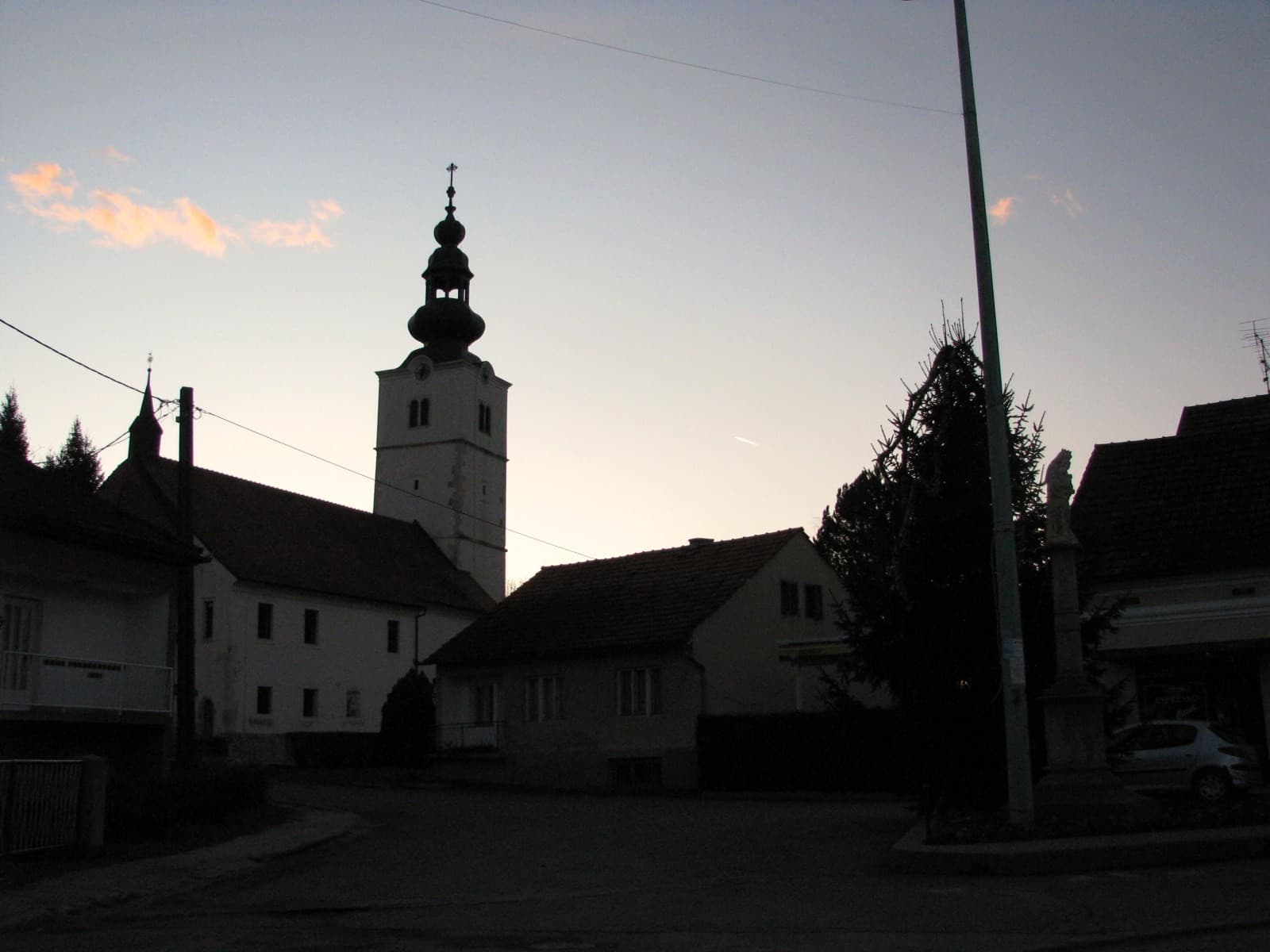
Tuhelj
The population of the municipality has fallen from a peak of 3,780 in 1971 to 2,043 in 2021, and 61 people were lost in the last census decade alone. Eleven settlements, from Banska Gorica…
Read the guide

Help improve this page
Spot something missing or wrong? Suggest a correction, add your photo or report a problem. Editors review every suggestion before it is published.
Photo credits
- Krapina — Mich973 · CC BY-SA 3.0 · Wikimedia Commons
- Trški Vrh, Crkva sv. Nikole (Krapina) — Zeitblick · CC BY-SA 3.0 · Wikimedia Commons
- Šušelj Brijeg — Sandor Bordas · CC BY-SA 3.0 · Wikimedia Commons
- Doliće


