
Hrašćina
About this place
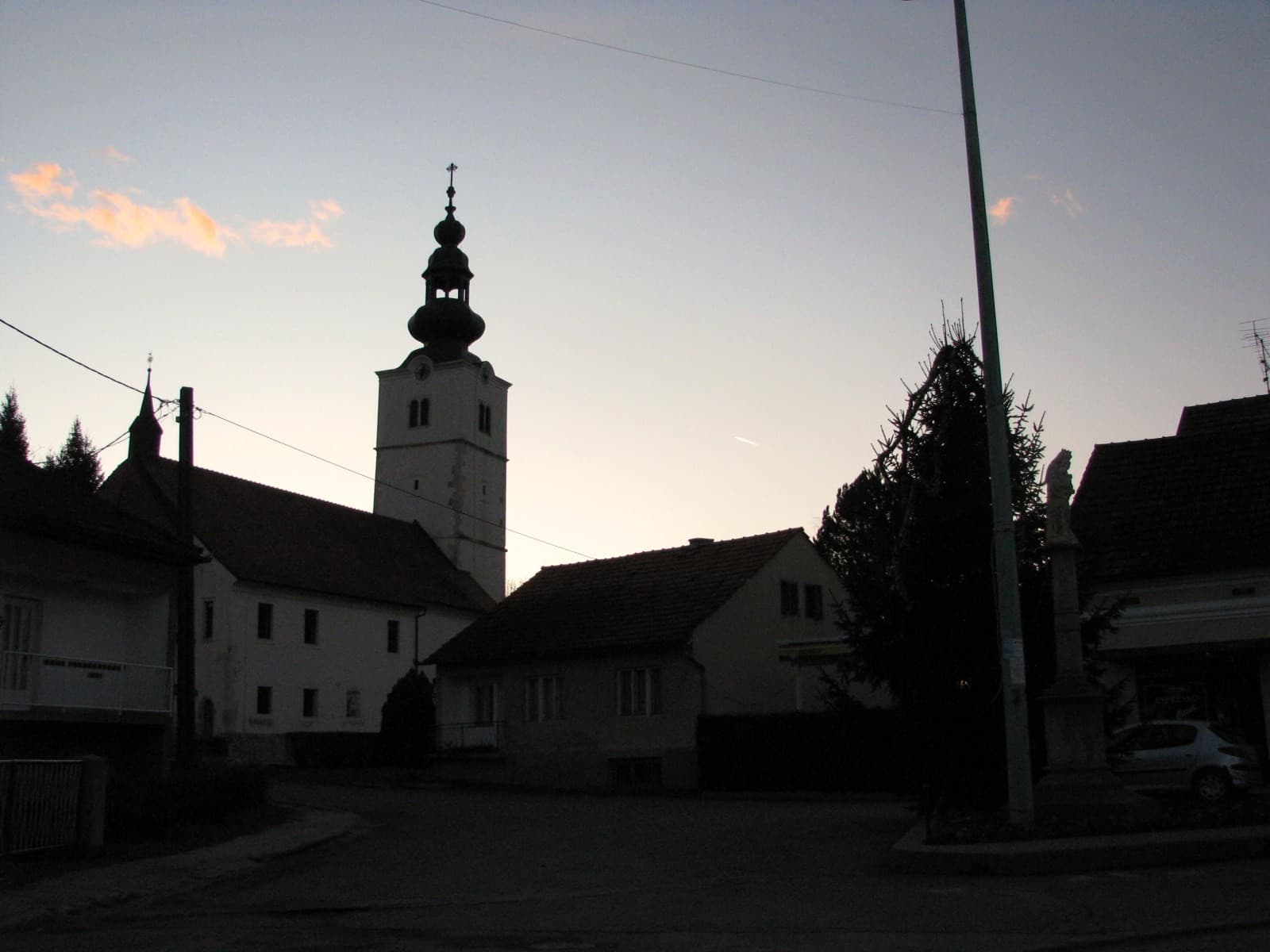
Hrašćina is a small Zagorje settlement near the Budinščina–Breznički Hum road, standing 235 metres above sea level close to the Krapina River. Its name travelled far beyond this rural corner after an iron meteorite crashed near Domovec on 26 May 1751, accompanied by a flash and a powerful detonation. The larger recovered mass weighed roughly 39 kilograms and is held by Vienna’s Natural History Museum; Zagreb’s Natural History Museum preserves a tiny slice and a cast. At the Kiternaši fall site, visitors find a memorial with a low obelisk, a life-size replica and an information panel written in Croatian, English and Esperanto. Hrašćina’s other major landmark is St Nicholas’s Church, where a Gothic sanctuary adjoins a Baroque-remodelled nave decorated with eighteenth-century illusionistic paintings. Hrašćina-Trgovišće station, on the Zagreb–Varaždin railway, provides a useful starting point for reaching the meteorite memorial. A day here can therefore combine an unusual chapter of astronomy, distinctive Zagorje church art and an unhurried walk through the surrounding hills.
Hrašćina’s identity rests on an exceptional link between a Zagorje village and the history of meteoritics. The 1751 fall was recorded through eyewitness testimony in the Kukuljević document, helping the object become important early evidence that iron masses could genuinely arrive from space. Its polished surface was later associated with the distinctive Widmanstätten pattern, and the specimen also became known as the “Zagreb iron.” A more earthly counterpoint is St Nicholas’s Church, remodelled in 1675 and 1761 and furnished with Late Baroque altars and a pulpit. Hrašćina is therefore not a conventional museum destination: its defining story unfolds between the church, the impact site at Domovec and the original meteorite preserved in Vienna.
Stays nearby
 Apartment
Apartmeni Klenovica.eu
Klenovica
Klenovica, 155 km from Hrašćina
up to 4 guests · 1 bedroom
The host confirms the exact price for your dates and availability.
Things to do
In Domovec, seek out the Hrašćina meteorite memorial and place it in the story of the two iron fragments that fell here on 26 May 1751. The larger piece weighed 39.76 kilograms and the smaller 8.96 kilograms; a slice of the larger fragment is held by the Croatian Natural History Museum in Zagreb. This was the world’s first officially documented fall of an iron meteorite, giving the stop real scientific weight. Continue to St Nicholas’s parish church in Hrašćina Trgovišće, where the fragments were taken after the fall before news reached the Bishop of Zagreb.
Practical information
Getting there and around
Hrašćina-Trgovišće station lies on the railway linking Zagreb and Zabok with Konjščina, Novi Marof and Varaždin. HŽ Passenger Transport’s timetable valid from 13 April to 12 December 2026 places it between Budinščina and Konjščina, at kilometre 76 in the published table from the Kotoriba direction. Local roads lead from the station towards Hrašćina, St Nicholas’s Church and Domovec, making a bicycle or car useful when combining the scattered sights. Drivers approach the village via the Budinščina–Breznički Hum road, then follow the paved route through Trgovišće towards Kiternaši for the meteorite memorial. Because some 2026 rail services vary by weekday, the exact departure should be selected in HŽPP’s journey planner before travelling.
Frequently asked questions
Where did the Hrašćina meteorite fall?
The meteorite fell on farmland in the Kiternaši hamlet at Domovec on 26 May 1751; a memorial with a replica now marks the site.
Where is the original meteorite kept?
The main specimen is held by Vienna’s Natural History Museum, while Zagreb’s Natural History Museum has a tiny slice and a cast.
Can Hrašćina be reached by train?
Yes. Hrašćina-Trgovišće station is on the Zagreb–Zabok–Varaždin route; check HŽPP’s 2026 timetable for the required departure.

Related guides
Tuhelj
The population of the municipality has fallen from a peak of 3,780 in 1971 to 2,043 in 2021, and 61 people were lost in the last census decade alone. Eleven settlements, from Banska Gorica…
Read the guide

Help improve this page
Spot something missing or wrong? Suggest a correction, add your photo or report a problem. Editors review every suggestion before it is published.
Photo credits
- Hrašćina — K. Korlević · Public domain · Wikimedia Commons
- Budinščina — Suradnik13 · CC BY-SA 4.0 · Wikimedia Commons
- Apartmeni Klenovica.eu — Apartmani Klenovica.eu · courtesy of the property owner
- Tuhelj — Ex13 · CC BY-SA 3.0 · Wikimedia Commons
- Sveti Martin na Muri — Silverije · CC BY-SA 3.0 · Wikimedia Commons
- Velika Gorica

