
Jalžabet
About this place
Jalžabet is a municipal centre in Varaždin County whose character is shaped by its railway halt, the Church of St Elizabeth of Hungary and the Bistričak archaeological zone. Its defining landmark is Gomila, a vast Early Iron Age burial mound at Bistričak, roughly a kilometre east of the village centre. It is about 75 metres across and eight metres high, and is protected as archaeological site Z-1945. Excavations have identified traces of a circular ditch around Gomila; a smaller mound some 130 metres to the east yielded a horse burial and finds with Scythian features. Somogy Castle and the Church of St Elizabeth of Hungary add two further historical stops in Jalžabet’s immediate surroundings. Jalžabet railway halt sits on the Varaždin–Koprivnica route, with Ludbreg the next larger stop eastbound. That makes the village a rewarding short outing for visitors drawn to Hallstatt-period archaeology and the quiet lowland landscape outside Varaždin.
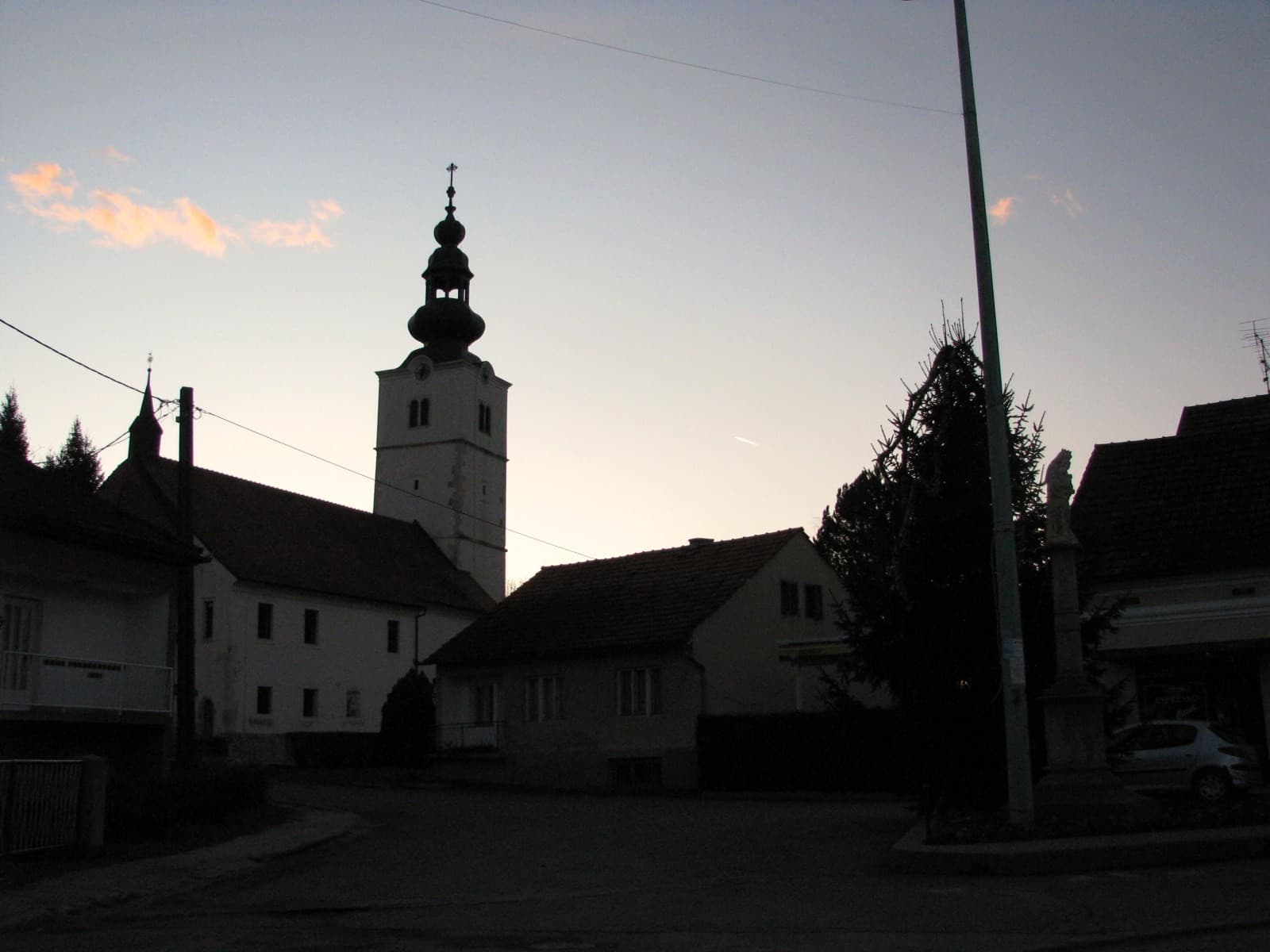
Jalžabet combines a lowland archaeological landscape with the vineyards of Topličko gorje. Although the present village is modest in size, its noble estate was first recorded in 1251 and later associated with families including the Bedekovićs, Patačićs and Somogys. The Somogy-Bedeković manor and the Church of St Elizabeth of Hungary provide the centre with its main historical landmarks. The church dedication is itself distinctive: the municipality identifies Jalžabet as Croatia’s only parish dedicated to St Elizabeth of Hungary. East of the village rises Gomila, an immense prehistoric tumulus within the Bistričak archaeological zone, giving Jalžabet significance beyond that of an ordinary settlement between Varaždin and Ludbreg.
Stays
No stays listed here yet
Things to do
Start in central Jalžabet at the Church of St Elizabeth of Hungary, then head east for about a kilometre to Bistričak. Gomila rises from the open landscape there: a protected Early Iron Age mound, registered as Z-1945, about 75 metres wide and eight metres high. Take in its scale from the surrounding paths rather than climbing its slopes, as this is an archaeological site. A smaller excavated mound with a horse burial lies around 130 metres east of Gomila, giving the necropolis a more tangible context. On the way back, include a look at Somogy Castle, roughly 1.1 kilometres from Bistričak.
Practical information
Getting there and around
For rail arrivals, use Jalžabet halt on the Varaždin–Koprivnica line. HŽ Passenger Transport lists it between Zbelava and Novakovec, with Ludbreg reached after Martijanec. Check the current HŽPP timetable before travelling, as works can bring replacement bus stops. For the Jalžabet–Ludbreg direction, HŽPP places the replacement stop on the Jalžabet–Vrbanovec main road just before the railway, by the access road. From the halt, Gomila at Bistričak is about a kilometre east on foot.
Frequently asked questions
Where does the rail-replacement bus stop?
Under HŽPP’s 2026 engineering arrangements, replacement buses use the regular bus stops on Varaždinska Street in both directions.
How large is Gomila in Jalžabet?
Gomila is about 75 metres across and around eight metres high.
Which period does Bistričak date from?
Bistričak is an Early Iron Age site associated with Hallstatt-period burial mounds.
What was found in the smaller mound near Gomila?
The smaller mound east of Gomila contained a horse burial and finds with Scythian characteristics.
Nearby

Imbriovec Jalžabetski
Village · Central Croatia
More nearby
Novakovec, Jalžabet
Village · Central Croatia
Related guides
Tuhelj
The population of the municipality has fallen from a peak of 3,780 in 1971 to 2,043 in 2021, and 61 people were lost in the last census decade alone. Eleven settlements, from Banska Gorica…
Read the guide

Help improve this page
Spot something missing or wrong? Suggest a correction, add your photo or report a problem. Editors review every suggestion before it is published.
Photo credits
- Jalžabet, Imbriovec Jalžabetski — Luka Hrgarek · CC BY-SA 3.0 · Wikimedia Commons
- Tuhelj — Ex13 · CC BY-SA 3.0 · Wikimedia Commons
- Sveti Martin na Muri — Silverije · CC BY-SA 3.0 · Wikimedia Commons
- Velika Gorica — Frane Lovošević · CC BY-SA 3.0 · Wikimedia Commons

