
Petrijevci
About this place
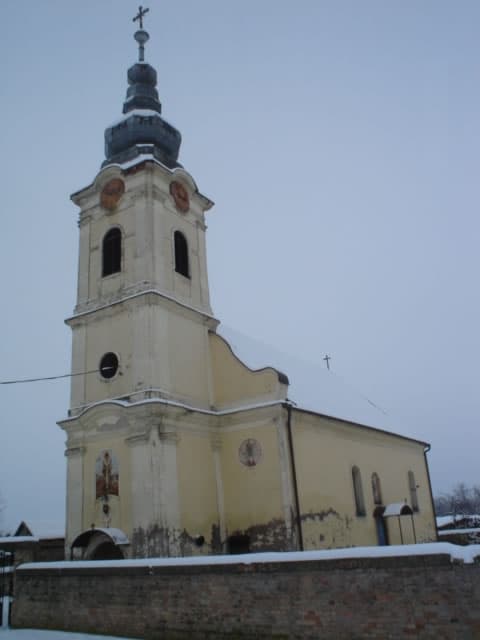
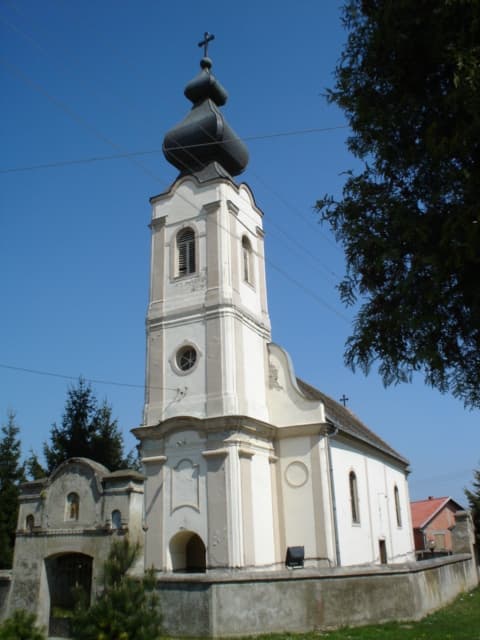
Petrijevci lies on the right bank of the Karašica River, between Valpovo and Osijek, beside the historic road linking the two towns. Its principal landmark is the late-Baroque parish church of St Peter the Apostle, begun in 1754 by Baron Petar Antun Hilleprand von Prandau. The single-nave church shapes the village centre and preserves a protected collection that includes the high altar, a painting of St Peter and old oak pews. The Karašica gives Petrijevci its recognisable setting in the Slavonian plain, while archaeological sites named Karaševo, Popovac, Starac, Španice and Volosavo point to much earlier settlement in the area. The village is about ten kilometres from Valpovo and fifteen kilometres from Osijek, making it a convenient stop between Valpovo’s heritage and Osijek’s museums. The Petrijevci Harvest Festival keeps local costumes, songs and a reconstruction of traditional harvesting in public view; the 2026 edition included a church celebration on 12 July.
Petrijevci is a lowland municipal centre standing 93 metres above sea level beside the Karašica and the Osijek–Valpovo road. Proximity to both towns has not erased its village layout or its ties to crop farming and livestock breeding. St Peter the Apostle’s Church, begun in 1754, is its clearest historic landmark and a protected cultural property. Archaeological sites bearing the names Karaševo, Popovac, Starac, Španice and Volosavo show that local heritage reaches beyond the Baroque church. Petrijevci’s identity is most visibly presented during its Harvest Festival, where costumes, music and reconstructed field work recall the agricultural calendar that shaped the settlement.
Things to see


Stays
No stays listed here yet
Things to do
Start at St Peter the Apostle’s Church and look inside for the high altar, the painting of the patron saint and the old oak pews. Afterwards, walk towards the Karašica to understand the riverside line along which Petrijevci developed. The local archaeological sites are not arranged as conventional open-air museums, so their history is best explored through municipal publications rather than by entering excavation areas. A July visit in 2026 could be combined with the Petrijevci Harvest Festival, whose programme brought together folk costumes, music, exhibitions and a church celebration rooted in the village’s agricultural traditions.
Tours and activities
AdAd · partner offers: GetYourGuideThe partner handles booking, payment and support. StayBravo may earn a commission on bookings made through these links.How we choose offersGetYourGuide offers are selected and ordered by GetYourGuide based on the name of the nearest larger town or national park; we do not influence their selection and do not use data about you.GetYourGuide · Osijek
We show GetYourGuide offers once you allow their cookies.
Practical information
Getting there and around
Petrijevci is approached along the road corridor linking Valpovo with Osijek’s western edge, while the 3.88-kilometre southern bypass, open since 29 June 2020, diverts through-traffic away from the village centre. The former D34 alignment along the main street is now classified as D673, and county road Ž4061 connects Petrijevci with Ladimirevci. Arriva services call at Petrijevci on routes between Osijek and Bizovac, Belišće or Donji Miholjac; check the date-specific timetable because departures change during school holidays. For onward travel to more distant Croatian cities, Osijek bus station is the practical interchange.
Frequently asked questions
When was St Peter’s Church in Petrijevci built?
Baron Petar Antun Hilleprand von Prandau began construction of the present late-Baroque church in 1754.
How far is Petrijevci from Osijek?
Petrijevci is approximately 15 kilometres northwest of Osijek, on the road towards Valpovo.
What does the Petrijevci Harvest Festival celebrate?
The festival presents Petrijevci’s folk customs and traditional harvesting practices; the 2026 edition also included a church celebration on 12 July.
Nearby
Petrijevci
Open in OpenStreetMap(opens in a new tab)straight-line distance
Related guides

Osijek
Tvrđa and the centre around the main square are distinct starting points for understanding Osijek. The former emphasises the fortified historic quarter and Baroque architecture; the latter…
Read the guide

Vukovar
A cultural visit to Vukovar has several separate centres of gravity. Eltz Palace and the City Museum address the city and its inhabitants across different periods. Vučedol reaches much…
Read the guide

Stubičke Toplice
Stubičke Toplice derives almost its entire identity from thermal water and the Zagorje landscape. There is no large urban historic core; green spaces, bathing facilities and traces of the…
Read the guide
Slavonski Brod
Slavonski Brod developed around one of the major crossings of the Sava, and that border and transport role left a strong mark on the city. Brod Fortress represents the eighteenth-century…
Read the guide
Know Petrijevci? Correct us
Tell us in your own words what is not accurate. We check right away.Do not enter personal data. Corrections are checked by the StayBravo AI assistant; changes to the description are approved by an editor. Use the form instead
Do you know Petrijevci?
Help the guests who come after you.
Help us complete
Nothing is published without an editor’s review.Report illegal content
Photo credits: Petrijevci, Samatovci, Nard — Robert Ruff (CC BY 3.0) · Josipovac, Šag — IvanOS (CC BY-SA 3.0) · Bizovac — Belirac (CC BY-SA 3.0) · Višnjevac, Osijek — Downluke (Public domain) · Church of St. Nicholas, Church of St. Peter and Paul — Ljubomir Damjanovic (CC BY-SA 3.0) · Prandau-Normann Castle, Osijek Zoo and Aquarium — Roko Poljak (CC BY-SA 4.0) · Osijek — Rp031 (CC BY-SA 4.0) · Vukovar — Bybbisch94, Christian Gebhardt (CC BY-SA 4.0) · Stubičke Toplice — MOs810 (CC BY-SA 4.0) · Slavonski Brod — Petar Milošević (CC BY-SA 4.0)