About this place
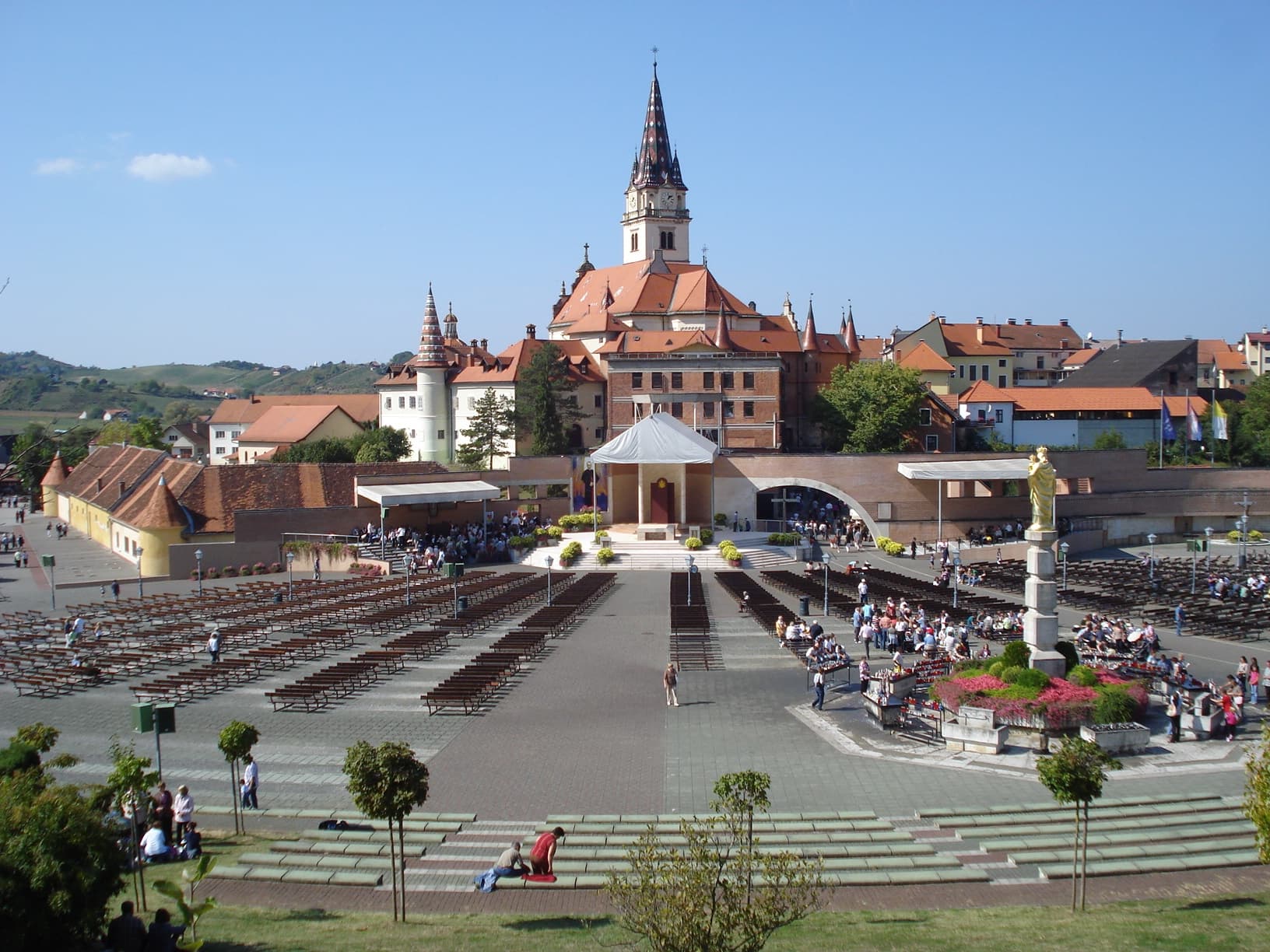
Marija Bistrica lies on Medvednica’s northern slopes, 32 kilometres north-east of Zagreb, and its daily rhythm revolves around Croatia’s National Shrine of Our Lady of Bistrica. The basilica houses a late-15th-century Gothic wooden Madonna and Child, now known as the Black Madonna; its rediscovery in 1684 accelerated the shrine’s growth as a pilgrimage centre. Hermann Bollé reconstructed the complex between 1878 and 1883, combining Gothic, Baroque and Renaissance references, and the church received the title of minor basilica in 1923. The Calvary rises behind the shrine: its first four life-size marble stations were installed in 1943, with later stations created by major Croatian sculptors. Local pilgrimage culture also survives through licitar hearts, wooden toys, medica and gvirc produced by Bistrica’s traditional honey-cake and candle makers. From Pope John Paul II Square, a short walk continues to the sculpture park on the Vinski Vrh road, about 500 metres away. Pope John Paul II’s visit on 3 October 1998, when he beatified Alojzije Stepinac, remains the defining event in the town’s modern history.
Marija Bistrica developed at an elevation of 191 metres on Medvednica’s northern side, beside the historic road linking Sesvete and Zagorje through Kašina and Laz. Bistrica was first recorded in 1209, while the present name became established as the Marian shrine expanded during the 18th century. The basilica, arcaded enclosure, Calvary and open-air church form a pilgrimage precinct far more prominent than an ordinary village square. Traditional licitar and honey-cake workshops, candle making and carved wooden toys give Marija Bistrica a distinctive craft identity beyond its religious celebrations.
Stays nearby
 Apartment
Apartmeni Klenovica.eu
Klenovica
Klenovica, 141 km from Marija Bistrica
up to 4 guests · 1 bedroom
The host confirms the exact price for your dates and availability.
Things to see
The Basilica of Our Lady of Bistrica contains a Gothic wooden Madonna and Child that was hidden in a church wall during the Ottoman threat and rediscovered in 1684. Hermann Bollé reshaped the complex from 1878 to 1883, combining Gothic, Baroque and German Renaissance elements. The first four life-size Carrara-marble stations on the Calvary were installed in 1943; later works were created by Kruno Bošnjak, Ante Orlić, Marija Ujević, Stanko Jančić, Josip Poljan and Ante Starčević. Another marked site recalls where Pope John Paul II beatified Alojzije Stepinac in 1998.
Things to do
Begin at the Shrine of Our Lady of Bistrica, home to the venerated Gothic Black Madonna, then take in the church façade and the forecourt on Pope John Paul II Square. Continue up the Calvary on the adjoining hill: its creation began in 1938 at Alojzije Stepinac’s initiative and was completed in 1990. Back in the centre, visit the Ethnographic Collection of Licitar Craft and look for a licitar heart or a wooden toy—two local traditions inscribed on UNESCO’s Representative List. This route joins the pilgrimage setting with the crafts that give Bistrica its distinctive character.
Food and drink
Dining in Marija Bistrica is rooted in Zagorje cooking, local wine and sweets associated with pilgrimage days. Bistricza and Academia operate within Hotel Kaj on Zagrebačka Street, presenting regional dishes in a hotel-restaurant setting. Bistro i pizzeria Bistrica is on Kralja Tomislava Street near the pilgrimage precinct, while Dobro nam došel prijatel is located on Nova cesta. Micak Winery in Hum Bistrički connects a meal with the municipality’s vineyard landscape. For flavours specific to the shrine town, seek out gvirc, medica and honey cakes from Marija Bistrica’s traditional honey-cake makers.
Practical information
Practical information
In 2026, the Marija Bistrica Tourist Board is temporarily based inside the municipal building at Trg pape Ivana Pavla II 34 and lists 099 707 3308 as its contact number. The basilica is an active shrine, so sightseeing must accommodate Masses, confessions, processions and major pilgrimages. Public toilets are available below the church, behind Hotel Kaj and beside the open-air church. Firm footwear is useful on the Calvary, while the longer route linking roadside crosses and chapels includes woodland, unpaved tracks and asphalt.
Getting there and around
Marija Bistrica is 32 kilometres north-east of Zagreb and six kilometres south-east of Zlatar Bistrica. The traditional road approach from Zagreb runs through Sesvete, Kašina and Laz on Medvednica’s northern side. Krapina-Zagorje County’s bus system lists Hanžeks, based in nearby Selnica, among local operators, but departures should be checked for the intended travel date. Zlatar Bistrica provides a more useful rail connection than the shrine settlement itself, so a train journey normally requires a final road transfer. A car or organised pilgrimage coach is more practical for reaching Vinski Vrh and the outlying chapels.
Frequently asked questions
How far is Marija Bistrica from Zagreb?
The Croatian Encyclopaedia places Marija Bistrica 32 kilometres north-east of Zagreb.
When did the church become a basilica?
Pope Pius XI granted it the title of minor basilica in 1923.
How far is the sculpture park from the square?
The sculpture park is about 500 metres from the main square, beside the tourist road towards Vinski Vrh.
What is Bistrica gvirc?
Gvirc is an aromatic honey-based drink associated with the town’s traditional honey-cake and candle-making craft.
Nearby

Tugonica
Village · Central Croatia

Related guides
Tuhelj
The population of the municipality has fallen from a peak of 3,780 in 1971 to 2,043 in 2021, and 61 people were lost in the last census decade alone. Eleven settlements, from Banska Gorica…
Read the guide

Help improve this page
Spot something missing or wrong? Suggest a correction, add your photo or report a problem. Editors review every suggestion before it is published.
Photo credits
- Marija Bistrica, Sveti Martin na Muri — Silverije · CC BY-SA 3.0 · Wikimedia Commons
- Tugonica — Andres rus · CC BY-SA 3.0 · Wikimedia Commons
- Laz Bistrički — Slavko Stepanić · CC BY-SA 3.0 · Wikimedia Commons
- Apartmeni Klenovica.eu — Apartmani Klenovica.eu · courtesy of the property owner
- Tuhelj — Ex13 · CC BY-SA 3.0

