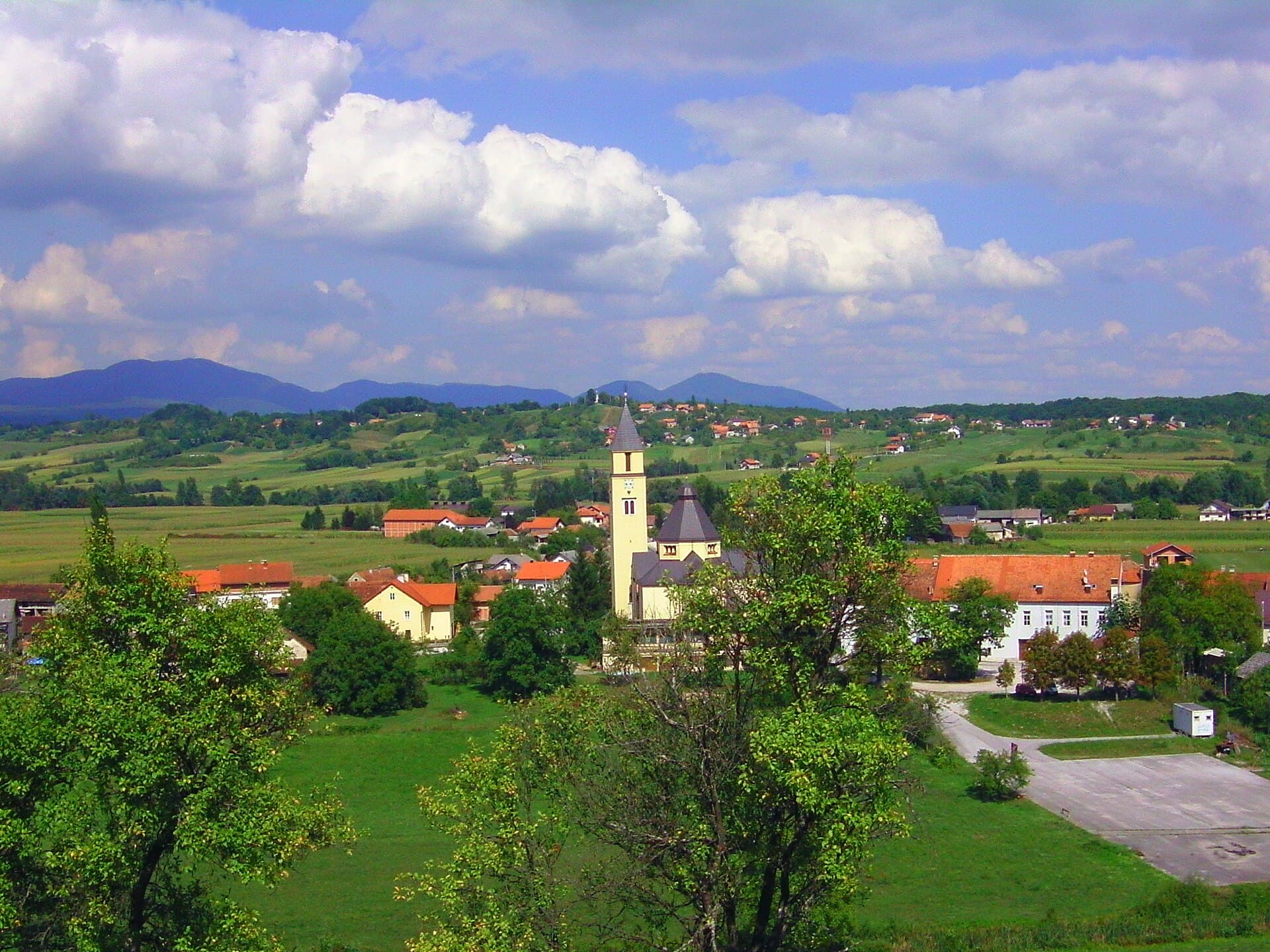
About this place
Krašić is a small settlement between Zagreb and Karlovac, on the southern edge of the Žumberak region and about 50 kilometres southwest of Zagreb. Its identity is inseparable from Blessed Alojzije Stepinac, who lived under confinement in the parish house from 1951 until his death on 10 February 1960 after imprisonment at Lepoglava. His former rooms now form a memorial displaying personal belongings. On the main square, the Parish Church of the Holy Trinity—first recorded in 1334—was enlarged to plans by architect Stjepan Podhorsky between 1911 and 1913. Krašić is more than a pilgrimage destination: vineyard-covered hills surround the village, and local roads, gravel tracks and forest paths suit recreational cycling. About 300 metres from the centre, the old Mrzljak family house recreates an earlier rural household. Toward Pribić, visitors encounter the Church of St Sixtus, a Greek Catholic episcopal residence and the unusual Church of the Annunciation on a tiny artificial island. A car is the easiest way to connect these dispersed sights because public transport is limited. Krašić is particularly rewarding for travellers interested in sacred heritage, Stepinac’s life, wine-growing landscapes and a quieter gateway to Žumberak.
Krašić developed in a wine-growing valley on the approach to Žumberak, between Jastrebarsko and Ozalj. Tourism literature places it at the heart of the Valley of the Cardinals because of its links with Alojzije Stepinac and Franjo Kuharić, who was born in nearby Pribić. The Church of the Holy Trinity and the parish house dominate the centre, and pilgrimage days strongly influence both the appearance and rhythm of the village. Beyond the square, vineyards, orchards, forest roads and scattered hamlets preserve Krašić’s rural character rather than that of a purpose-built visitor resort.
Stays nearby
 Apartment
Apartmeni Klenovica.eu
Klenovica
80 km from Krašić
up to 4 guests · 1 bedroom
The host confirms the exact price for your dates and availability.
Things to see
The Church of the Holy Trinity was first recorded in 1334, probably Baroque remodelled in 1759, and given its bell tower in 1771. Inside are a Gothic sanctuary, a 1743 altar, a Rococo monstrance and ceiling paintings by Marko Rašica. The parish house preserves the rooms where Stepinac spent 2,990 days between his arrival in 1951 and death in 1960, together with personal objects and his canary’s cage. At Strmec Pribićki stands the episcopal residence with a portal dated 1751; the nearby Greek Catholic Church of the Annunciation was begun in 1911 to a design by Podhorsky.
Things to do
Begin on the main square with the Church of the Holy Trinity, then visit Stepinac’s memorial rooms upstairs in the parish house. Continue on foot to the old Mrzljak family home, roughly 300 metres from the centre, where the display recreates domestic life in the Krašić area. Next drive toward Pribić to combine the Church of St Sixtus, the Greek Catholic episcopal residence and the small Annunciation church on its island. End with a bicycle ride using the area’s mix of asphalt, gravel and forest tracks, or arrange a tasting at Vina Ćuk, Krašić 107b.
Practical information
Practical information
The Krašić municipal tourist board is based at Krašić 101 and publishes the contact number +385 99 871 6389. Advance arrangements are advisable for Stepinac’s memorial, the churches around Pribić and wine tastings, since access may depend on parish duties or the host’s availability. Krašić has shops and a petrol station, but dispersed sites such as Strmec Pribićki, Dol and Gornje Prekrižje require private transport. Stepinac’s feast day and the May Days of the Krašić Region bring substantially more pilgrims and visitors into the centre than an ordinary weekend.
Getting there and around
Krašić has no railway station; the nearest useful rail connection passes through Jastrebarsko on the Zagreb–Karlovac route. The published timetable for bus 260A links Jastrebarsko, Krašić and Pribić on weekdays, with a small number of direct services between Pribić and Zagreb, but none on Saturdays, Sundays or public holidays. That timetable dates from 2021 and should be reconfirmed before travel. A car remains the practical solution for the outlying churches, manor houses, wineries and villages, especially when continuing toward Ozalj or Žumberak.
Frequently asked questions
How long did Stepinac live in the Krašić parish house?
He spent 2,990 days in the parish house, from his arrival in 1951 until his death on 10 February 1960.
What is preserved inside the Holy Trinity church?
The church contains a Gothic sanctuary, a 1743 Baroque altar, a Rococo monstrance, a wooden Calvary relief and ceiling paintings by Marko Rašica.
Where is the Annunciation church on an island?
It stands on a small artificial island in the park of the Greek Catholic episcopal complex at Strmec Pribićki.
Does the bus to Krašić run at weekends?
The published 260A timetable for Jastrebarsko–Krašić–Pribić lists weekday services only, with none on Saturdays, Sundays or public holidays.
Nearby

Strmac Pribićki
Village · Central Croatia
More nearby
Vranjak Žumberački
Village · Central Croatia
Related guides
Tuhelj
The population of the municipality has fallen from a peak of 3,780 in 1971 to 2,043 in 2021, and 61 people were lost in the last census decade alone. Eleven settlements, from Banska Gorica…
Read the guide

Help improve this page
Spot something missing or wrong? Suggest a correction, add your photo or report a problem. Editors review every suggestion before it is published.
Photo credits
- Krašić — Bern Bartsch · CC BY-SA 3.0 · Wikimedia Commons
- Strmac Pribićki — Perun at German Wikipedia · CC BY-SA 3.0 · Wikimedia Commons
- Apartmeni Klenovica.eu — Apartmani Klenovica.eu · courtesy of the property owner
- Tuhelj — Ex13 · CC BY-SA 3.0 · Wikimedia Commons
- Sveti Martin na Muri — Silverije · CC BY-SA 3.0 · Wikimedia Commons

