About this place
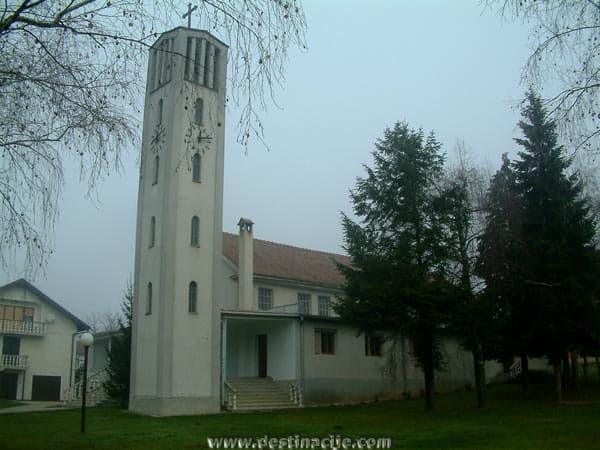
Nova Gradiška was founded as a planned Military Frontier settlement in 1748, and its rectangular square and orderly street grid still reveal the administrative logic behind the town’s creation. A walk through the centre links the Church of St Teresa of Ávila, begun in 1754, the former Main Guard building with its distinctive arcades, the Town Museum and the Church of the Immaculate Conception. The last contains murals by Celestin Medović, including scenes of the Nativity and Holy Trinity together with figures of the Evangelists. Ulica slavonskih graničara now serves as the central promenade, while a formally arranged park brings greenery into the historic core. The town’s position beside the A3 motorway and Zagreb–Vinkovci railway gives it a strong transit role, yet a visit can readily extend beyond the centre: Cernik and its Franciscan monastery lie immediately north, and the Strmac recreation area beneath Psunj is about ten kilometres away. Local menus draw on the cooking of the old frontier region, including čobanac stew and sarma.
Nova Gradiška was founded on 1 May 1748 as the future command post of the Gradiška Border Regiment, following Maria Theresa’s decision to reinforce the Empire’s southern frontier. The date places it among Croatia’s younger urban centres, while its frontier origin explains its deliberately planned military-administrative character. From 1748, the Military Frontier established military communities as privileged craft and trading centres, and Nova Gradiška developed within that wider Slavonian frontier setting. Its identity is therefore tied to the Gradiška Border Regiment rather than to a medieval town core.
Stays nearby
 Apartment
Apartmeni Klenovica.eu
Klenovica
Klenovica, 200 km from Nova Gradiška
up to 4 guests · 1 bedroom
The host confirms the exact price for your dates and availability.
Things to see
The Church of St Teresa of Ávila was built between 1754 and 1765 and is marked by an unusual pyramidal late-Baroque tower. The former Main Guard, courthouse and prison are recognised by a ground-floor arcade of rounded arches, locally called bolte. Built from 1811 to 1828, the Church of the Immaculate Conception contains Medović murals depicting the Nativity, Holy Trinity, Evangelists and musical figures. The Town Museum covers archaeology, local history and visual arts, while the central park was laid out with a regular network of paths inspired by formal French gardens.
Things to do
Start at Trg kralja Tomislava with the Church of St Teresa of Ávila, the town’s oldest major Baroque building. Continue past the arcades of the former Main Guard to the Town Museum, housed in a historic building at number 7. Next, visit the Church of the Immaculate Conception, where works by Celestin Medović cover parts of the vault and sanctuary walls. Complete the central circuit along the pedestrianised Ulica slavonskih graničara and through the geometric paths of the town park. Extend a half-day visit with a short drive to Cernik, continuing to Strmac for a walk beneath Psunj.
Food and drink
The easiest introduction to Nova Gradiška’s food is through restaurants participating in the county’s Flavours of Frontier Posavina project. The Brod-Posavina County tourist board highlights Slavonski biser, Dukat and the restaurant of Hotel Kralj Tomislav among the town’s options. Slavonski biser combines accommodation with regional dishes such as sarma and the paprika-rich meat stew čobanac. This style of meal echoes the history of a town created within the Military Frontier, while the urban locations allow visitors to walk back towards Trg kralja Tomislava, the town park and the promenade along Ulica slavonskih graničara.
Practical information
Practical information
Visitor information is available in the historic centre, within the former guardhouse and prison adapted as the Gateway to Slavonia visitor centre. The Town Museum is at 7 Trg kralja Tomislava; its published 2026 information lists opening from 7:00 to 15:00, with visits at other times available by prior arrangement. Most central sights—the two churches, museum, park and Ulica slavonskih graničara—fit within a walkable area, so a car is unnecessary once parked. An excursion to Strmac requires a further road journey of roughly ten kilometres north of town.
Getting there and around
By road, Nova Gradiška is reached from the Nova Gradiška interchange on the A3 motorway, with state road D51 leading towards Požega. International railway line M104—Novska, Vinkovci, Tovarnik and the state border—runs through the city, and HŽ Passenger Transport lists the station at 5 Kolodvorska Street. Arriva’s bus station is about 100 metres from the railway station and roughly a ten-minute walk from the centre. Rail and coach journeys can therefore be combined without crossing the city.
Frequently asked questions
When was Nova Gradiška founded?
Nova Gradiška was founded in 1748 as a planned settlement within the Military Frontier.
Where can the Medović murals be seen?
Celestin Medović’s murals are inside the Church of the Immaculate Conception.
What are Nova Gradiška’s bolte?
Bolte is the local name for the rounded ground-floor arcades of the former Main Guard, courthouse and prison.
How far is Strmac from town?
The Strmac recreation area lies roughly ten kilometres from Nova Gradiška beneath Psunj.


Related guides

Osijek
Tvrđa and the centre around the main square are distinct starting points for understanding Osijek. The former emphasises the fortified historic quarter and Baroque architecture; the latter…
Read the guide

Help improve this page
Spot something missing or wrong? Suggest a correction, add your photo or report a problem. Editors review every suggestion before it is published.
Photo credits
- Nova Gradiška — ZeljkoStuttgart at German Wikipedia · Public domain · Wikimedia Commons
- Prvča — Ex13 · CC BY-SA 3.0 · Wikimedia Commons
- Cernik — MagdalenaSad · CC BY-SA 4.0 · Wikimedia Commons
- Rešetari — Brkang · Public domain · Wikimedia Commons
- Apartmeni Klenovica.eu — Apartmani Klenovica.eu · courtesy of the property owner
- Osijek