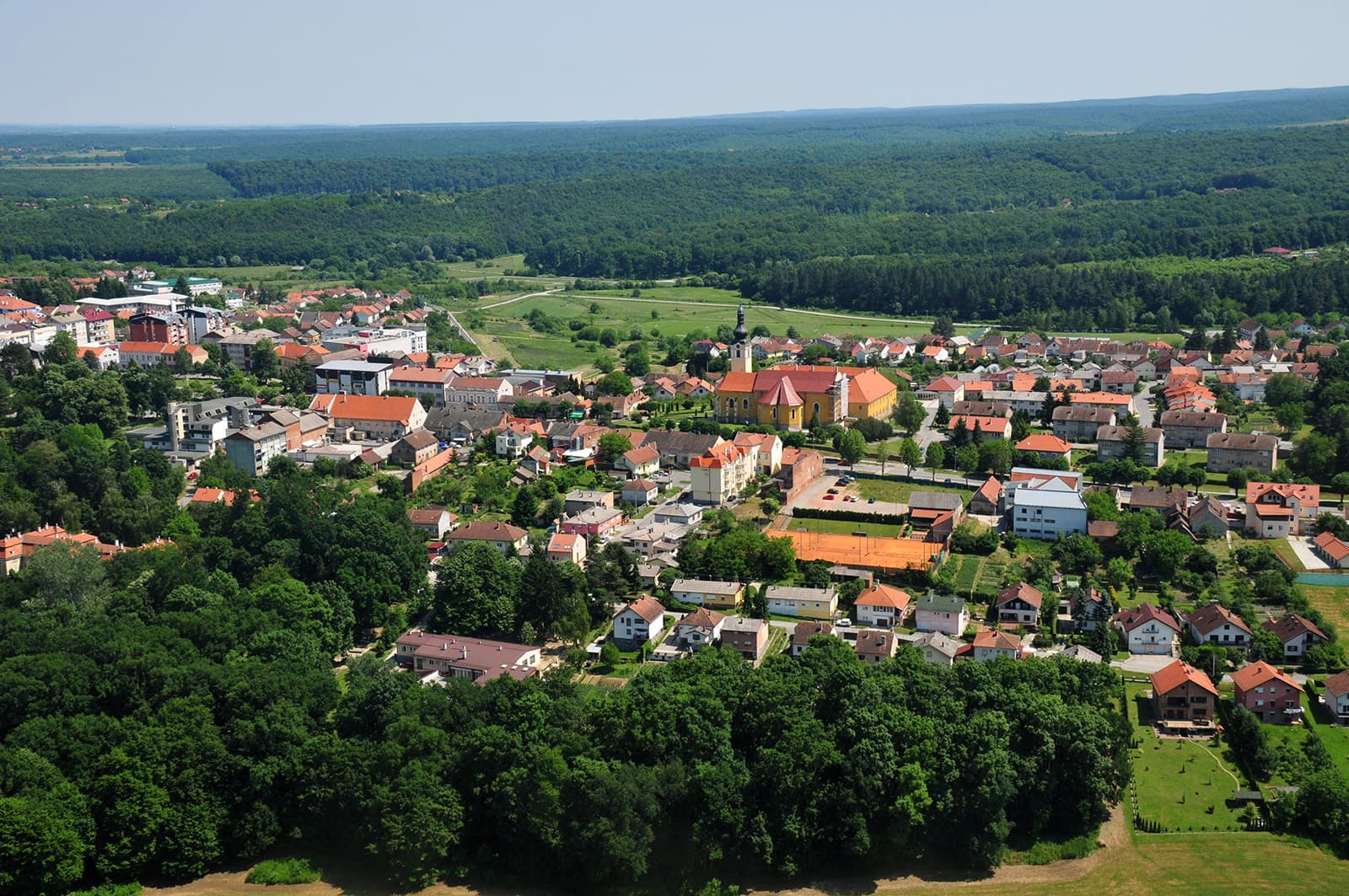
Našice
About this place
Našice lies 51 kilometres south-west of Osijek where the Slavonian plain meets the northern foot of Krndija. First recorded in 1229, the town’s present visual identity is most strongly associated with the Pejačević family, owners of the estate from the 18th century until 1945. The restored Great Castle, dating from 1812, now houses the Local History Museum; its period rooms, family possessions and Dora Pejačević’s piano recreate the atmosphere of an aristocratic home. The protected park also contains the Small Castle, mature trees and an artificial lake. A historical walk continues to the Franciscan Church of St Anthony of Padua, the monastery library with ten incunabula and the Pejačević mausoleum of 1881. Three kilometres from the centre, Lapovac reservoir—created in 1993—supports running, cycling and fishing. Našice is also a road and railway junction for Osijek, Virovitica, Đakovo and Slavonski Brod, making it a useful base for Martin, Feričanci, Orahovica and the Krndija forests.
Našice joins the Slavonian plain to the hills of Krndija, and its defining landmark is not a fortress or cathedral but the Pejačević aristocratic estate. The Great and Small Castles, landscaped park and family mausoleum form a coherent ensemble associated with composer Dora Pejačević and two Croatian bans born in the castle. An older layer survives in the Franciscan community and Church of St Anthony of Padua, while Lake Lapovac gives the town a modern recreational focus. Its position on the Varaždin–Virovitica–Osijek road and railway corridor, with routes towards Đakovo and Slavonski Brod, makes Našice a junction between Podravina, Osijek and central Slavonia.
Stays nearby
 Apartment
Apartmeni Klenovica.eu
Klenovica
Klenovica, 258 km from Našice
up to 4 guests · 1 bedroom
The host confirms the exact price for your dates and availability.
Things to see
The Great Pejačević Castle was built in 1812 and now contains the renewed Local History Museum of Našice. Its permanent displays combine ceremonial rooms, original Pejačević possessions, ethnography, pottery and the legacy of Dora Pejačević. The surrounding park holds the Small Castle, an ornamental lake and mature native and exotic trees. The Church of St Anthony of Padua and a Franciscan library containing ten incunabula represent the town’s religious heritage, while the Pejačević mausoleum of 1881 preserves family graves. Nearby Martin contains a rare Romanesque church associated by local tourism sources with the Knights Templar and the 13th century.

Things to do
Begin a Našice visit at the Great Pejačević Castle, built in 1811–12, where the local museum presents restored reception rooms, a bedroom, library and music salon with Dora Pejačević’s piano. Then walk through the park to the Small Castle, built for Marko Pejačević in the early 20th century. The park’s northern section leads to a lake with an islet, laid out in the second half of the 19th century when the grounds took on their Romantic character. Complete the loop at Dora’s Pavilion beside the lake, reconstructed in 1983.
Food and drink
Našice offers a choice between regional Slavonian cooking and quicker urban meals. Egghus at 142 Ulica kralja Tomislava lists a pork escalope filled with kulen and cheese, lamb cutlets with porcini and dishes cooked under a metal bell. The Bricks at 133 Ulica braće Radića has operated since 2007, serving daily set lunches and à-la-carte dishes, with a terrace and private parking. Bon Appetit at 52 Ulica braće Radića offers more than forty pizza varieties alongside grilled food, pasta and baked beans. All three addresses lie within the urban area of Našice.
Practical information
Practical information
The tourist board and Local History Museum use the address 7 Trg dr. Franje Tuđmana within the restored Pejačević castle complex. Information published in 2026 lists museum opening from Tuesday to Saturday, 10:00–16:00; groups and any photography or filming of the permanent exhibition require a week’s advance notice. Lapovac is not an officially equipped bathing site, making its shores more appropriate for walking, cycling, picnics and regulated angling. Našice railway station is at 4 Kolodvorska, outside the immediate castle-park circuit.
Parking
Našički park operates the municipal parking service and published a tariff effective from 1 June 2026. As charging is governed by the tariff and municipal decisions, drivers should read the zone, price and maximum stay from the sign beside their chosen space. For the castle and museum, use marked central spaces around Trg dr. Franje Tuđmana rather than driving into the protected park. According to the tourist board, The Bricks at 133 Ulica braće Radića and Bon Appetit at number 52 provide private parking for their customers.
Getting there and around
Našice lies on the Varaždin–Virovitica–Osijek road and rail corridor, 51 kilometres south-west of Osijek. State roads also connect it with Đakovo, Donji Miholjac and Slavonski Brod, making a car practical for exploring Krndija and surrounding villages. HŽ Passenger Transport lists Našice station at 4 Kolodvorska and provides a dedicated timetable page for Našice–Osijek services. Departures in the 2026 timetable should be checked for the intended date because engineering works can produce temporary changes and replacement transport.
Frequently asked questions
Where is Dora Pejačević’s piano displayed?
Dora Pejačević’s piano is displayed in the music room of the Local History Museum inside the Great Castle.
How far is Lapovac from central Našice?
Lake Lapovac is approximately three kilometres from the town centre.
Is Lapovac an official bathing area?
Lapovac is not an officially equipped bathing area; it is primarily used for walking, cycling, picnics and angling.
When was the Great Pejačević Castle built?
The Great Pejačević Castle was built in 1812 and now houses the Local History Museum of Našice.
Nearby

Martin, Našice
Village · Slavonia

Related guides

Osijek
Tvrđa and the centre around the main square are distinct starting points for understanding Osijek. The former emphasises the fortified historic quarter and Baroque architecture; the latter…
Read the guide

Help improve this page
Spot something missing or wrong? Suggest a correction, add your photo or report a problem. Editors review every suggestion before it is published.
Photo credits
- Našice — Ivancosic2804 · CC BY-SA 4.0 · Wikimedia Commons
- Martin, Našice — Roko Poljak · CC BY-SA 4.0 · Wikimedia Commons
- Markovac Našički — Frane Lovošević · CC BY-SA 3.0 · Wikimedia Commons
- Gradac Našički — Robert Ruff · CC BY 3.0 · Wikimedia Commons


