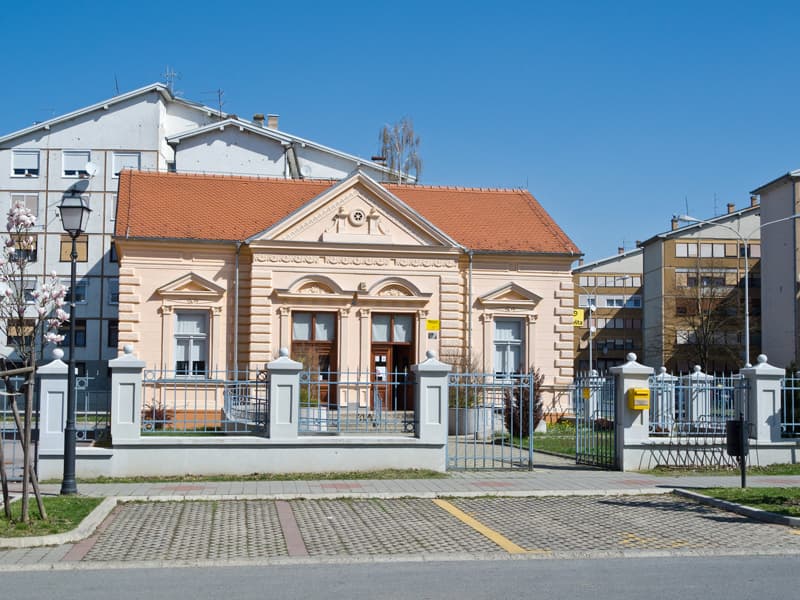
Lipik
About this place
Lipik is a Slavonian spa town shaped by thermal mineral water, a historic park and Lipizzaner breeding. Its spring water emerges at 62°C, while written references to its use reach back to the 16th century. During the late 19th century, the spa acquired the Kursalon, Wandelbahn, villas, avenues and an elaborate landscaped park, giving central Lipik the character of a Central European resort rather than a typical small Slavonian town. The spa park covers about 12 hectares and has been protected as a monument of landscape architecture since 1965. Lipik’s second defining story belongs to its state stud farm. Count Izidor Janković founded it in 1843; it gained state status in 1938, and the surviving horses taken away in 1991 finally returned on 13 October 2007. Visitors can now meet the Lipizzaners and arrange riding or carriage experiences. Beyond the spa, paths reach Antunovo spring and Jelkin brijeg, while lakes Raminac and Pjeskara and the woodland retreat at Točak reveal the town’s green edge.
Lipik developed not around a fortress or market square but around medicinal water and a spa park. The Janković family controlled the estate from 1760 to 1861 and encouraged the creation of avenues, pavilions and social spaces for spa guests. In the late 19th century the resort gained its distinctive Central European architecture, while the railway made travel easier and helped distribute bottled mineral water. The park combines a historicist Neo-Baroque northern section beside the spa with a late Romantic southern landscape. Lipizzaners, thermal water and spa architecture damaged during the war and subsequently restored now form the three intertwined strands of Lipik’s identity.
Stays nearby
 Apartment
Apartmeni Klenovica.eu
Klenovica
Klenovica, 184 km from Lipik
up to 4 guests · 1 bedroom
The host confirms the exact price for your dates and availability.
Things to see
Founded in 1843, the Lipik State Stud Farm now houses about sixty Lipizzaners, but its story also encompasses the destruction of 1991 and the surviving horses’ return in 2007. The spa park, protected since 1965, covers approximately 12 hectares and preserves both historicist and late Romantic landscaping. Jelkin brijeg in the southern park was named after a daughter of the Janković family, for whom a lookout pavilion was created above the trees. The Kursalon and Wandelbahn form the architectural heart of the old resort, while Antunovo spring offers a direct encounter with Lipik’s thermal mineral water, which reaches 62°C at its source.
Things to do
Start a day in Lipik by walking from the spa complex through the century-old park, passing Antunovo spring, the Wandelbahn and Jelkin brijeg. Continue to the State Stud Farm, where visitors can meet Lipizzaners in their home stables and arrange recreational riding or a carriage tour through town. In the afternoon, head to Lake Raminac opposite the stud; created by a dam in 1973, it extends for roughly 800 metres. Lake Pjeskara offers an easy walking or cycling circuit and has two small rest huts. For a more active finish, continue five kilometres to Točak spring, where a hikers’ shelter and a marked route lead onto the slopes of Psunj.
Food and drink
Lipik’s dining options cluster around the spa, town centre and stud farm. Kamene kupke operates within the Toplice Lipik complex and provides step-free access for guests with reduced mobility. Restaurant Nada occupies a family house near the centre, with heated dining rooms, a terrace and garden, while Pizzeria and Bistro Lukas combines pizzas and meat dishes with an open kitchen. Zdravljak Fontana beside the spa specialises in cakes, ice cream and Turkish-style coffee prepared in a džezva. Restaurant Ergela stands beside the stables and a large car park and is geared mainly towards larger functions, so independent visitors should confirm availability before going.
Practical information
Practical information
Visitor information is provided by the Lipik Tourist Board, which publishes maps covering restaurants, picnic areas and town facilities. For exploring the centre, follow the yellow parking signs to the large visitor car park at the end of Hrvatske mladeži Street, beside the outdoor pools and Lipik Glas factory. The State Stud Farm’s winter 2026 information states that it opens daily, although riding and carriage experiences should be arranged directly with the farm. Thermal treatments belong to the Toplice Lipik programme; the quoted temperature of 62°C describes the source water, not the bathing water provided to guests.
Parking
The principal visitor car park is at the end of Hrvatske mladeži Street, beside the outdoor pool complex and the Lipik Glas factory. Yellow parking signs installed by the tourist board direct drivers there, particularly useful during fairs and programmes held in the spa park. The State Stud Farm has a separate large parking area beside its restaurant and stables, so visitors heading only to the farm need not leave their car in the spa centre. No verifiable unified municipal parking tariff for 2026 has been published in the consulted official material, so no prices or parking zones are listed here.
Frequently asked questions
How hot is Lipik’s water at the source?
Lipik’s thermal mineral water has a constant source temperature of 62°C.
When was the Lipik stud founded?
Count Izidor Janković founded the stud in 1843, and it received state status in 1938.
When did the displaced Lipizzaners return?
The surviving horses returned to their home stables on 13 October 2007.
Where is Jelkin brijeg?
Jelkin brijeg stands in the southern part of Lipik’s spa park and is approached along a linden avenue.
Which lake lies opposite the stud farm?
Nearby

Donji Čaglić
Village · Slavonia

Related guides

Osijek
Tvrđa and the centre around the main square are distinct starting points for understanding Osijek. The former emphasises the fortified historic quarter and Baroque architecture; the latter…
Read the guide

Help improve this page
Spot something missing or wrong? Suggest a correction, add your photo or report a problem. Editors review every suggestion before it is published.
Photo credits
- Lipik, Pakrac — Roberta F. · CC BY-SA 3.0 · Wikimedia Commons
- Donji Čaglić — Bariloche2018, Commons · CC BY-SA 4.0 · Wikimedia Commons
- Prekopakra — Philipp2018 · CC BY-SA 4.0 · Wikimedia Commons
- Apartmeni Klenovica.eu — Apartmani Klenovica.eu · courtesy of the property owner
- Osijek — Rp031 · CC BY-SA 4.0


