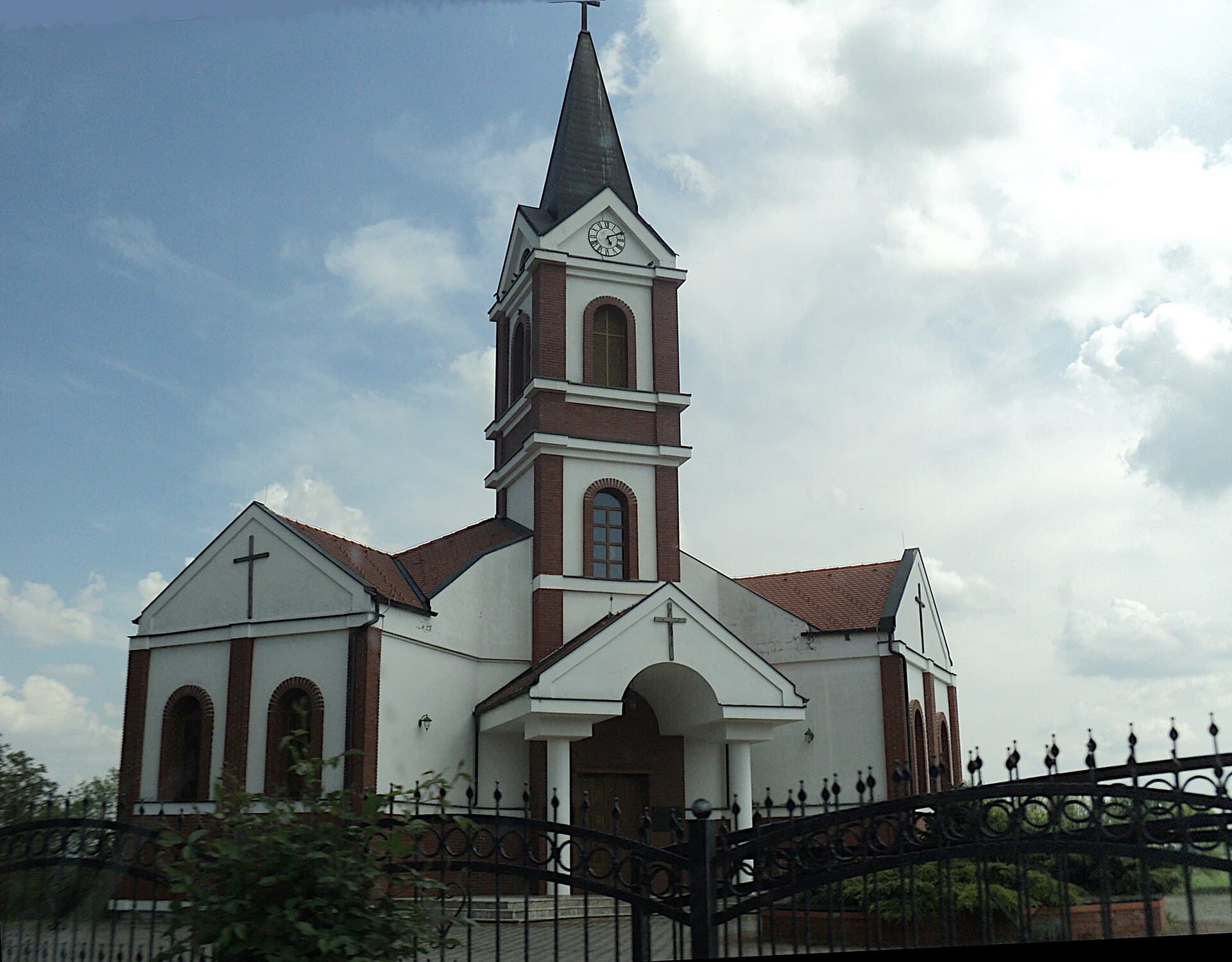
Kneževi Vinogradi
About this place
Kneževi Vinogradi, locally also called Suljoš, stands on the southern side of Banovo Brdo and ranks among Baranja’s strongest wine destinations. Its central attraction is the old Vina Belje cellar, a multi-level gator cut horizontally into the loess hill and first mentioned in records connected with the Battle of Mohács in 1526. The passages contain large Slavonian-oak barrels, while the wine archive holds more than 20,000 bottles, including one dating from 1949. The village also has an important religious landmark: a 1576 synod at the Reformed Church adopted the Canons of Kneževi Vinogradi. In summer, local life shifts towards the Bazeni sports and recreation centre, with an Olympic-size pool, children’s pool, playground, sports grounds, fishpond and Panon restaurant. Kneževi Vinogradi also works well as a base for Suza, Zmajevac and Karanac, municipal villages known for gatori cellars, wineries and Baranja cooking. Spend the first day on the cellar, church and pools, then follow the wine roads along the southern slopes of Banovo Brdo.
Kneževi Vinogradi sits on the southern side of Banovo Brdo, within a municipality covering almost a quarter of Baranja. Vineyards, loess slopes and cellars cut into the hill shape the village more strongly than the familiar flatland image of eastern Croatia. The settlement appears under its present name in a 1687 record, while the municipal history places the Roman settlement of Donatium on the same site. Reformed, Orthodox and Catholic heritage reflects its multicultural past, and the historic Belje cellar anchors its wine identity. In summer, the Olympic-size and children’s pools at the Bazeni sports centre provide a bright counterpoint to the cool wine passages.
Stays
No stays listed here yet
Things to see
The old Belje cellar is the village’s principal landmark. First mentioned in 1526, it covers more than 1,200 square metres and includes an upper level built as a characteristic Baranja gator. Among its barrels and archived vintages, a bottle from 1949 stands out. The Reformed Church is significant for the 1576 synod at which the Canons of Kneževi Vinogradi were adopted; the building acquired its present form in the 19th century. A third attraction is the Bazeni recreation centre, combining an Olympic-size and children’s pool with sports grounds, playground, fishpond and the Panon restaurant.
Things to do
Begin the morning with a guided tour of the old Vina Belje cellar, passing through three levels of corridors, Slavonian-oak barrels and an archive of more than 20,000 bottles. After the tasting, walk to the Reformed Church in Olgina Street, associated with the synod of 1576. Spend the hottest hours at the Bazeni recreation centre, where an Olympic-size pool and children’s pool are joined by a playground, sports grounds and fishpond. Towards evening, continue to nearby Suza or Zmajevac, whose gatori cellars cut into Banovo Brdo extend the wine story begun in Kneževi Vinogradi.
Food and drink
Panon restaurant forms part of the Bazeni recreation centre and highlights river fish, game, Baranja čobanac stew, the house-named Kneževi Vinogradi steak, spit-roasted lamb, homemade strudels and pancakes. For a broader wine-country meal, continue to Zmajevac, where the Josić winery restaurant serves fish paprika stew, perkelt, smoked fish, game and čobanac inside a traditional gator setting. Kolar Cellars in Suza can pair tastings of numerous wines with traditional dishes by arrangement. Together, these three addresses connect central Kneževi Vinogradi with the wine villages on the southern slopes of Banovo Brdo.
Practical information
Practical information
The municipal administration is at Hrvatske Republike 3, with published public-office hours from 8:00 to 12:00 on weekdays. The Baranja Tourist Board portal provides visitor information on the cellars, pools and surrounding villages. Under the schedule published for 2026, Belje cellar tours begin every full hour from 10:00 to 17:00, Monday to Saturday, while Sunday visits are limited to groups with advance arrangements. Wine tastings should be booked, particularly for larger parties, and any group arriving by car should designate a driver before the tasting.
Getting there and around
Kneževi Vinogradi lies about 11 kilometres south-east of Beli Manastir, on a road corridor linking Baranja’s wine villages. A car is the most practical option for combining the Belje cellar with Suza, Zmajevac and Karanac because the attractions are distributed among several settlements and the southern slopes of Banovo Brdo. Within the village, the cellar, municipal building and Reformed Church can be linked on foot, while the Bazeni centre at Moše Pijade 11 fits easily into a short local drive. Current regional bus departures towards Beli Manastir and Osijek should be checked before relying on public transport.
Frequently asked questions
What is the local name for Kneževi Vinogradi?
Local residents also call Kneževi Vinogradi Suljoš, a name commonly used in descriptions of the Baranja village.
When was the Belje cellar first mentioned?
The old cellar was first mentioned in 1526 in accounts associated with the Battle of Mohács.
Is there a children’s pool?
The Kneževi Vinogradi recreation centre has a children’s pool beside an Olympic-size pool, playground and sports grounds.
Why is the Reformed Church important?
The church hosted a synod in 1576 at which the Canons of Kneževi Vinogradi were adopted.
Nearby

Kotlina, Kneževi Vinogradi
Village · Slavonia

Related guides

Osijek
Tvrđa and the centre around the main square are distinct starting points for understanding Osijek. The former emphasises the fortified historic quarter and Baroque architecture; the latter…
Read the guide

Help improve this page
Spot something missing or wrong? Suggest a correction, add your photo or report a problem. Editors review every suggestion before it is published.
Photo credits
- Kotlina, Kneževi Vinogradi — Roland Puskaric · CC BY-SA 4.0 · Wikimedia Commons
- Grabovac, Čeminac, Vinkovci — IvanOS · CC BY-SA 3.0 · Wikimedia Commons
- Suza, Kneževi Vinogradi — Flammard · CC BY-SA 3.0 · Wikimedia Commons
- Kozarac, Čeminac — Ivan Molnar · CC BY-SA 3.0